

Most dealerships we talk to spend $10,000-15,000 monthly on Google Ads while their competitors down the street pay half that for the same number of leads. The difference? Those competitors figured out organic search three years ago. They stopped renting traffic and started owning it.
In 20 years working exclusively with car dealerships, we’ve watched this pattern repeat across hundreds of stores. The dealers who invest in organic SEO early build cost advantages that compound year after year. The ones who stay addicted to paid search keep paying more for less. We’ve broken down the real cost comparison between PPC and SEO before, and the numbers are stark.
Here’s the math that should keep every dealer CFO up at night.
Cut Your CAC by 40-60%
With Organic Search
Stop renting traffic. Start building an asset that compounds year after year.
The 24-Month ROI Journey
See Where You're Losing Ground
Free competitive analysis shows your organic gaps vs. top 3 local competitors. No obligation.
📞 Call us at 302-394-6940Or email info@a3brands.com
The Real Cost Nobody Calculates
When we audit dealership marketing spend, the first thing we do is calculate what we call TrueCAC. It’s almost always double what the dealer thinks.
Take a typical store spending $45,000 monthly on paid search, $12,000 on lead aggregators like TrueCar or CarGurus, and $8,000 on social ads. That’s $65,000 in obvious costs. But add sales commission on those deals, marketing staff allocation, and your CRM costs, and the real monthly investment hits $75,000 or more.
According to NADA’s 2024 Data report, the average dealership spent $543,539 on advertising last year, with 73% going to digital channels. That breaks down to roughly $705 per new vehicle sold in advertising alone. Divide that by close rates and factor in all costs, and your actual cost to acquire each customer climbs toward $1,600. Not the $900 most dealers report when they only count ad spend.
Now here’s where it gets painful.
Those third-party aggregators charging $35 per lead? They’re sending the same leads to your five closest competitors. Your close rate on aggregator leads runs 60% lower than leads that come directly through your website. You’re paying to compete against yourself.
What Organic Actually Costs
When we run the comparison for dealers, the numbers are stark.
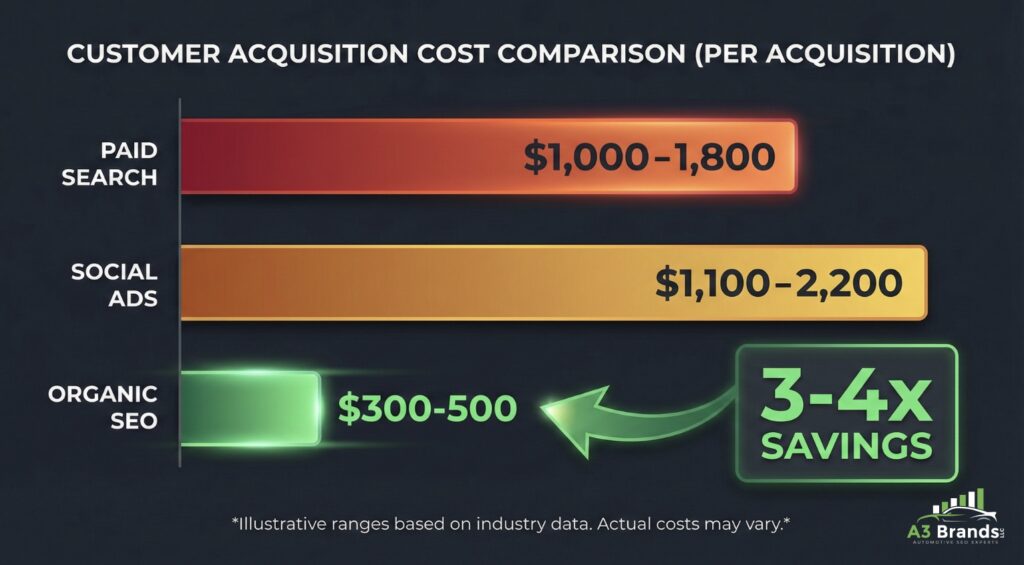
Paid search CAC in most markets runs $1,000-1,800 per customer. Social advertising CAC is even worse at $1,100-2,200. Traditional media? Don’t get us started.
Organic search CAC after SEO investment matures typically lands between $300-500 per customer. That’s a 3-4x difference.
And here’s what makes organic fundamentally different: once you rank, you don’t pay per click. The content we create in month three keeps generating leads in month thirty. Paid ads stop the second your budget runs out. This is exactly why content marketing reduces PPC dependency over time.
The 12-Month Reality
We won’t pretend SEO is a quick fix. It’s not. When we build an organic strategy for a dealership, we’re honest about the timeline.
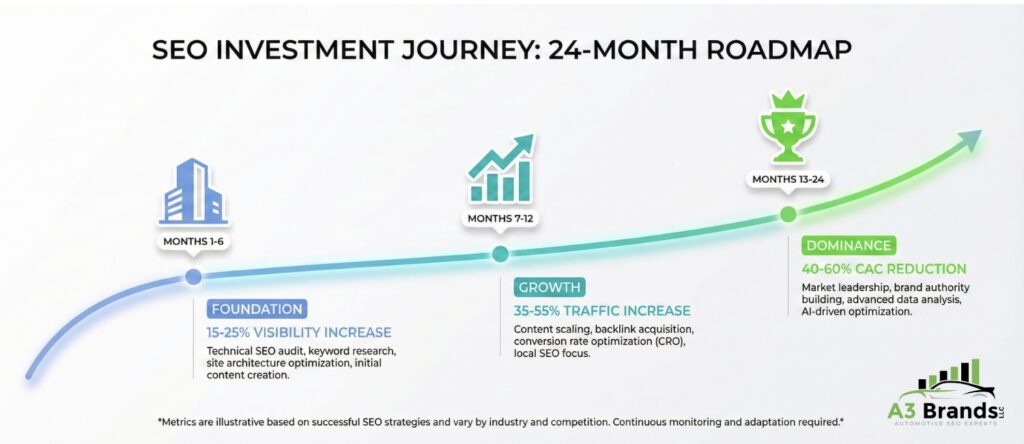
Months one through six focus on technical foundation and early wins. We’re fixing site speed, building Model Landing Pages for your highest-volume vehicles, optimizing your Google Business Profile. Expect to see your local visibility improve 15-25% and some early lead quality improvements, but this phase is about building infrastructure. Our 90-day dealership SEO plan breaks down exactly what happens in those critical first months.
Months seven through twelve is when compound growth kicks in. Those Model Landing Pages start ranking for terms like “2024 Toyota Camry [your city]” and delivering 200-400 monthly visitors at zero cost per click. We’re publishing 20-30 locally optimized content pieces monthly. Traffic increases 35-55% with noticeably better lead quality.
By month thirteen through twenty-four, you’re playing a different game. We’ve seen dealers achieve 65-85% organic visibility for their target keywords with CAC reductions of 40-60%. At that point, your competitors can’t catch up without years of investment.
What Makes This Work
Three things separate dealers who succeed with organic from those who don’t.
First, Model Landing Pages. We build dynamically generated pages targeting specific vehicle searches. A properly optimized page for “2024 Honda Accord EX-L [your city]” can rank in the top three positions within 120 days. That’s 200-400 monthly visitors who are actively shopping for that exact vehicle, at zero ongoing cost versus $5-7 per click on paid ads. We’ve written extensively about how Model Landing Pages drive showroom visits and the technical approach behind them.
Second, first-party data ownership. Every organic visitor who interacts with your site becomes a data asset you own. Their behavior tells you what they want to buy and when. Unlike aggregator leads you’re renting, this data compounds over time and powers increasingly accurate remarketing. This is what we mean when we talk about owning your traffic instead of renting it.
Third, Google Business Profile dominance. According to Birdeye’s 2025 State of Google Business Profile report, fully optimized and verified profiles surface 80% more often in search and generate 4x more website visits than incomplete listings. Local intent searches convert at dramatically higher rates than broad paid traffic. When someone searches “Toyota dealer near me,” they’re ready to visit. Winning that search with a complete, review-rich GBP listing captures customers your competitors have to pay for. And if you’re wondering whether your Google reviews are helping or hurting, that’s worth examining closely.
Why This Matters More in 2026
The Cox Automotive 2024 Car Buyer Journey Study confirms what we’ve seen for years: 95% of car buyers research online before purchasing, spending an average of 14 hours and 19 minutes in the research phase. Buyers now establish contact with dealerships before visiting in-store 65% of the time, up from just 20% in 2009.
The shift has only accelerated heading into 2026. AI Overviews now appear in over half of all Google searches, changing how shoppers discover dealerships. Paid ad costs continue climbing while organic real estate becomes more competitive. Dealers who built their organic foundation in 2023 and 2024 are now reaping compound returns while latecomers face steeper climbs.
If your dealership isn’t showing up during that research phase, you’re invisible to most of your potential customers. And paid ads alone can’t fill that gap profitably.
How We Measure Success
CFOs ask us the same question: how do I know this is working?
We track it the same way you’d track any capital investment. Net present value over 36 months, internal rate of return, and most importantly, months to payback.
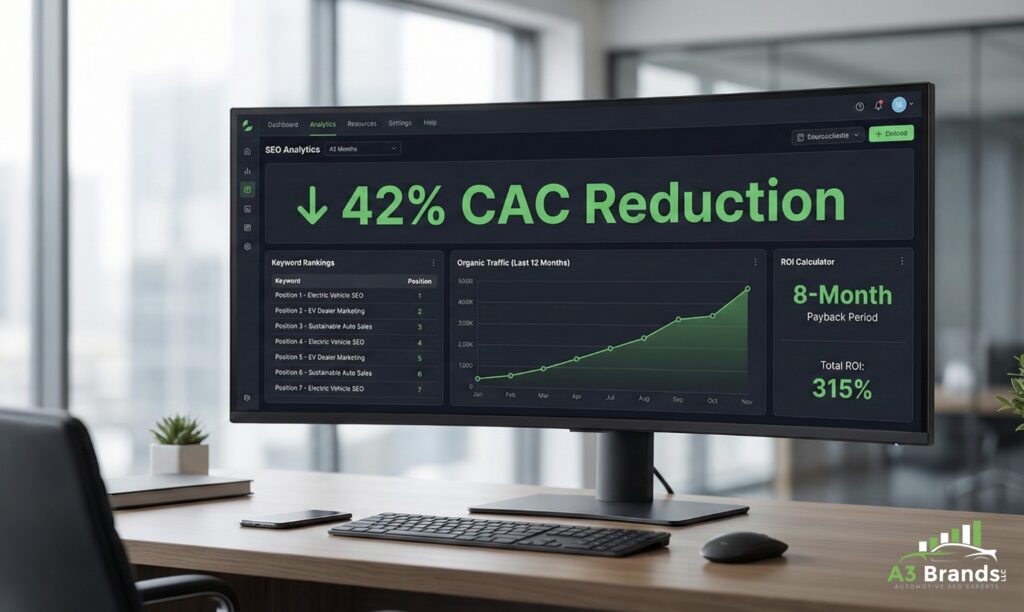
For a typical SEO program, we see payback around months eight through twelve, with accelerating returns after that. A $15,000 monthly SEO investment that matures properly can generate 35-65% IRR, which beats most paid advertising returns we’ve analyzed.
But the hidden value is what really matters. The first-party data asset you’re building. The competitive moat that makes it harder for new dealers to enter your market. The brand authority that commands premium pricing.
Those don’t show up in month-one dashboards. They show up in your enterprise value.
The E-E-A-T Factor
Google’s Search Quality Evaluator Guidelines now emphasize E-E-A-T: Experience, Expertise, Authoritativeness, and Trustworthiness. For dealerships, this means your website content needs to demonstrate real automotive knowledge and local market expertise.
Generic manufacturer descriptions won’t cut it. Neither will thin content created just to rank. Google’s systems are designed to reward content that provides genuine value to users, which is exactly what we focus on when building organic strategies for our clients.
Starting Without the Risk
We get it. You’ve heard promises before. Agencies that talked big and delivered nothing.
That’s why we structure everything around proof.
We’ll start with a 90-day pilot focused on your highest-volume model line in your primary market. Investment capped at $15,000-20,000. Clear success metrics: 25% increase in organic leads for that segment.
If it works, we scale. If it doesn’t, you’ve learned something valuable for a limited investment.
You’ll have complete visibility the entire time. Real-time dashboard access to rankings, traffic, and lead attribution. No black boxes, no vague promises about “improved visibility.”
We’ll show you exactly what we’re doing, why we’re doing it, and what results it’s producing. If you’re not satisfied, we’ll tell you.
The Math That Matters
Dealers who started serious organic investment in 2022 now pay 40-50% less per customer than stores still dependent on paid search. Every year that gap widens because paid costs keep rising while organic compounds.
You can keep renting traffic from Google and competing for the same aggregator leads as every other dealer in your market. Or you can start building an owned asset that generates leads at a fraction of the cost.
The question isn’t whether organic search works for dealerships. We’ve proven that across 20 years of exclusive automotive focus.
The question is whether you’ll act before your competitors lock up the organic real estate in your market.
We’ll pull your current organic performance, compare it to your top three local competitors, and show you exactly where you’re losing ground. No charge for the analysis. If we can show you a clear path to 40%+ CAC reduction, we’ll talk about working together. If we can’t, at least you’ll understand your market position.
Call A3 Brands directly at 302-394-6940 or email info@a3brands.com. Let’s see what’s possible.

Tim Boyle

Local SEO for Multi-Store Auto Dealers: The Operational Playbook

Why Your Dealership Conversion Tracking Is Costing You More Than Your Ad Budget

A3 Brands Heads to Digital Dealer 2026: Why AI Search Is the Biggest Shift in Dealership Visibility

How Multi-Store Dealer Groups Finally Make SEO Measurable Across Every Location

Local SEO for Car Dealers: What Actually Works in 2026
