
Your closest competitor ranks number one for “Honda Accord for sale [your city].” You’re on page three. That gap costs you roughly 15 qualified shoppers every single day, and every one of them lands on someone else’s lot. We know because we’ve run these audits for dealerships for over 20 years, and the pattern is always the same: the dealer who owns local inventory queries wins the market. We broke down why competitors consistently outrank dealers with bigger budgets in a previous post, and the answer almost always comes back to one thing: they did the audit work you skipped.
Most competitor SEO advice stops at “check their keywords and build more content.” That’s not an audit. That’s a to-do list. What we’re going to walk you through here is the actual process we use when a new dealership partner asks us, “Why is my competitor beating me online?” It’s a seven-step framework built on transactional local intent, not vanity traffic.
SEO Audit Process
Why Transactional Queries Matter More Than Traffic Volume
Here’s something we tell every dealer GM who sits across from us: stop obsessing over total website traffic. The only searches that matter are the ones where someone is ready to buy, book service, or request a quote. Queries like “buy Camry near me,” “oil change 90210,” or “certified pre-owned Civic [your city]” convert at two to four times the rate of generic informational searches.
When we audit your competitors, we’re not looking at who gets the most visitors. We’re looking at who owns the searches that put people on lots and in service bays. That distinction changes everything about how you prioritize your SEO investment. We’ve written extensively about the real cost difference between PPC and organic search for dealerships, and the math consistently favors dealers who invest in owning these transactional queries organically.
Step 1: Define Your Real Competitive Landscape
Before we touch a single tool, we map your actual trading area using your DMS and CRM data. For most dealerships, about 80 percent of buyers come from within a 15 to 25 mile radius, though certified pre-owned and specialty models can pull from much farther out.
Your competitors aren’t just same-brand franchises. According to Cox Automotive’s Car Buyer Journey Study, roughly two-thirds of automotive purchases involve cross-shopping across brands, which means we segment competitors into three groups: direct brand rivals, cross-shop brands targeting similar buyers (think Honda, Toyota, Mazda, and Hyundai all competing for compact sedan shoppers), and digital-first platforms like Cars.com, CarGurus, and Carvana that dominate search results through sheer content volume.
That third group surprises most dealers. When we show a GM that CarGurus outranks them for their own inventory queries in their own city, it changes the conversation fast.
Step 2: Run a Keyword Gap Analysis Focused on Revenue
We pull the top 500 keywords your competitors rank for and filter ruthlessly. We don’t care about informational queries like “best family SUV 2026.” We care about transactional, local queries tied to your inventory and services.
The framework is simple. We score each opportunity using search volume, your current ranking versus the competitor’s ranking, estimated conversion rate, and the average gross profit per unit. That math turns abstract keyword lists into dollar amounts your controller can understand.
For example: if a competitor owns 127 high-intent queries you’re missing entirely, and those queries represent roughly 1,200 monthly searches with a 2 to 3 percent conversion rate, that’s 24 to 36 leads per month you’re not getting. At an average gross of $2,800 per unit, the revenue math speaks for itself. This is exactly how we approach customer acquisition cost reduction through organic SEO: find the high-value queries your competitors own, calculate the lost revenue, and prioritize accordingly.
⚠️ UNVERIFIED STAT NOTE: Conversion rate benchmarks (2-3%) and gross profit figures should be sourced or marked as A3 pattern observations before publishing.

Step 3: Tear Down Competitor Landing Pages
This is where most agencies get lazy and we get specific. We reverse-engineer the model landing pages (that’s the page for, say, “New Toyota Camry” on a competitor’s site) and vehicle detail pages (individual car listings) that outrank you.
What we’re looking for: How deep is their content? Do they include trim comparisons, local offers, and live inventory feeds? Is their page structured so Google can easily pull answers for AI Overviews? Do they use vehicle schema markup, which is essentially a digital window sticker that tells Google the price, mileage, availability, and condition right in the search results?
We’ve found that winning model pages typically include detailed trim breakdowns, integrated inventory with real-time availability, locally relevant content (city and suburb references, not just state-level), and strong internal links connecting to related buying guides and comparison pages. We cover exactly how to build model landing pages that drive showroom visits and the full optimization playbook for dealership model pages in separate guides.
One thing we see constantly: dealers using manufacturer-provided descriptions on their vehicle pages. That’s duplicate content shared with every other franchise in the country. Google has no reason to rank your page over the next dealer’s when you both say the exact same thing. Original descriptions aren’t optional. They’re the price of admission.
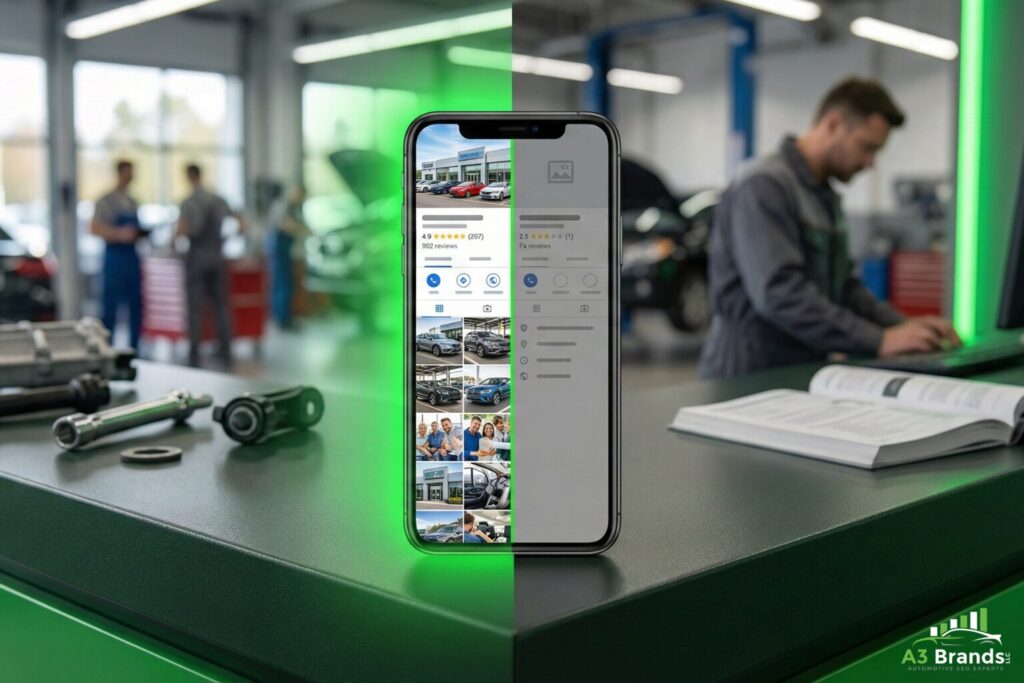
Step 4: Compare Google Business Profiles Head to Head
Your Google Business Profile (your free listing that shows up in Maps and the local three-pack) is often more important than your website for capturing local searches. If you’re deciding where to put your next marketing dollar, our local SEO vs. PPC decision framework breaks down exactly when each channel makes sense. For the audit, we compare your profile against competitors across every detail: categories, services listed, photo count and quality, review count and velocity, response times, and posting frequency.
Dealers who respond to every review within 24 hours and post weekly updates consistently outperform those who treat their profile as a “set it and forget it” listing. We’ve seen dealers move from position eight to position three in the local pack just from consistent profile optimization, before we even touched their website.
We also check what Google calls NAP consistency. That stands for Name, Address, Phone number. If your business name, address, or phone number is listed differently across Yelp, Cars.com, the BBB, and your own website, Google loses confidence in your listing. Google’s Business Profile help documentation spells out exactly how important consistent information is for local rankings. We audit every major directory and clean up inconsistencies as part of every engagement.
Step 5: Benchmark Technical Performance
Technical SEO is the foundation everything else sits on. If your site loads slowly, doesn’t work well on phones, or blocks Google from properly reading your pages, none of your content investments will pay off. We’ve seen dealership traffic drop overnight from technical issues that went undetected for months, and competitor audits are often where those problems surface first.
We benchmark your site against competitors on page speed (specifically Google’s Core Web Vitals, which measure how fast your page loads, how quickly it becomes interactive, and how stable the layout is while loading), mobile experience, and crawlability. That last one matters more than most dealers realize. If Google can’t efficiently discover and index your inventory pages because of technical issues like broken sitemaps, duplicate URLs, or overly complex site architecture, those pages simply won’t rank.
We also check structured data implementation. Think of structured data as labels on your pages that help Google understand exactly what’s on them. Vehicle schema tells Google the make, model, year, price, and availability. Local business schema confirms your location, hours, and contact information. Review schema can display your star ratings directly in search results. Google’s own structured data documentation explains why this matters for search visibility, and dealers with proper implementation consistently get more clicks because their listings look richer and more trustworthy.
Step 6: Analyze Backlink Gaps on Commercial Pages
Backlinks are essentially votes of confidence from other websites. When a local chamber of commerce, a community news site, or an automotive publication links to your model landing page, Google interprets that as a trust signal.
We don’t chase links for the sake of volume. We analyze which links actually point to competitor pages that rank for money keywords, then identify the opportunities you’re missing. Common wins include local business partnerships, community sponsorship pages, local news coverage, and automotive directory listings that competitors have but you don’t.
The goal is targeted authority building on the pages that drive revenue, not a generic link count that looks good in a report but doesn’t move rankings.
Step 7: Turn Findings Into a 90-Day Action Plan
This is where most audits fail. They produce a 40-page document that sits in a drawer. We don’t do that. Every audit we deliver comes with a prioritized roadmap organized into three timeframes.
In the first 30 days, we tackle quick wins: Google Business Profile fixes, schema markup implementation, and any technical blockers preventing proper indexing. From 30 to 90 days, we focus on content gaps, starting with the highest-value model pages and service pages your competitors own. Beyond 90 days, we build sustained authority through link acquisition, content expansion, and ongoing optimization.
We present everything in language your GM and controller can act on. Not “improve crawl efficiency by 12 percent” but “fix these three issues so Google can find and rank 47 vehicle pages it currently can’t see.”
What Happens After the Audit
An audit is a snapshot. The dealers who win aren’t the ones who run a single audit. They’re the ones who build competitor intelligence into their ongoing SEO process. We help our partners set up monitoring that tracks competitor ranking changes, new content, and Google Business Profile activity so you’re never surprised.
We test changes methodically: update one model page template, measure results for 60 days, then roll the winning approach across all pages. That pilot-then-scale approach protects your investment and builds confidence with every iteration.
We’ll run a competitive audit on your top three local rivals, show you exactly where they’re capturing your buyers, and map out the first 90 days of action. No charge for the initial analysis. If the data shows a clear path to capturing those lost leads, we’ll build the full plan together. If it doesn’t, you’ll still walk away knowing exactly where you stand. Call us directly at (302)-394-6940 or grab 30 minutes on our calendar.


Tim Boyle

Local SEO for Car Dealers: What Actually Works in 2026

Car Dealership Local SEO: 5 Strategies to Boost Sales in 2026

Digital Transformation for Car Dealerships: How We Help Dealers Go Digital Without Losing What Works

How We Run a Dealership Competitor SEO Audit (And Why Most Dealers Skip the Steps That Actually Matter)

A3 Brands Wins Best Linear Booth at NADA Show 2026