
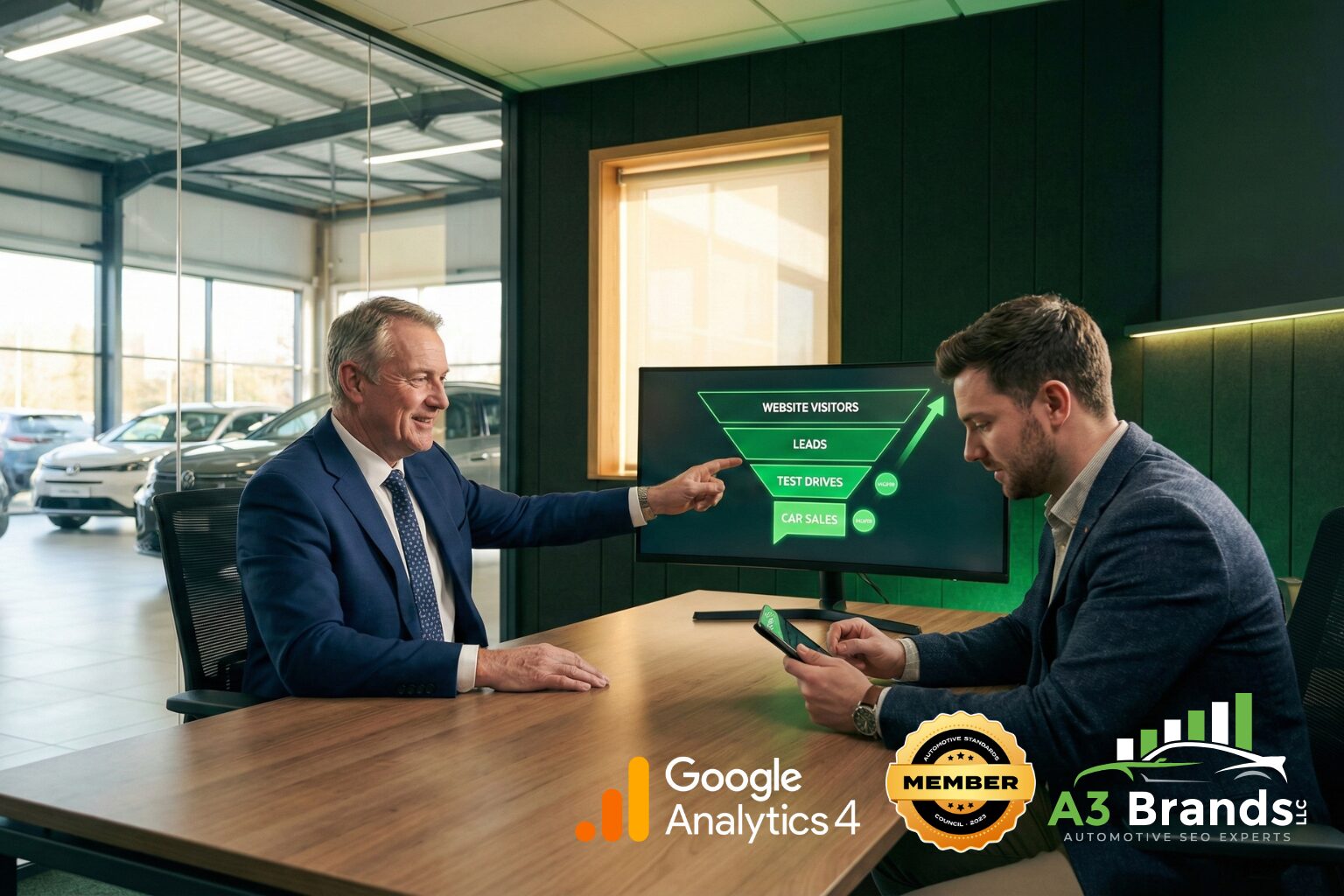
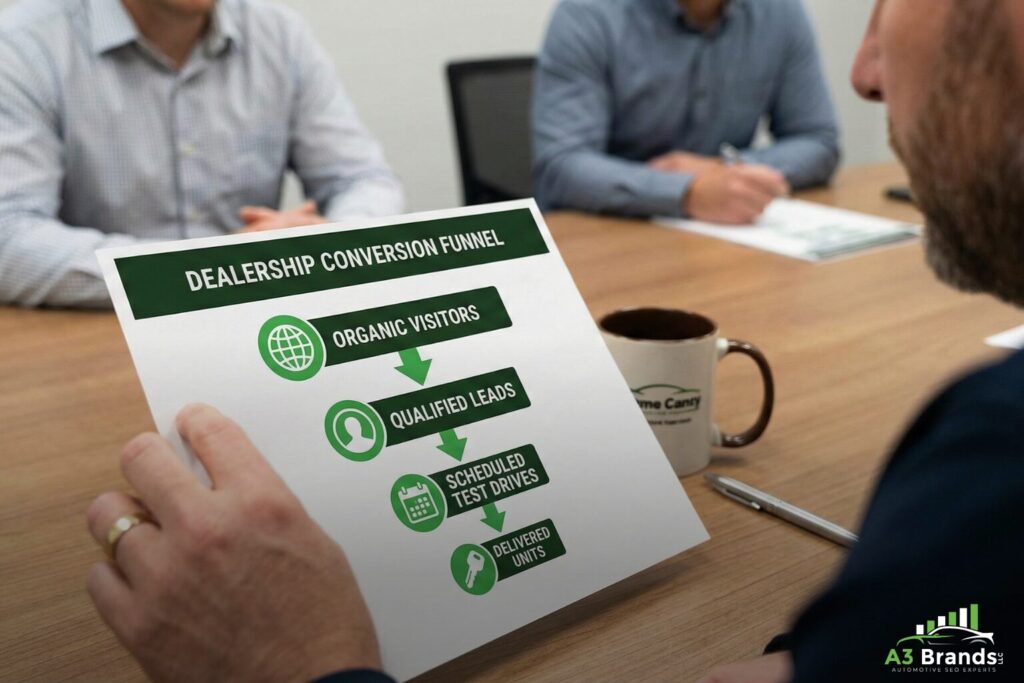
Dealership SEO ROI is measurable when you connect organic traffic to showroom outcomes. Map organic visits through a conversion cascade (visits to leads to appointments to sales), calculate true customer acquisition cost using dealership unit economics, and report results in the language GMs already use: test drives, attributed units, and gross profit per vehicle. A 90-day pilot focused on inventory pages and local SEO typically produces 3 to 6 additional attributed sales.
The Conversion Cascade
How organic search traffic maps to showroom results, measured in the numbers your GM already tracks.
Organic Visitors
Monthly sessions from Google organic search
0
Engaged Sessions
2+ min on site or 3+ pages viewed (your qualified ups)
0
Organic Leads
Form submissions and phone calls (your guest sheets)
0
Scheduled Test Drives
Confirmed appointments from organic leads
0
Attributed Unit Sales
Delivered vehicles traced back to organic search
0
Monthly SEO Impact (Last-Click Attribution)
6
Units
Attributed
$19.2K
Monthly Gross
Profit
$1,250
Cost Per
Attributed Sale
With multi-touch attribution, organic typically influences 25 to 35 equivalent sales monthly, dropping effective cost per unit substantially below last-click numbers.
Based on a dealership selling 150 units/mo at $3,200 avg gross • Consistent with NADA financial profiles • a3brands.com
What Does SEO Actually Cost You Per Car Sold?
Most dealerships spend $12,000 to $15,000 monthly on Google Ads and can tell you exactly what each click costs. But ask them what organic search contributes to unit sales and you’ll get a blank stare. That’s not because SEO doesn’t work. It’s because nobody showed them how to measure it in the numbers they already care about.
We’ve spent 20 years working exclusively with car dealerships, and the single biggest barrier to SEO investment isn’t skepticism about rankings. It’s that agencies report in sessions and impressions while GMs think in ups, test drives, and closing ratios. We fix that disconnect. And once dealers see organic performance translated into showroom language, the budget conversation changes fast. We wrote an in-depth breakdown of how we connect SEO directly to showroom attribution and car sales if you want the full methodology.
Consider the numbers: Cox Automotive’s 2024 Car Buyer Journey Study found that new-vehicle buyer satisfaction hit a record 75%, driven largely by digital tools that connect the online research phase to the in-store experience. That means your website isn’t just a brochure. It’s the first touchpoint in a buying journey that increasingly starts with a Google search and ends at your F&I desk.
How We Map Organic Traffic to Units Sold
The framework is straightforward. We build what we call a conversion cascade: a step-by-step funnel that traces an organic visitor from first click to delivered unit, using data your CRM and DMS already capture. We’ve detailed our full approach to reducing dealership customer acquisition cost through organic SEO separately.
Here’s how it works in practice. Take a dealership selling 150 units monthly at $3,200 average gross profit, a figure broadly consistent with NADA’s dealership financial profiles. Say organic search brings in 2,500 monthly visitors. The question isn’t “is that good traffic?” The question is “how many of those visitors end up in a salesperson’s CRM?”
We break it into four stages. First, we look at engaged sessions, meaning visitors who spend more than two minutes on the site or view three or more pages. That’s typically around 40% of organic traffic, so roughly 1,000 visitors. Think of those as your qualified ups.
Second, we measure lead submissions. Vehicle detail page visitors convert at around 4.5%, and model research page visitors at about 2.5%. That gives you approximately 70 organic leads monthly, which is your equivalent of completed guest sheets. Optimizing those model landing pages for dealership SEO is one of the highest-impact investments we make early in any engagement.
Third, appointments. With a 35% set rate on those leads, you’re looking at about 24 scheduled test drives. Fourth, sales. A 75% show rate and 33% close rate on shows produces roughly 6 attributed units monthly.
Six units at $3,200 gross profit equals $19,200 in monthly gross profit directly attributable to organic search. And here’s what matters: this cascade shows you exactly where to invest. A small improvement in VDP conversion rate or lead follow-up speed can move that number significantly.
How We Calculate the Real Cost Per Sale
Customer acquisition cost is where organic search starts winning the comparison. But you have to calculate it honestly, counting everything. We covered the real cost difference between PPC and SEO for dealerships in detail, and the math consistently favors organic over any 12-month window.
We include the full investment: agency retainer, content creation, technical optimization, internal staff hours, and tools. For a typical program, that runs about $7,500 monthly. With 6 directly attributed sales, that’s $1,250 per vehicle through last-click attribution.
But here’s where it gets interesting. Vehicle purchases involve 7 to 12 touchpoints over 45 to 60 days. Google’s own research on car buying search behavior shows that the average new car buyer visits only two dealerships before purchasing, which means the online research phase is doing most of the heavy lifting. When we apply multi-touch attribution, giving appropriate credit to organic search as a first touch and supporting touch throughout the buying journey, the attributed sales count increases substantially. We built our ASC implementation and GA4 tracking framework specifically to capture these touchpoints without the guesswork.
In our experience, weighted organic attribution often surfaces 25 to 35 equivalent sales per month rather than just the 6 that last-click captures. That drops your effective cost per attributed sale dramatically. And when you factor in lifetime value (F&I revenue, service appointments, trade-in cycles), organic customers consistently deliver more long-term value than paid search customers.
Why Organic Outperforms Paid Over Time
We’ve seen this pattern across hundreds of dealership engagements. Paid search delivers immediate leads but builds zero lasting value. The day you stop paying, the leads stop coming. Organic works differently. We broke down the local SEO versus PPC decision framework for dealerships to help GMs evaluate which channel deserves more budget, and the conclusion is clear once you look past the first 90 days.
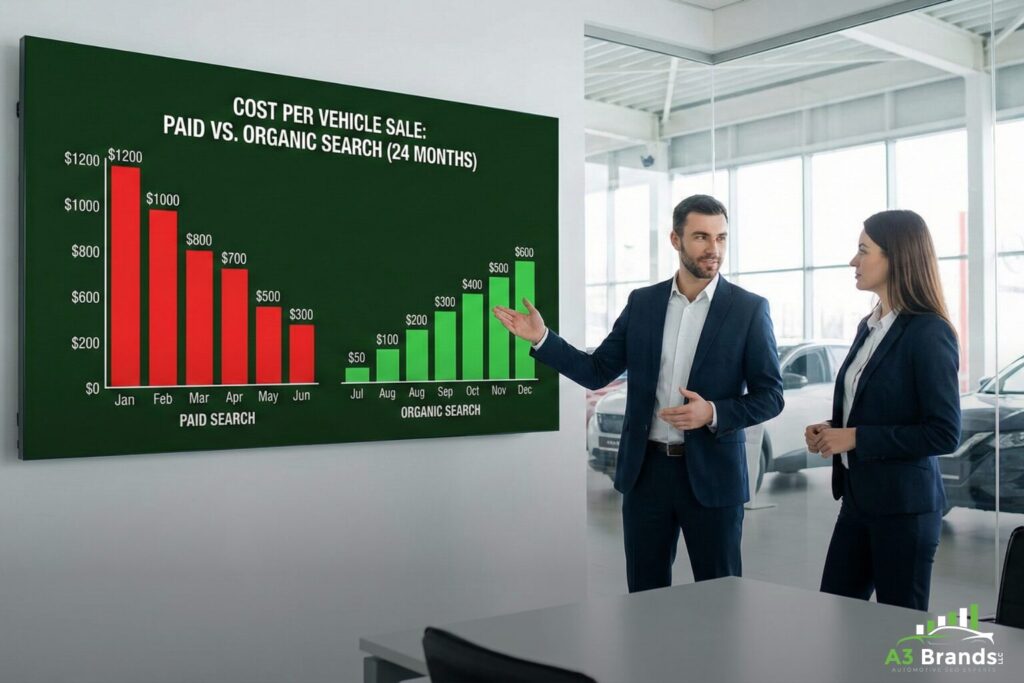
Consider a 24-month comparison at the same $15,000 monthly investment. Paid search generates leads only while the budget is active, and costs per click in automotive keep climbing year over year. Organic search ramps slower in months one through six, but compounds. By month 12, organic typically delivers materially lower cost per unit. By month 24, the gap is significant. And when you pause or reduce the SEO investment, the rankings and traffic don’t vanish overnight. That residual value is real, and it’s something paid search simply can’t offer.
The strategic advantages go further. Organic captures bottom-funnel inventory searches that paid campaigns often miss. Content marketing built around model-specific pages builds lifetime customer value while reducing your PPC dependency simultaneously. And the domain authority you accumulate creates a competitive moat that gets harder for competitors to overcome every month.
How We Build Attribution That Satisfies Your Leadership Team
We know the objection. “Attribution is too fuzzy.” We’ve heard it from dozens of dealer GMs, and they’re right to be cautious. That’s why we don’t rely on any single attribution model.
We use a composite approach: first-touch attribution to capture how organic generates initial demand, linear attribution to acknowledge the multiple interactions in a 45 to 60 day buying journey, and data-driven attribution to let the actual customer behavior patterns inform credit allocation. Combined, this produces a defensible picture that stands up to scrutiny from ownership and finance teams.
The implementation is practical. In the first two months, we establish baseline metrics and unified tracking. Months three and four, we run new attribution models alongside your existing reports so you can see the differences in real time. By months five and six, we’re walking your team through actual customer journeys showing how organic search influenced specific sales. That’s when the “fuzzy attribution” objection disappears, because you’re looking at real customers, real VINs, and real revenue.
What We Put on the Executive Dashboard
We’ve learned that dealer leadership doesn’t want another analytics tool. They want answers to three questions: Is this working? How much is it costing us per car? And should we spend more or less?
So we build dashboards that answer those questions in showroom language. The executive view shows organic-attributed vehicle sales (monthly and year-over-year), SEO-driven gross profit contribution, organic CAC versus paid CAC, and ROI multiple. That’s it. One page.
The management view adds the conversion cascade funnel, lead quality scores by channel, content performance, and local visibility metrics. And the practitioner view includes keyword rankings, competitive gaps, and technical health scores for our team and yours to work from.
The critical principle: we never report “traffic increased 35%” without translating it. Instead, we show “traffic increased 35%, producing 47 additional leads, 6 incremental sales, and $19,200 in monthly gross profit.” Numbers your GM can take to ownership without needing a translator.

How a 90-Day Pilot Proves the Model
We don’t ask dealers to sign a long-term contract on faith. We run 90-day pilots that produce measurable wins within a single quarter.
In the first 30 days, we handle technical cleanup: making sure your vehicle detail pages are properly indexed, your Google Business Profile (your free listing on Google Maps) is fully optimized with current inventory photos, and your review response process is active. These produce quick, visible improvements in map visibility and phone calls. Google’s Search Essentials documentation lays out the technical foundation clearly: crawlable pages, helpful content, and proper structured data are the non-negotiables.
Days 31 through 60, we optimize your VDP templates for conversion, implement proper tracking so every organic lead creates a CRM record with source flags, and begin connecting the data pipeline between your website analytics and your DMS. We also build out model landing pages designed to drive showroom visits, which consistently rank for high-intent “for sale” and “near me” queries.
Days 61 through 90, we scale what’s working, expand location and model content, and compile everything into an executive presentation showing ROI, projected annual impact, and specific customer journeys from organic search to delivered units. We apply Google’s own people-first content framework throughout, because content built for shoppers first and search engines second is what actually ranks and converts long-term.
Conservative pilot outcomes we’ve seen: 25 to 40% organic traffic growth, 30 to 50 additional organic leads monthly, 3 to 6 vehicles attributable to organic within the 90-day window, and projected annualized gross profit of $115,000 to $230,000 from pilot gains alone.
⚠️ UNVERIFIED STATS: The pilot outcome ranges above are pattern observations from our experience. Source documentation should be prepared before publishing to meet E-E-A-T standards.
What This Looks Like for Multi-Location Groups
For dealer groups operating five or more rooftops, the economics get even better. We centralize the technical infrastructure, content templates, and authority-building strategy while customizing local content and reputation management for each store. The result: per-location costs typically decrease 40 to 60% compared to running separate programs, while cumulative visibility and sales increase across the portfolio.
We use subdirectory structures to consolidate domain authority, standardize roughly 80% of content while localizing the rest, and unify customer tracking across location CRMs so attribution works across your entire group. Our 2026 automotive SEO roadmap covers the multi-location strategy in more detail for groups planning their annual marketing spend.
Ready to See What Organic Is Actually Worth?
We’ll pull your current organic performance data, map it against your top three local competitors, and build a preliminary conversion cascade using your actual traffic and CRM numbers. No charge for the analysis. If the numbers show a clear path to ROI, we’ll map out a 90-day pilot with specific KPI gates and a rollback clause so you’re never locked in. If the numbers don’t support it, we’ll tell you that too. We’ve built this business on 20 years of honesty, not on overselling.
Call us directly at (302)-394-6940 or email info@a3brands.com.

Tim Boyle

Local SEO for Multi-Store Auto Dealers: The Operational Playbook

Why Your Dealership Conversion Tracking Is Costing You More Than Your Ad Budget

A3 Brands Heads to Digital Dealer 2026: Why AI Search Is the Biggest Shift in Dealership Visibility

How Multi-Store Dealer Groups Finally Make SEO Measurable Across Every Location

Local SEO for Car Dealers: What Actually Works in 2026
