

Most dealerships spend $8,000 to $12,000 a month on Google Ads. Their competitor down the road spends half that and gets more showroom traffic. The difference isn’t budget. It’s that the competitor figured out how to make organic search do the heavy lifting two or three years ago. If you’ve ever wondered why your competitor ranks higher, the answer usually isn’t a bigger budget. It’s a smarter strategy.
We’ve spent 20 years working exclusively with car dealerships, and we see this pattern constantly. The stores that win aren’t the ones throwing more money at paid clicks. They’re the ones who built a digital foundation that compounds over time. And here’s the good news: it’s not too late to start. But you do need a plan that respects what your dealership already does well.
The Dealership
Digital Funnel
How organic search turns local shoppers into showroom visits, test drives, and delivered units.
Your CFO Reads This Funnel
PPC vs. Organic SEO
No contracts. No obligations. Just data.
What Does Digital Transformation Actually Mean for a Dealership?
Let’s be clear about what we’re not saying. We’re not saying your handshake deals don’t matter. We’re not saying your sales team’s relationship skills are outdated. We’re saying the opposite.
Modern buyers complete roughly 70% of their purchase research online before they ever walk into a showroom, according to Cox Automotive’s latest car buyer journey research. That doesn’t replace your team’s expertise. It makes that expertise more valuable, because the customers showing up have already done their homework. They’re ready to buy. Your people just need to be the ones they find first.
We’ve watched this play out hundreds of times. When we help a dealer group optimize their local search presence, their closing ratios go up. Not because the sales team changed anything. Because the buyers walking through the door were further along in the decision process. Digital didn’t replace the handshake. It delivered better handshakes.
How Do You Know Where You Stand Right Now?
Before changing anything, you need an honest look at where your dealership sits digitally. This isn’t about blame. It’s about finding the fastest path to results.
We start every engagement with four diagnostics. First, we compare your website’s conversion rate against your phone lead conversion rate. If your site gets 3,000 visitors a month but only produces 12 appointment requests, that’s a 0.4% conversion rate versus the 8% you’re probably getting from phone calls. That gap represents real money. If your dealership website traffic has dropped recently, this diagnostic becomes even more urgent.
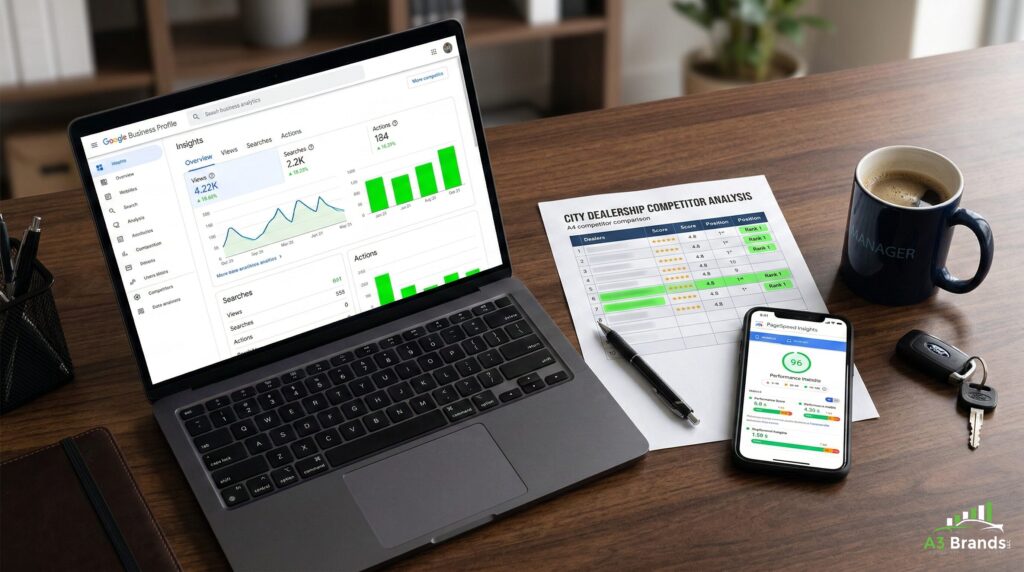
Second, we audit your Google Business Profile (that’s your free listing that shows up in Google Maps and local search results). Photos, hours, services listed, review responses. Think of your GBP as your digital curb appeal. If a shopper drives by and your lot looks empty and your sign is faded, they keep driving. Same thing happens online when your profile is incomplete or stale.
Third, we check whether you’re showing up for the searches that actually lead to sales. Queries like “Ford dealer in [your city]” or “[model] in stock near me.” If your competitors own those results, you’re invisible to the buyers most ready to purchase. Our dealership competitor SEO audit framework walks through exactly how we evaluate this.
Fourth, we run a quick technical check. How fast does your site load on a phone? Are your forms working? Can Google actually read and index your inventory pages? Google’s PageSpeed Insights is a free tool you can run right now to see where you stand. We’ve seen dealerships fix mobile load time from eight seconds down to two and increase lead form submissions significantly. These technical fixes often deliver the fastest returns.
Why Does Your Team Need to Be Part of the Plan?
Technology doesn’t sell cars. People sell cars. And we’ve learned that the dealerships that succeed with digital transformation are the ones where the whole team understands why it matters, not just the GM or the marketing director.
Here’s what works. Frame every digital tool as something that makes your team’s job easier, not something that replaces their judgment. We worked with a dealer group that renamed their new CRM rollout internally. Instead of calling it “digital transformation” (which scared people), they called it giving managers “superpowers.” Adoption jumped because the framing changed from “you’re doing it wrong” to “here’s how you do it even better.”
Share the numbers that matter to salespeople. When your team sees that digitally sourced leads close at higher rates and require less negotiation time, the resistance drops. Nobody argues with making more money in less time.
And start small. Pick one department for a pilot. Used cars or fixed operations (your service department) tend to work best because the sales cycles are shorter and the results show up faster. When the pilot team presents their wins at a staff meeting, that peer validation is worth more than any executive memo.
How Do You Translate Digital Numbers Into Showroom Language?
This is where most agencies lose dealers. They hand over a report full of impressions, click-through rates, and bounce rates, and the GM’s eyes glaze over. We don’t do that.
We translate everything into the language your business already uses. Organic search impressions become “how many local shoppers saw your dealership this month.” Website visits become “digital lot traffic.” Form submissions and calls become “leads.” And we track those leads all the way through your sales process to delivered units and gross profit. We’ve written in detail about how to connect SEO results to showroom attribution and car sales if you want the full breakdown.
The tracking setup matters. Your CRM (that’s the system where you manage customer records and follow-up) needs to capture where each lead came from and which page on your site produced it. Call tracking ties phone leads back to the specific search or page that drove the call. We’ve covered our approach to ASC implementation and how we use GA4 tracking to cut dealer PPC waste in a separate guide.
The goal is a simple funnel your CFO can read: digital visibility led to this many site visits, which produced this many leads, which resulted in this many test drives, which closed into this many sales at this average gross. When you can show that pipeline, budget conversations get a lot easier. We break down the full measurement approach in our piece on dealership SEO ROI tied to test drives and units sold.
Why Start With a 60 to 90 Day Pilot?
We’re big believers in pilots because they reduce risk and build internal confidence at the same time. A well-designed 60 to 90 day pilot gives you enough time to see real signal without committing to a long-term contract you’re nervous about.
Here’s how we structure them. We pick a narrow focus. One model line, your used car inventory, or your service department. Something with enough volume to generate meaningful data in two to three months. For model-specific work, our guide on how to optimize model landing pages for dealership SEO covers exactly what we build and why.
We set success ranges, not single targets. Instead of “we’ll increase leads by 25%,” we frame it as “we expect a 15 to 25% increase in digital leads for this segment.” Ranges are more honest, and they give both sides a realistic benchmark.
Every week, we review performance together and adjust. Landing page not converting? We change the messaging. Call volume up but appointment bookings flat? We look at the phone process. This isn’t a set-it-and-forget-it approach. It’s active optimization.
By day 90, we have documented results, a playbook for what worked, and a clear replication plan if you want to expand. If the pilot underperforms, we tell you that too. We’d rather be honest about what didn’t work than pretend and waste your money for another quarter.

How Do You Pick the Right Digital Partner (and Avoid Getting Burned Again)?
If you’ve been through a bad agency experience before, you already know the warning signs. We hear the same stories from dealers every week. Vague reporting. Promises about rankings that never materialized. The feeling that your account got handed off to a junior team member the moment the contract was signed.
Here’s what to look for instead. Your partner should speak your language. If they can’t explain what they’re doing in terms of showroom outcomes, that’s a problem. They should integrate with the systems you already use, your DMS, your CRM, your inventory feed. If they need you to manually update anything, they’re creating work, not saving it. NADA’s dealer resource center publishes benchmarks that can help you evaluate whether a partner’s promised results are realistic for your market size and brand mix.
They should give you direct access to your data. Real-time dashboards showing rankings, traffic, leads, and costs. Not a pretty PDF once a month with cherry-picked numbers. And they should invest in training your team, not just running campaigns in the background.
We’ve worked exclusively with dealerships for over 20 years. We understand inventory dynamics, seasonal trends, how local markets work, and why a strategy that works for a Honda store in Phoenix won’t necessarily work for a Toyota store in Philadelphia. That specialization matters because automotive isn’t like any other industry, and generic agencies treat it like it is. If you’re weighing the tradeoffs between channels, our local SEO vs. PPC decision framework for dealerships can help you think through where to invest first.
What Makes Digital Advantages Stick Over Time?
The dealerships we work with that build lasting competitive advantages all have three things in common.
First, they own their data. Your service records, your sales history, your customer interactions. That information is yours, and it’s incredibly valuable. We help dealers use that data to predict when customers are likely to buy again and reach out at exactly the right time. That kind of personalized outreach gets dramatically better response rates than generic email blasts.
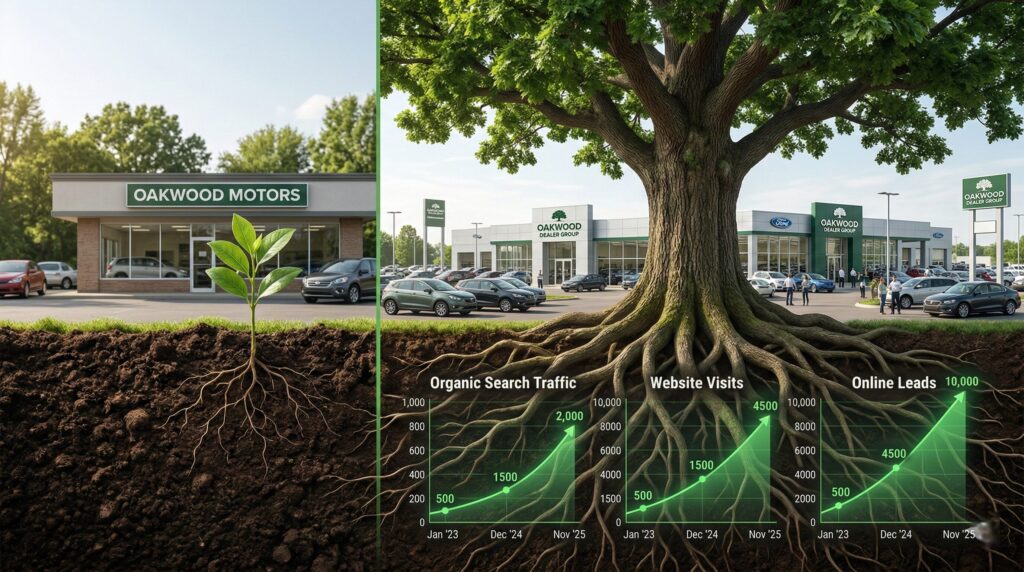
Second, they invest in localized content. Community-specific landing pages, service content tailored to your market, model landing pages built to drive showroom visits. National ad campaigns can’t replicate the trust that comes from content built for your specific community. And that content compounds over time. Every page you publish keeps working for you month after month, driving organic traffic without additional ad spend. We’ve outlined our full thinking on content marketing strategies that reduce PPC costs for car dealerships.
Third, they build a culture of testing and learning. The stores that pull ahead aren’t necessarily the smartest. They’re the fastest at trying things, measuring results, and iterating. We help build that rhythm through structured pilots, documented playbooks, and regular performance reviews that keep the whole team aligned. Google’s own guidance on helpful content reinforces this approach. The sites that rank best over time are the ones consistently producing useful, people-first content.
How Should You Measure What Actually Matters?
Don’t let anyone hand you a report full of metrics that don’t connect to your bottom line. The numbers that matter are straightforward: how many local shoppers found you through organic search, how many of those became leads, how many of those leads turned into test drives, and how many test drives turned into delivered units. Our detailed guide on reducing dealership customer acquisition costs through organic SEO walks through the full cost-per-lead math.
Beyond immediate sales, we also track customer lifetime value. A buyer you acquire through organic search today might come back for service visits, refer friends, and buy their next vehicle from you. That long-term value is where organic search really separates itself from paid advertising. You’re not just buying a click. You’re building a relationship. The real cost comparison between PPC and SEO for dealerships makes this math very clear.
We recommend a simple cadence. Daily check on lead volume and response times. Weekly review of pilot or campaign performance. Monthly reconciliation against your actual DMS sales records. And quarterly, step back and look at the bigger trends: market share movement, customer lifetime value, and how your organic channel is growing relative to paid.
Ready to See Where You Stand?
We’ll pull your Google Business Profile, audit your local search visibility for your top models, and show you exactly where you’re losing ground to competitors. No charge for the initial analysis. We’ll identify the 10 highest-value keywords in your market, show you where you rank versus your main competitor, and explain exactly what it would take to outrank them.
If it makes sense to work together, we’ll map out a 60 to 90 day pilot tailored to your market, your inventory, and your goals. If it doesn’t, at least you’ll know what you’re up against, and you’ll walk away with a clear picture of your competitive landscape.
We don’t do long-term contracts until you’ve seen results. We don’t hide behind vague metrics. And we don’t disappear after the contract is signed. Twenty years of working exclusively with dealerships means we understand what’s at stake for your business, and we take that seriously.
Call A3Brands directly at (302)-394-6940 or [schedule your free competitive audit here]. Let’s find out what you’re leaving on the table.

Tim Boyle

Local SEO for Multi-Store Auto Dealers: The Operational Playbook

Why Your Dealership Conversion Tracking Is Costing You More Than Your Ad Budget

A3 Brands Heads to Digital Dealer 2026: Why AI Search Is the Biggest Shift in Dealership Visibility

How Multi-Store Dealer Groups Finally Make SEO Measurable Across Every Location

Local SEO for Car Dealers: What Actually Works in 2026
