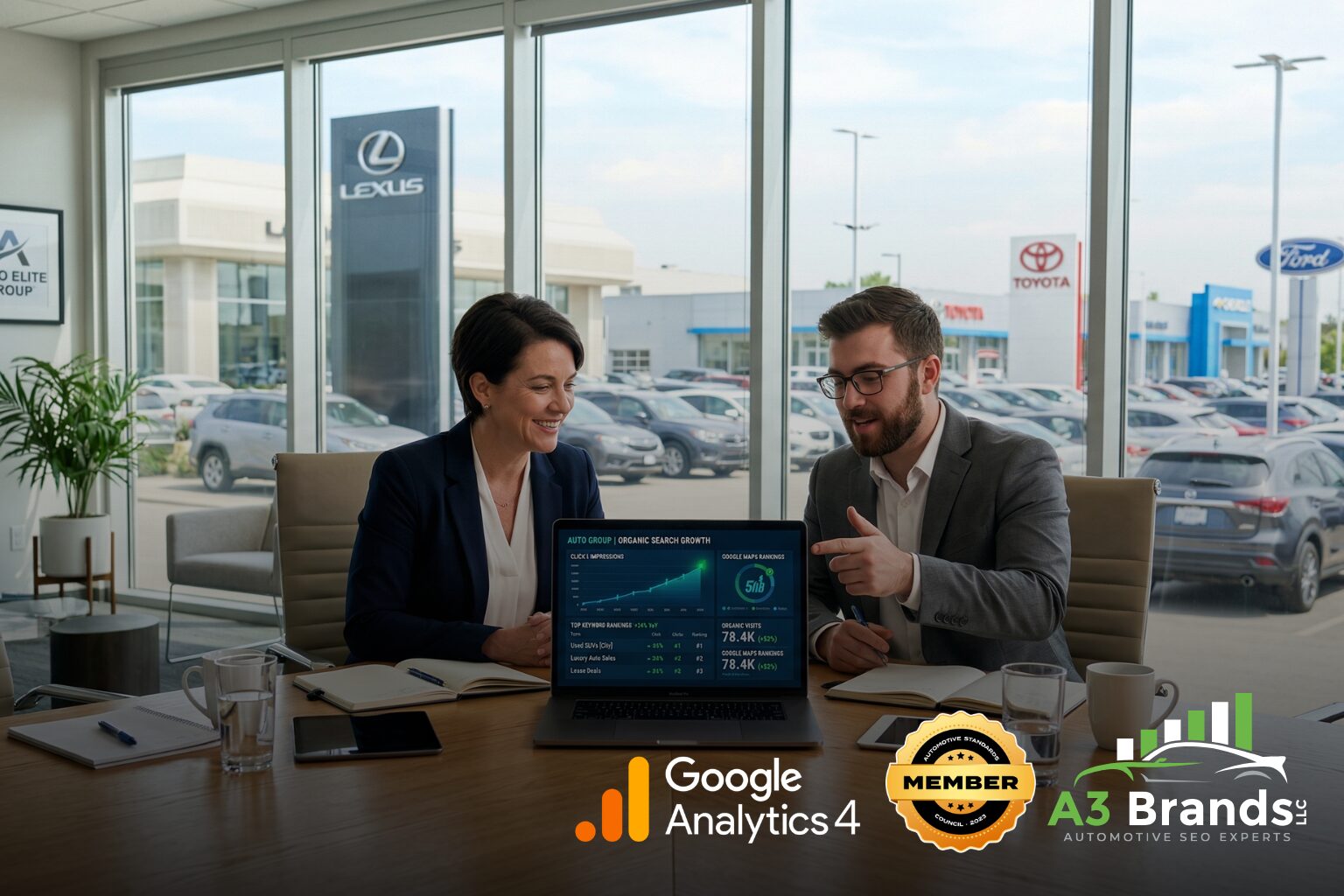
Dealer groups we talk to in 2026 aren’t skeptical of SEO. They’re skeptical of promises. They’ve sat through agency presentations, signed 12-month contracts, and watched vague “visibility improvements” show up in reports while their PPC budget kept climbing. We get it. After 20 years working exclusively with dealerships, we’ve seen that pattern more times than we can count.
What’s changed this year is the urgency. Google AI Overviews now appear in more than half of all searches. Dealers who built strong organic foundations in 2024 and 2025 are capturing those placements. Dealers still dependent on paid search are paying more per click for less visibility than they had two years ago. The gap is widening fast.
That’s exactly why we built the 90-day SEO pilot for dealerships.
It isn’t a trial. It isn’t “let’s see what happens.” It’s a governance-driven sprint with defined scope, measurable attribution, and a clear decision gate at day 90: either the numbers justify scaling, or they don’t. No ambiguity, no upselling into a second phase you didn’t agree to. If you’ve been weighing whether PPC or SEO makes more financial sense for your stores in 2026, this pilot framework gives you real data from your own market to answer that question.
Dealer groups make the same mistake. They take what works at one store and multiply it. They assign someone at each location to “handle the SEO” and hope for consistency. What they get instead is fragmented data, mismatched business profiles, and a review response strategy that depends entirely on which store manager checked their phone last.
We’ve seen this across every type of dealer group we work with. The problem isn’t effort. It’s the absence of an operational system. And without that system, even the strongest automotive marketing strategies for car dealerships fall apart at scale.
Here’s how we run it.
The 90-Day SEO Pilot
at a Glance
Three phases. Binary decision at day 90. Board-grade data before full rollout.
Core Web Vitals, GA4 setup, CRM attribution, baseline metrics locked.
Localized model pages, VDP schema, GBP hardening, NAP sync.
Organic leads in CRM, paid vs. organic CPA, AI Overview tracking.
Organic CPA beats paid. Scaling recommendation issued.
30-day extension. Specific issue identified and fixed.
Root-cause analysis. We won't recommend scaling what didn't work.
How Do You Scope the Pilot Without Contaminating the Results?
We limit every pilot to 1-3 stores and 2-3 model funnels. That’s not arbitrary. Narrow scope means clean attribution. When you run SEO changes across 12 locations simultaneously, you can’t isolate what moved the needle. A focused cluster, matched by market size and inventory profile, gives you causal data rather than correlation noise.
We pair pilot stores with 2-3 control locations that aren’t touched during the 90 days. Same market dynamics, same historical traffic patterns. This is the same discipline you’d apply to any capital allocation decision. Your CFO expects it. We build for it.
Location selection matters more in 2026 than it did two years ago. Markets where a competitor already dominates AI Overview placements for core model queries are harder starting points. We look for moderate competition markets, sites with at least 12 months of analytics history, and store managers willing to engage. A pilot at a location where the GM is checked out will underperform regardless of what we do technically.
What Has to Be Instrumented Before Day One?
This is where most pilots fail before they start. If your attribution isn’t clean going in, your results are uninterpretable coming out.
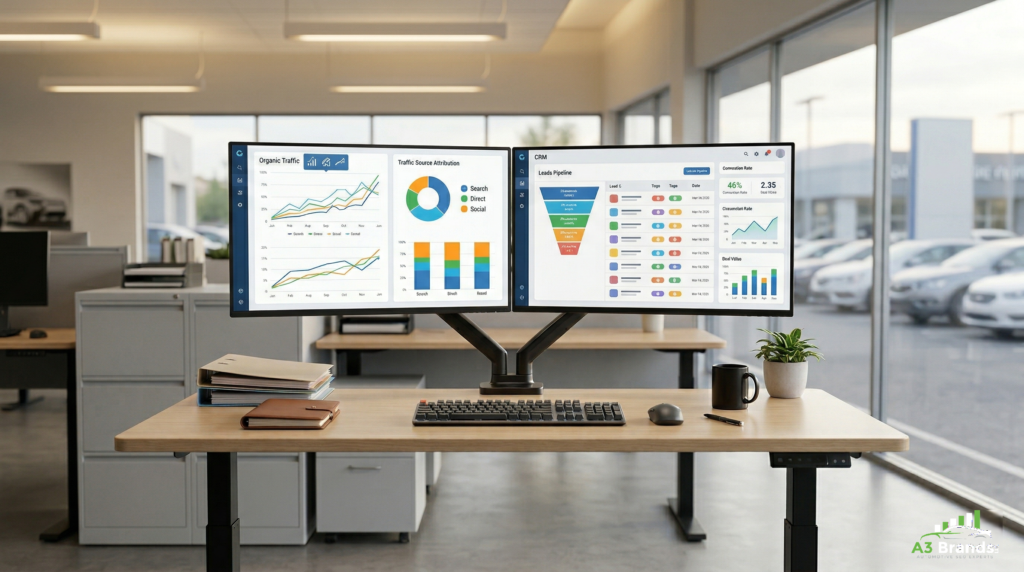
Before we launch anything, we configure GA4 for cross-domain tracking, connect your CRM so lead source follows the customer through to close, set up unique phone numbers per traffic source, and establish baseline metrics across every pilot page. We cover exactly how we do this — and why most dealer GA4 setups still miss critical lead data in 2026 — in our guide to ASC-compliant GA4 tracking and PPC waste reduction. Think of the instrumentation phase like a pre-inspection report before you put a vehicle on the lot. You need to know the starting condition to prove what changed.
We also agree upfront on what success looks like for each stakeholder. Your CFO cares about cost-per-lead compared to what you’re paying Google. Your store managers care about appointment quality. Your COO wants to know implementation won’t disrupt operations. We map all of that before day one so there’s no subjective interpretation at day 90. For guidance on building closed-loop attribution from organic search to actual vehicle sales, Google’s helpful content standards outline the trust signals that make your reporting credible to outside reviewers, including OEM partners and board members.
What Actually Happens in Days 1 Through 90?
Days 1-30: We fix what’s bleeding traffic before we build anything new. Core Web Vitals, indexation problems, duplicate content, structured data for inventory pages. Google’s 2026 ranking systems weight page experience signals more heavily than ever, and dealers with slow, poorly structured sites are paying for it in both organic rankings and AI Overview exclusion. This phase isn’t glamorous, but it’s the mechanical work that makes everything else possible. It’s like trying to increase service drive revenue when half the bays are down.
Days 31-60: We build localized model pages, optimize your vehicle detail pages, and harden your Google Business Profile. We’ve written a full breakdown of how model landing pages should be structured for dealership SEO — the short version is that generic manufacturer pages don’t rank in 2026, and custom localized pages do. Each pilot store also gets a fully optimized Google Business Profile with updated photos, active Q&A, weekly posts, and consistent name, address, and phone across every major directory. In our experience, GBP optimization alone drives measurable local pack improvement within this window, often before the content work fully indexes.
Days 61-90: This is where organic leads start showing up in your CRM. We’re running A/B tests on title tags to improve click-through, fine-tuning mobile experience, and beginning to compare organic cost-per-lead against what you’re paying for the same model queries in paid search. In 2026, we’re also tracking AI Overview appearances for pilot store model queries — this is now a reportable metric, not a bonus observation. The comparison between organic and paid cost-per-lead is usually striking by day 75.
What KPIs Tell You Whether to Scale or Stop?
We use binary thresholds, not ranges. At day 90, the answer is yes or no.
Primary KPIs we track: organic traffic growth to vehicle detail pages, additional organic leads per month per location, cost-per-acquisition compared to your current paid search baseline, local pack visibility for targeted model and location queries, and AI Overview appearances for high-intent model searches. We’ve outlined how we connect these metrics directly to test drives and units sold in our piece on dealership SEO ROI measurement. According to Cox Automotive’s Car Buyer Journey research, the majority of buyers visit multiple digital touchpoints before stepping into a showroom — which means organic influence on purchase decisions is consistently undervalued when you look at last-click data alone.
That undervaluation is the argument you bring to your CFO at day 90. Organic didn’t just generate leads. It influenced buyers at the research stage, weeks before they called or submitted a form. Paid search claimed the last click. SEO did the heavy lifting.
If organic CPA comes in below paid search and lead volume is trending in the right direction, the case for scaling writes itself. If it doesn’t, we do a post-mortem and separate execution issues from strategy mismatch before recommending next steps. We’re not going to tell you to scale something that didn’t work.
How Do You Build the Internal Case for Scaling in 2026?
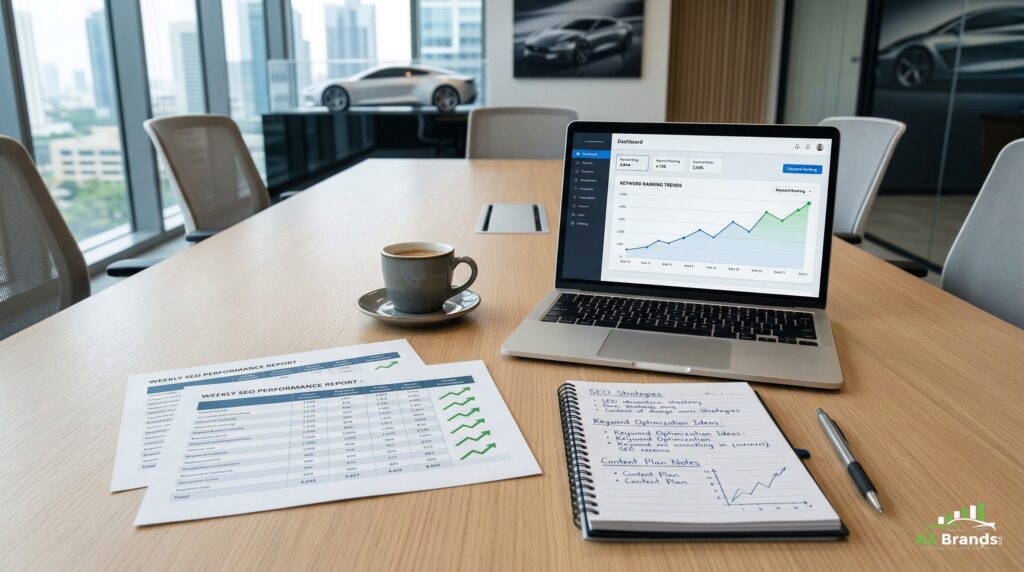
Weekly scorecards go out every Monday morning. Not monthly. Not quarterly. Every week. They show KPI status, what moved, and what we’re adjusting. This isn’t just reporting. It’s the discipline that keeps stakeholders informed and prevents the anxiety spiral that kills pilots mid-run.
At 30 days, you get a business case update. At 60 days, you get a trend projection. At 90 days, you get a full ROI analysis with three scenarios: clear success with a scaling recommendation, qualified success with a 30-day extension plan, or underperformance with a root-cause analysis.
The dealers who scale fastest in 2026 are the ones where someone inside the organization becomes a genuine champion, not just a budget-approver. We help build that by making results visible to the people closest to the outcomes: sales managers, internet directors, and service advisors who see appointment quality firsthand. Connecting those organic sessions all the way through to showroom visits requires airtight attribution — here’s how we map SEO activity to actual car sales across multi-store groups.
We’ve run this framework with dealer groups managing anywhere from 3 to 14 rooftops. The ones who treat this 90-day SEO pilot for dealerships as a governance experiment, not a leap of faith, end up with the clearest path to scaling. In 2026, with AI search reshaping how buyers find inventory, the cost of waiting another quarter is no longer theoretical. Competitors who moved first are compounding their advantage every month.
And once you have that first pilot data, every subsequent rollout gets faster and cheaper.
Ready to See What a 90-Day Pilot Looks Like for Your Group in 2026?
We’ll pull your top model queries, show you exactly where you rank organically versus where you’re currently paying for placement, and build a 90-day projection based on your actual market. No cost for the analysis. If it doesn’t show a clear path to reducing your paid budget, we’ll tell you straight. If it does, we’ll map out a pilot scoped to your specific stores and model mix.
No long-term commitment required to start. Just a 30-minute conversation and your top three model priorities.
Call A3 Brands directly: 302-394-6940 Email: info@a3brands.com

Tim Boyle
90-Day SEO Pilot for Dealerships: 2026 ROI Guide
Local SEO for Multi-Store Auto Dealers: The Operational Playbook

Why Your Dealership Conversion Tracking Is Costing You More Than Your Ad Budget

A3 Brands Heads to Digital Dealer 2026: Why AI Search Is the Biggest Shift in Dealership Visibility

How Multi-Store Dealer Groups Finally Make SEO Measurable Across Every Location