

The problem
Why multi-store groups need SEO standards
A single-rooftop dealer hires an SEO agency, signs a scope of work, and the agency owns every page on the site. The accountability is clean. The brand voice is one person's voice. The schema is one spec.
A dealer group with 5, 10, or 20 rooftops rarely has any of that.
What the group office actually has, in most cases:
- Multiple website platforms. Dealer.com on the import stores, DealerOn on the domestic stores, sometimes a custom WordPress build inherited from an acquisition.
- Multiple SEO vendors. The OEM-provided vendor at one store, a local marketing agency at another, an in-house marketing director running the third.
- Multiple brand voices. Each rooftop's content reads like the agency or in-house writer behind it, not like one company.
- Inconsistent schema and structured data. One store has AutoDealer + Vehicle + FAQ schema. Another has only the OEM-template basics. A third has invalid markup that's been flagged in Search Console for months.
- GBP entropy. Each location's Google Business Profile is run by whoever happens to log in that month — the BDC manager, the GM's assistant, the agency, or no one.
- OEM co-op claims filed differently at each store, sometimes leaving real co-op dollars on the table.
The result is predictable. The group's strongest rooftop ranks well in its DMA and produces 200+ organic leads a month. The weakest produces 30. The group VP looks at the variance and assumes it's market difference. It rarely is. It's the standards gap.
The purpose of an SEO standards framework is not to make every store identical. It's to make every store legible to the same buyer experience — so a shopper who walks into the Ford store after researching the Honda store sees the same brand, the same trust signals, the same level of professionalism on the website that brought them in.
This guide is the operating manual for that work. What to standardize, what to leave to store-level discretion, how to audit, and how to govern without becoming the bottleneck that slows every rooftop down.
Buyer experience
What a consistent buyer experience actually means
Group leadership tends to talk about "consistency" in branding terms — logo, color palette, ad creative. Those matter, but they're the visible layer. The layer that actually moves rankings and leads is the one underneath.
A consistent buyer experience across a multi-store dealer group has six tangible markers:
- Same page architecture at every rooftop. A model landing page on the Honda store, the Toyota store, and the CDJR store should follow the same template — same H1 structure, same trim-walk module, same finance CTA placement, same FAQ block at the bottom. A shopper who hops between stores in the group should feel the muscle memory of the layout.
- Same content cadence. Every store publishes model pages on the same launch calendar. Every store updates fixed-ops pages on the same recall cycle. Every store refreshes city pages on the same quarterly review.
- Same schema spec. AutoDealer, Vehicle, FAQ, Breadcrumb, Review — implemented identically across rooftops, with the only variables being store-specific NAP, OEM, and inventory.
- Same review-response standard. Same response window (24–48 hours), same tone of voice, same escalation rules for negative reviews. Mystery shoppers reading Google reviews across the group should not be able to tell the stores are operated by different teams.
- Same lead-form behavior. Same fields, same validation, same auto-responder copy, same routing rules into CRM. A lead submitted on the Audi store and a lead submitted on the BMW store should hit the BDC with the same data structure and the same handoff time.
- Same NAP, GBP, and citation hygiene. Address, hours, phone, services, and category formatting identical in syntax across every rooftop, every directory, every aggregator. Different stores, same operational rigor.
When all six are in place, the group reads as one operator with multiple stores. When they're not, the group reads as a holding company with a portfolio. The buyer-experience difference shows up in cross-shop conversion: the shopper who liked the Honda store will trust the group's BMW store if the website signals match, and walk past it if they don't.
This is also the layer Google, ChatGPT, Perplexity, and Gemini are measuring. Consistent schema, consistent NAP, consistent content depth across rooftops — these are the signals that get a group's stores cited together when an AI engine answers a question like "best dealer group near me." The 108 citations and 13.58% Share of Authority our pillar coverage on this topic already pulls from Microsoft Copilot are a function of exactly this kind of consistency.
Framework
The five-layer SEO standards framework
Five layers cover everything a dealer group's SEO operation actually does. Standards live at each layer. Without all five written down, the group is running on tribal knowledge — which works until the person carrying the tribal knowledge leaves.
| Standards layer | What gets standardized | Who owns it |
|---|---|---|
| 1. Brand & voice | Group-wide tone, terminology, OEM-compliant claim language, prohibited phrases, photography style. | Group marketing director + agency editor. |
| 2. Content architecture | Model page template, city page template, fixed-ops template, finance template, FAQ block structure, internal-link rules. | Group marketing director + SEO partner. |
| 3. Technical & schema | Schema spec (AutoDealer, Vehicle, FAQ, Breadcrumb, Review), Core Web Vitals targets, sitemap/robots rules, redirect policy, AI crawler access. | SEO partner + group IT/web. |
| 4. Local presence | GBP optimization checklist, NAP format, review-response SLA, citation aggregator policy, geo-grid tracking cadence. | Group marketing director + store-level BDC manager. |
| 5. Measurement | GA4 + ASC key events, CallRail tagging rules, lead-source attribution map, monthly reporting template, cross-rooftop KPI dashboard. | Group VP + SEO partner. |
1. Brand & voice
- What gets standardizedGroup-wide tone, terminology, OEM-compliant claim language, prohibited phrases, photography style.
- Who owns itGroup marketing director + agency editor.
2. Content architecture
- What gets standardizedModel page template, city page template, fixed-ops template, finance template, FAQ block structure, internal-link rules.
- Who owns itGroup marketing director + SEO partner.
3. Technical & schema
- What gets standardizedSchema spec (AutoDealer, Vehicle, FAQ, Breadcrumb, Review), Core Web Vitals targets, sitemap/robots rules, redirect policy, AI crawler access.
- Who owns itSEO partner + group IT/web.
4. Local presence
- What gets standardizedGBP optimization checklist, NAP format, review-response SLA, citation aggregator policy, geo-grid tracking cadence.
- Who owns itGroup marketing director + store-level BDC manager.
5. Measurement
- What gets standardizedGA4 + ASC key events, CallRail tagging rules, lead-source attribution map, monthly reporting template, cross-rooftop KPI dashboard.
- Who owns itGroup VP + SEO partner.
Layer 1
Brand and voice standards
The brand and voice layer is the shortest and most-skipped. It is also the one that catches OEM co-op problems before they happen and the one that makes the group's content recognizably its own.
A group-level voice standard covers six things:
- Tone. Plainspoken vs aspirational, formal vs conversational, third-person vs second-person. Pick one and apply it everywhere.
- Terminology. Whether the group says "pre-owned," "used," or both. Whether "finance" or "financing." Whether "service center" or "service department." The vocabulary list is short. Settling it removes 80% of the inconsistency.
- OEM-compliant claim language. What can be said about pricing, payments, APR, lease specials, and incentives — in language that survives every manufacturer's co-op review. A specialist automotive SEO agency that has worked Toyota TDA, Audi DSP, Stellantis co-op, and Honda's program has this list already.
- Prohibited phrases. Words and constructions that get pages flagged: "lowest price guarantee," "#1 dealer" without qualifier, payment claims without disclaimers, manufacturer logos used outside spec. The list is shared across rooftops so a new copywriter at the Hyundai store doesn't accidentally use language the Toyota co-op auditor will pull.
- Photography and creative style. Hero image treatment, headshot style, showroom photography rules, drone-shot guidelines. Cheap or off-brand photography on one rooftop drags the whole group's perceived quality.
- Bio and author standards. How GMs, service managers, and finance directors are introduced on the site. Photo standard, title format, link-out policy.
This layer should be a 5–8 page document, not a 60-page brand bible. It lives in the group's shared drive and gets reviewed once a year. Every new content piece — at every rooftop — gets cross-checked against it before publishing.
Layer 2
Content architecture standards
If the brand-voice layer answers how do we sound?, the content-architecture layer answers what do we build, and where do we put it?
A group-level content architecture covers two things: the page templates every store uses, and the internal linking rules that connect them.
The core templates are these:
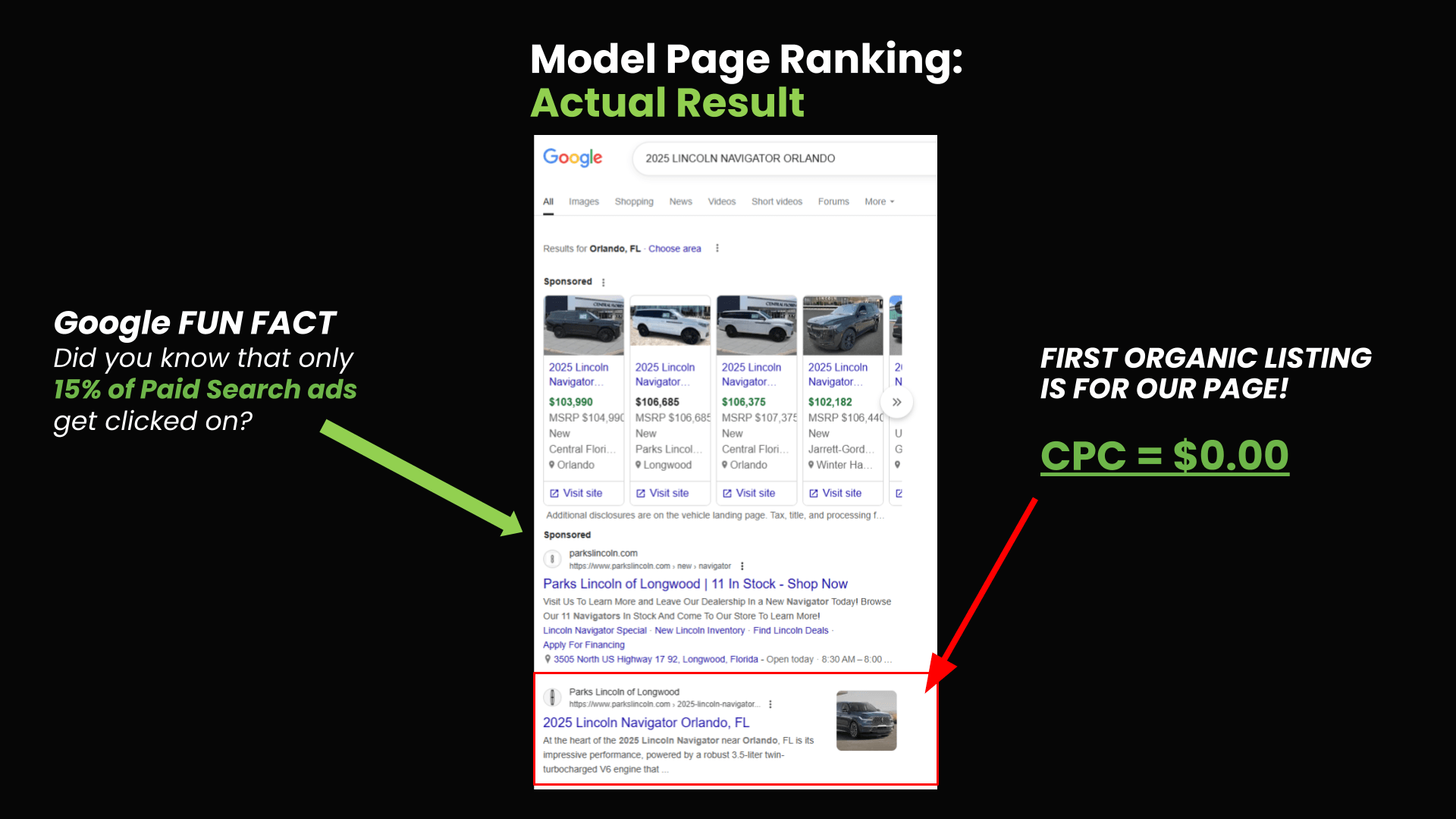
- Model landing pages. One template covering H1, hero, trim walk, key specs block, comparison vs nearest rival trim, finance CTA, FAQ, schema. Every rooftop uses this template for every model in its lineup. Variables are limited to brand, model, trim list, pricing, and store NAP.
- City pages. Template for buyer-ZIP and DMA-adjacent pages — "[Make] dealer in [City]" — with consistent structure: H1, neighborhood context, drive directions, inventory snapshot, financing context, FAQ, schema. Different cities, same shape.
- Fixed-ops pages. Service, parts, recalls, oil change, tires, brakes, body shop. Each rooftop's fixed-ops pages share template DNA even when the service offerings differ slightly by store.
- Finance and lease pages. Pre-qualification, trade-in, lease-end, used-finance. Templates make these the highest-converting non-inventory pages on a dealer site — and templating them across the group means every store gets the conversion lift, not just the one that happens to have a senior marketer.
- FAQ blocks. A reusable structure that drops into every page type. Same Q&A formatting, same schema, same length discipline. This is the block AI engines lift most often into Overviews, ChatGPT answers, and Perplexity citations.
- Author and bio blocks. Used at the bottom of expert content (service-advisor articles, finance-manager guides) to add E-E-A-T signal.
Internal linking is the second half of the architecture. A standards document specifies:
- How model pages link to VDPs and SRPs — anchor text rules, link placement, no-follow policy on the inventory layer.
- How city pages link to model pages and to each other.
- How fixed-ops content links to service-scheduling forms.
- How blog content links back into commercial pages, not the other way around.
With templates and linking rules in place, a 12-rooftop group can publish 200+ new pages a quarter without a single page reading like it came from a different brand. Without templates and rules, the same group publishes 50 pages a quarter, each one slightly different, none of them ranking together.
Layer 3
Technical and schema standards
Technical SEO across a group is mostly about removing variance. The standards document at this layer specifies the floor, not the ceiling — every rooftop has to meet the floor, individual stores can exceed it.
Schema spec. Five Schema.org types make up the group minimum:
- AutoDealer on every store's homepage, contact page, and location pages, with consistent NAP, hours, OEM brand, parent organization reference, and `sameAs` social links.
- Vehicle on every model page and VDP, with consistent properties: brand, model, model year, trim, body type, fuel type, drive wheel configuration, offers (price, availability).
- FAQ on every page with an FAQ block, with the question/answer structure validated and AI-extractable.
- Breadcrumb on every page two clicks or deeper from the homepage.
- Review with `aggregateRating` on the homepage and on key landing pages — sourced from the rooftop's actual review profile, never spoofed.
Core Web Vitals targets. A group standard sets the LCP, CLS, and INP targets every rooftop has to hit. Most groups should aim for LCP under 2.5 seconds and INP under 200 milliseconds on the model and inventory layer — the pages where the buyer actually transacts.
Indexing rules. Sitemaps generated automatically per rooftop, robots.txt allowing the right AI crawlers (GPTBot, ClaudeBot, PerplexityBot, OAI-SearchBot), no accidental noindex on the model layer, and a redirect policy that prevents the kind of cascade we see when a group migrates platforms.
AI crawler access. The group's standard robots.txt explicitly allows the AI search crawlers. An llms.txt file lives in every rooftop's root, naming the canonical pages, the brand entity, and the key citations the AI engines should lift. Same template at every store.
Page-speed and CWV exceptions. OEM-template inventory layers often miss CWV targets out of the box. The standard names the workarounds — image optimization, lazy-load policy, third-party tag governance — that bring those layers into spec.
This layer is the one where a senior technical SEO partner earns the retainer. A group running 10 rooftops cannot get its technical standards in spec by accident. The audit cadence below is what keeps it there.
Layer 4
Local presence and GBP standards
Local presence is the layer most groups try to standardize first — and the one most have the hardest time keeping consistent. Each rooftop has its own GBP, its own review profile, its own BDC, and often its own social accounts. The group office tries to apply one policy and discovers that twelve stores find twelve ways to drift from it.
A workable local-presence standard has six rules:
- NAP format. One canonical address format, one phone-number format, one hours-of-operation format. Applied identically across every rooftop's GBP, website footer, sitemap, schema, and external citation. Variance here is what kills map-pack rankings on the rooftops that need them most.
- GBP category and attributes. Same primary category logic across rooftops by OEM ('Honda dealer,' 'Toyota dealer'), same secondary categories, same service-area definition. Attributes (delivery, online estimates, languages spoken) updated quarterly on the same calendar.
- GBP content cadence. Group standard for GBP posts (frequency, format, link policy), GBP photos (cadence, photography style aligned with Layer 1), and GBP Q&A monitoring.
- Review-response SLA. 24–48 hour response window, same tone of voice, same escalation rules for any review under three stars. Single-source response template library so the response copy reads like one operator, not twelve.
- Geo-grid tracking. Same tracking tool, same query set per rooftop, same monthly grid pulls. The group VP should be able to look at one dashboard and see all rooftops' local rankings on one screen.
- Citation aggregator policy. One aggregator (Yext, Moz Local, or equivalent) running across the entire group, never one per rooftop. Updates push from the same source to every directory, so a phone number change at one store doesn't leave a 6-month tail of inconsistent NAP across the open web.
This is the layer where group leverage actually shows up. A single rooftop cannot afford a dedicated citation aggregator subscription or an enterprise review-response tool. A 10-rooftop group can, and the per-store cost drops by an order of magnitude.
Layer 5
Measurement and reporting standards
The measurement layer is where standards either pay off or evaporate. Every standards conversation in the world is worthless if the group VP can't see, on one screen, whether the standards are working.
A group-level measurement standard has four components:
- GA4 with ASC key events. Every rooftop's GA4 property runs the Automotive Standards Council event spec — same event names, same parameters, same conversion designations. A 'submit_lead' on the Honda store is the same event on the Toyota store, and the group office can roll up lead volume across all stores by event, not by digging through individual property exports.
- CallRail (or equivalent) tagging. Source, medium, campaign, and rooftop dimensions on every tracked phone number. Group-level reporting filters by rooftop without needing each store's BDC manager to send a CSV.
- Lead-source attribution map. A written document showing how every lead source (organic search, paid search, GBP call, organic social, direct, referral) maps to a GA4 channel and to the CRM. This is the document the group VP hands to a new marketing director on day one.
- Monthly group reporting template. One template, eight to twelve pages, covering: total organic leads by rooftop, CPL by rooftop, GA4 ASC key events, top model-page rankings by rooftop, AI citation share by rooftop, GBP map-pack rankings, top fixed-ops queries, and a quarter-over-quarter trend. Same template every month. Same template every rooftop. The group VP can read it in twenty minutes and know what to ask about.
A group running this standard can answer four questions in real time: Which rooftop is gaining? Which rooftop is losing? Where is the variance coming from? What is the next quarter's priority for each store?
A group without it answers those questions with anecdotes and gut feel — which works until the GM at the underperforming rooftop pushes back, and the group office has no data to escalate with.
Audit cadence
How to audit the standards across rooftops
Standards documents that sit in a shared drive don't enforce themselves. The audit cadence is what turns a written standard into operating reality.
A workable group-level audit runs on a 30-point scorecard, applied to every rooftop, every month. The categories track the five layers:
- Brand and voice (4 points). Sample three pages per rooftop. Score for tone, terminology, OEM-compliant language, prohibited phrases.
- Content architecture (6 points). Template compliance on model pages, city pages, and fixed-ops pages. Internal-link rule adherence. New-page publish cadence vs the group standard.
- Technical and schema (8 points). Schema validation for AutoDealer, Vehicle, FAQ, Breadcrumb, Review. Core Web Vitals on the model layer. Sitemap and robots hygiene. AI crawler access. llms.txt presence.
- Local presence (6 points). NAP consistency across GBP and website. GBP post cadence. Review-response SLA compliance. Geo-grid ranking trend.
- Measurement (6 points). GA4 ASC event configuration. CallRail tagging. Reporting template compliance. Lead-attribution map updates.
Each rooftop gets a score out of 30 every month. The group VP sees a one-page roll-up showing every rooftop, every score, every trend.
Three rules make the audit work
- Same day every month. Not 'the first week.' A specific day. The audit produces comparable trend data only when the cadence is identical month to month.
- Same auditor. Either a single dedicated person on the group's internal team, or the SEO partner. Different auditors apply standards differently no matter how clearly the rubric is written.
- Findings get fixed before next month. The audit's value is in closing gaps, not documenting them. Each rooftop's score should trend up over the first 90 days of the program, then stabilize in the high 20s.
A dealer group running this audit consistently catches drift inside 60 days — long before it shows up as a lead-volume drop in the BDC. A group not running it discovers the drift when the GM calls about a quarterly miss, and by then the recovery work is twice as expensive.
Rollout
How to roll standards out without slowing stores down
The most common mistake in standards rollouts is treating them as policy mandates. A standards memo from the group office, sent to every rooftop, telling every GM what they're now required to do.
That approach loses every time.
The right rollout is staged, store-level, and rooted in showing the win before asking for the change. Three phases:
Phase 1: Pilot at the strongest rooftop (Days 1–30). Pick the store with the highest-functioning marketing director and the cleanest data. Apply all five layers there first. Build the case studies and the audit scorecard against that store's baseline. When the rest of the group sees the strongest store getting stronger, the political weather changes.
Phase 2: Tier-two rooftops (Days 31–60). Roll the standards out to the next three to four stores. These are the rooftops with engaged marketing teams but inconsistent execution. The pilot store's playbook (and visible lift) gives the group office leverage to standardize without it feeling top-down.
Phase 3: Long-tail rooftops (Days 61–90). Apply the standards at the stores that have historically run on their own. These are typically the rooftops where a single GM has had de facto control of marketing for years. The conversation here is led by data — the pilot store's ranking lift, the tier-two stores' lead growth — not by mandate.
Three non-negotiables across all three phases:
- Standards are floors, not ceilings. Every rooftop has to meet the minimum on each layer. Stores that want to exceed it (more content, additional schema, deeper localization) are encouraged to.
- Store-level marketing teams keep editorial input. The group decides templates and schema specs. The store decides which models to feature this quarter, which fixed-ops campaigns to run, and how to localize the city pages.
- The audit scorecard is collaborative, not punitive. Monthly review meetings between the group office and each rooftop's marketing lead. Findings are framed as the next month's priorities, not as performance reviews.
A group that handles the rollout this way usually has full compliance and visible lead-volume lift across every rooftop in 6 months. A group that mandates from the top almost never gets past the third rooftop without resistance.
AI search
Why standards matter twice as much for AI search
Classic SEO is forgiving of inconsistency. Google ranks pages individually, so a strong page at one rooftop can rank even when the rest of the group's pages are mediocre.
AI search is not forgiving.
When ChatGPT, Perplexity, Gemini, or Microsoft Copilot answer a question like 'best multi-location dealer groups near me' or 'which dealer group has consistent service across locations,' the engines synthesize an answer from many sources at once. The signal they reward is operator-level coherence — the appearance of one organization speaking with one voice across every rooftop.
A dealer group with five rooftops on five templates and five voices reads to an AI engine as five different operators. A dealer group with five rooftops on shared standards reads as one operator with five locations. The latter gets cited. The former gets fragmented mentions, if any.
This is not theoretical. Our internal coverage on multi-store dealer-group queries already pulls 108 citations from Microsoft Copilot in the last 7 days, with a 13.58% share of authority on the relevant query cluster — measured directly in Microsoft Clarity's AI Visibility module. The signal is strong enough that Copilot was citing our coverage even before this guide was published. The remaining 86%+ of authority share fragments across the dozens of dealer groups whose websites don't operate to a shared standard.
The practical implication for a group running this framework:
- Consistent schema across rooftops is what lets an AI engine attribute a citation to the dealer group as an entity, not just to a single store.
- Consistent FAQ blocks across rooftops give the AI engine a clean passage to lift when answering buyer questions.
- An llms.txt file in every rooftop's root, naming the parent dealer group as the canonical entity, tells the AI engine which organization to credit.
- Brand-mention consistency across YouTube, Reddit, LinkedIn, and Wikipedia (the open-web signals AI engines weight heavily) compounds when every rooftop in the group is reinforcing the same brand entity.
Classic SEO with inconsistent standards costs a group rankings. AI search with inconsistent standards costs a group existence in the answer. A dealer group that wants to be cited in 2026 buys consistency now.
FAQ
Frequently asked questions
The questions group marketing directors, group VPs, and multi-rooftop dealer principals most often ask before standardizing SEO across their group.
What are automotive SEO standards for a multi-store dealer group?+
Automotive SEO standards for a multi-store dealer group are the written specifications that govern brand voice, content architecture, technical and schema implementation, local presence, and measurement — applied identically across every rooftop the group operates.
The standards cover five layers: brand and voice, content architecture (templates and internal linking), technical and schema spec, local presence (GBP, NAP, reviews, citations), and measurement (GA4 with ASC events, CallRail, group-level reporting). A workable standards framework is short — a 5–8 page brand voice document, a template library, and a 30-point monthly audit scorecard — and gets reviewed on a monthly cadence.
The purpose is to make every rooftop in the group legible to the same buyer experience, so a shopper who researches one store before walking into another sees the same brand, the same trust signals, and the same level of professionalism.
Why do multi-location dealer groups need consistent SEO standards across stores?+
Multi-location dealer groups need consistent SEO standards across stores for three reasons.
First, buyer experience: the average U.S. car shopper researches 3.2 dealers before submitting a lead (Cox Automotive), and two of those three are often inside the same dealer group without the shopper realizing it. Inconsistent websites across rooftops break that cross-shop trust.
Second, AI search: ChatGPT, Perplexity, Gemini, and Microsoft Copilot synthesize answers from multiple sources at once and reward operator-level coherence. A dealer group with inconsistent standards reads to an AI engine as multiple operators competing with each other, not as one organization. Groups with shared standards get cited together; groups without them fragment into mediocre individual mentions.
Third, governance: without standards, the group's organic lead volume gravitates toward the worst-performing rooftop's ceiling, because each store reinvents the wheel and none reach the level the strongest store has proven is possible.
How do we audit SEO consistency across multiple dealership rooftops?+
A workable group-level SEO audit uses a 30-point scorecard applied to every rooftop, every month, covering five layers: brand and voice (4 points), content architecture (6 points), technical and schema (8 points), local presence (6 points), and measurement (6 points).
Three rules make the audit work. Same day every month — not 'the first week,' a specific date — so trend data is comparable. Same auditor every cycle, because different auditors apply the same rubric differently. Findings get fixed before the next audit, not documented and ignored.
Each rooftop's score should trend upward over the first 90 days of the program, then stabilize in the high 20s. The group VP sees a one-page monthly roll-up showing every rooftop, every score, and every trend. Drift gets caught inside 60 days — long before it shows up as a lead-volume drop in the BDC.
What schema markup standards should a dealer group enforce across all rooftops?+
A dealer group should enforce five Schema.org types as the minimum spec across every rooftop.
AutoDealer on every homepage, contact page, and location page — with consistent NAP, hours, OEM brand, parent organization reference, and sameAs social links. Vehicle on every model page and VDP, with consistent properties (brand, model, model year, trim, body type, offers). FAQ on every page with an FAQ block, validated and AI-extractable. Breadcrumb on every page two or more clicks from the homepage. Review with aggregateRating on the homepage and key landing pages, sourced from the rooftop's actual review profile.
The schema is implemented identically across rooftops, with the only variables being store-specific NAP, OEM, and inventory. Inconsistent schema costs the group AI visibility — AI engines select citations partly from clean structured data, and a group with five different schema implementations reads as five different operators.
How do you handle SEO governance across stores with different OEM brands?+
SEO governance across stores with different OEM brands works when the group standards distinguish between the layers that must be brand-agnostic and the layers that flex by OEM.
Brand-agnostic (same at every rooftop regardless of OEM): content architecture templates, schema spec, technical CWV targets, GA4 ASC event configuration, CallRail tagging, review-response SLA, NAP format, and the 30-point audit scorecard.
OEM-specific (varies by manufacturer): brand voice nuances (Audi DSP vs Toyota TDA tone), OEM-compliant claim language, co-op submission documentation, image-rights and logo-usage rules, and OEM-required disclaimer placement. These get a per-OEM appendix to the master standards document, written by someone with hands-on co-op-submission experience for that manufacturer.
The practical effect: a 12-rooftop group with five different OEMs runs one set of master standards plus five short OEM appendices, not 12 different programs.
How long does it take to roll out group-wide SEO standards across all rooftops?+
A staged rollout reaches full compliance across every rooftop in approximately 90 days, with visible lead-volume lift across the group typically following in months 4–9.
Days 1–30 are pilot phase: standards applied at the group's strongest rooftop first, to build the case study and the audit scorecard against that store's baseline. Days 31–60 extend the rollout to the tier-two rooftops with engaged marketing teams. Days 61–90 reach the long-tail rooftops that have historically operated independently — the rollout here is led by the pilot and tier-two stores' visible results, not by top-down mandate.
Three non-negotiables make the rollout sustainable: standards are floors not ceilings (rooftops can exceed them), store-level marketing teams keep editorial input (the group decides templates, the store decides which models to feature), and the monthly audit is collaborative not punitive.
Can OEM co-op dollars fund SEO standards work for a dealer group?+
In many cases, yes. Honda, Toyota, Subaru, Hyundai, Mazda, and several Stellantis brands reimburse qualifying SEO and content work — often at 50% or more of the cost — and group-level standards work frequently qualifies under content production, technical SEO, and reporting categories.
For a multi-rooftop group, the co-op math compounds. A standards rollout that produces, say, six new model-page templates and 50 city pages across 10 rooftops is producing co-op-eligible content at every store. The eligibility depends on how the work is documented per OEM program and how the invoice is structured for each store's co-op submission.
A dealer group that doesn't realize co-op applies to SEO standards work is overpaying at every rooftop. An SEO partner without OEM-program experience leaves real co-op dollars unclaimed every month. We walk groups through co-op eligibility at the strategy call, by OEM, before the engagement scope is finalized.
How does AI search change the case for dealer group SEO standards?+
AI search makes standards twice as important as they were in classic SEO.
Google ranks pages individually, so a strong page at one rooftop can rank even when the rest of the group's pages are mediocre. ChatGPT, Perplexity, Gemini, and Microsoft Copilot synthesize answers from many sources at once and reward operator-level coherence — the appearance of one organization speaking with one voice across every rooftop.
A dealer group with five rooftops on five templates and five voices reads to an AI engine as five different operators competing with each other. A group with shared standards reads as one operator with five locations. The latter gets cited; the former gets fragmented.
The practical levers: consistent schema across rooftops (so AI engines attribute citations to the group as an entity, not just one store), consistent FAQ blocks (clean passages for AI engines to lift), an llms.txt file in every rooftop's root naming the parent group as the canonical entity, and consistent brand mentions across YouTube, Reddit, LinkedIn, and Wikipedia. Groups with these in place are already getting cited in Microsoft Copilot, Perplexity, and ChatGPT — without buying ads.
What does it cost to implement SEO standards across a multi-rooftop dealer group?+
Group-level SEO standards work is priced per rooftop, with multi-rooftop pricing tiers that get more efficient as the group grows. A3 Brands plans run $2,499/month for Essentials, $3,499/month for Accelerate, and $4,999/month for Dominate per rooftop, with custom group pricing that compresses the per-store rate for groups of five or more rooftops.
The group-level work — standards documentation, audit scorecard, monthly reporting template, cross-rooftop dashboards — sits inside the engagement, not as an add-on. There are no setup fees, no onboarding fees, and no long-term contracts.
For a 10-rooftop group, the all-in monthly investment usually lands between $20,000 and $35,000, depending on plan tier and per-store scope. OEM co-op programs frequently offset 50% or more of the qualifying portion of that spend. Most groups recover the retainer in displaced PPC inside 12 months, with cost per lead running 60–70% below paid search.
How do I know if my dealer group's SEO is operating to a real standard?+
Run five quick checks across your rooftops. If any of them fail, the group is running on tribal knowledge, not standards.
First, pick any model page from three different rooftops in the group. If the H1 structure, trim-walk module, finance CTA, and FAQ block layout are not visibly the same template, there is no content architecture standard.
Second, check the schema on the same three pages using Google's Rich Results Test. If one returns AutoDealer + Vehicle + FAQ and another returns only the OEM-template basics, there is no schema standard.
Third, look at the response time on the most recent negative Google review at each rooftop. If responses range from 6 hours to 6 days, there is no review-response standard.
Fourth, ask three different rooftops what their GA4 'submit_lead' event is configured to capture. If the parameters or the conversion designation differs, there is no measurement standard.
Fifth, ask the group office for the last monthly audit scorecard. If it doesn't exist, there is no operating standard — only an aspirational one. The fix is to build one, run it monthly, and have a senior SEO partner own the audit cadence.
If your group is running on tribal knowledge
About the author

Tim Boyle
Founder & President, A3 Brands
Tim Boyle is the founder and president of A3 Brands, the automotive SEO agency working with car dealerships across the United States. His 20+ years in automotive include distributing products to 3,000+ dealerships at Speedway Distributors, running the Internet Sales and BDC department at Baker Automotive Group, and managing Acura's digital programs across North America at Shift Digital. He built A3 Brands as one of very few SEO agencies working exclusively with car dealers — and as a result has built dozens of multi-rooftop SEO programs from the ground up.
Read Tim’s full bio →