
New General Managers walk into a dealership and find the same thing: a vendor roster full of overlapping claims, attribution disputes no one can settle, and a marketing budget hemorrhaging into paid search with diminishing returns. The previous agency says the results were there. The data doesn’t back it up. Nobody agrees on what counts.
We’ve been in those rooms. After 20 years working exclusively with dealerships, we know the problem isn’t usually the vendor’s tactics — it’s the measurement. When there’s no standard for what a conversion is, everyone’s right and no one’s accountable. That’s a dynamic we break down in detail when we compare what PPC actually costs versus what organic SEO delivers — and the gap is bigger than most GMs expect.
That’s why we build every ASC SEO pilot around Automotive Standards Council (ASC) conversion tracking. And here’s what that changes for you.
What ASC Standards Actually Do for a New GM?
The Automotive Standards Council established standardized conversion events and measurement protocols specifically for dealerships. Think of it like a window sticker for your digital marketing — everyone uses the same format, so there’s nothing to dispute.
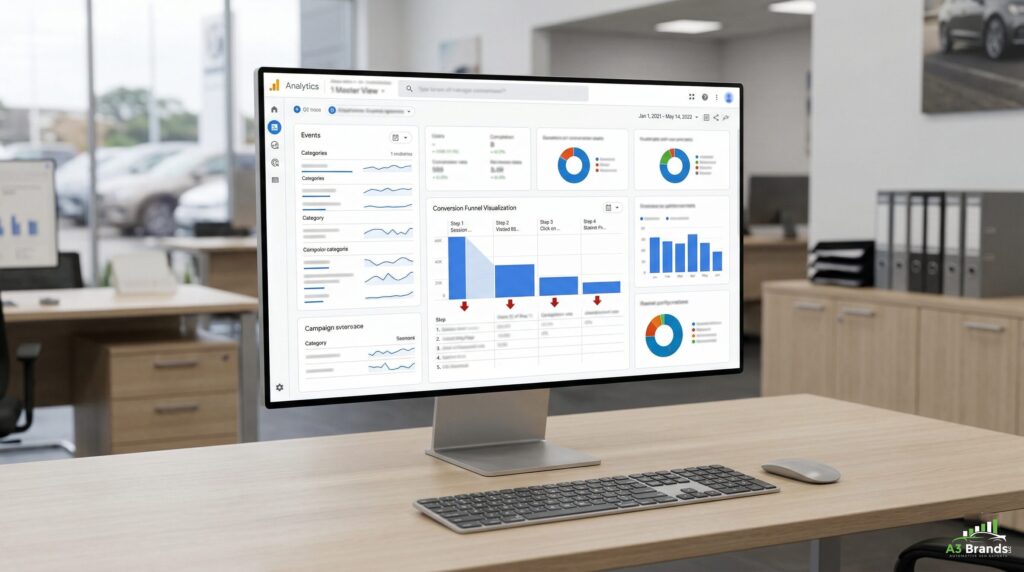
Before ASC alignment, your analytics might count a phone call, a form submission, and a chatbot interaction as three separate “leads” — or one, depending on which vendor is reporting. After ASC alignment, every event has a defined name, defined parameters, and a definition that travels across every tool you’re using. Your CRM, your Google Analytics 4 (GA4), your vendor dashboard — they all speak the same language.
We’ve written about exactly how that implementation works in practice, including where most dealerships leak data before they even know it: ASC Implementation: How We Cut Dealer PPC Waste with GA4 Tracking.
For a GM navigating a vendor transition, that standardization is protection. When you have a defined measurement system in your contract, “45% lift in organic traffic” either happened or it didn’t. There’s no room for creative attribution. And if you want to understand the full conversion tracking picture — beyond just the pilot — our breakdown of dealership conversion tracking and attribution covers how to structure that system across your entire operation.
Why 90 Days Is the Right Window?
We’ve run enough of these to know that 90 days is where the signal separates from the noise. It aligns with your quarterly review cycle, gives enough time to see real movement, and — critically for new leadership — limits your exposure before you’ve had a chance to validate the partner.
We structure the ASC SEO pilot in three focused phases.
The first 30 days are purely technical. Before we touch a single piece of content, we validate that your tracking is clean: GA4 is correctly configured, server-side event capture is working, your CRM is mapping to ASC events, and we have a solid baseline from the prior 90 days. Nothing we do in this pilot means anything without that foundation. We’ve seen dealers come to us with analytics so fragmented that their “organic traffic” included branded paid clicks. We fix that first.
Days 31 through 60 focus on early indicators. Are organic sessions growing? Are the right pages — vehicle detail pages, model research pages, financing calculators — converting at a higher rate? We’re not declaring victory here. We’re watching for the pattern that tells us the technical work is producing movement before we scale anything.
The final 30 days are where we look at business impact. Organic-attributed leads. Cost per acquisition compared to what you’re paying in paid search. Test drives we can trace back to an organic session. Units sold where the first touchpoint was a Google search, not an ad. That’s the chain we build toward — and it’s the same attribution chain we detail in our guide on SEO to showroom attribution for car sales.
Pro Tip: The 90-day window isn’t arbitrary. It’s long enough to show statistically meaningful movement in rankings and conversions, and short enough that you’re not locked into a vendor relationship before you know whether it’s working. If a vendor pushes back on a 90-day milestone structure, that’s a red flag.
How We Protect You From Vendor Finger-Pointing?
One pattern we see repeatedly with new GMs is the attribution dispute that comes after a pilot. Vendor A says their SEO drove the leads. Vendor B says it was their PPC. The CRM doesn’t match either story.
We solve this before the pilot starts, not after.
We insist on first-party data as the primary attribution source. CRM matches, appointment confirmations, VIN-level sales records — these are deterministic signals. They happened or they didn’t. We use these to validate our reporting rather than relying on modeled last-click attribution, which vendors can manipulate. For a deeper look at how dealership ROI should actually be measured — from test drives to units sold — our breakdown of dealership SEO ROI tied to real sales outcomes is worth reading before you sign anything.
We also recommend building control logic into the pilot design. If you have multiple rooftops, we keep one location unchanged and compare movement in your test location against it. That’s not sophisticated — it’s just discipline. And it’s what separates a marketing experiment from a business decision.
Understanding where you stand against your competition before the pilot launches also matters. We run a competitor SEO audit before every engagement because it sets realistic expectations on how much ground needs to be covered and how fast. Our dealership competitor SEO audit framework shows exactly how we approach that analysis.
If the pilot meets the gates we set at the start — a defined lift in organic leads, a measurable reduction in cost per acquisition — we expand. If it doesn’t, you exit cleanly with the optimization work completed, the documentation in your hands, and a clear picture of what happened. No sunk cost. No long-term contract you’re trapped in.
Pro Tip: Insist on audit rights in your vendor contract before the pilot launches. You should have access to raw data exports within 48 hours of any request. If a vendor hesitates on this, that tells you something.

What We Deliver in 90 Days?
At the end of a well-run ASC SEO pilot, you have three things. First, a clean measurement baseline — ASC-compliant tracking that survives vendor changes and can be audited by anyone. Second, a real answer: did organic SEO move the needle in your market, on your inventory, against your actual competition? Third, a defensible report you can put in front of your leadership team or ownership group that doesn’t rely on a vendor’s interpretation of their own data.
We’ve seen dealerships use this kind of structured pilot to reduce paid search dependency significantly over 12 to 18 months — a pattern consistent with what NADA research and Cox Automotive’s industry data show about organic-to-paid cost ratios in competitive markets. That shift doesn’t happen in 90 days. But what does happen in 90 days is that you have the evidence to make that decision confidently — or the evidence to stop and reallocate the budget elsewhere. Either outcome protects you.
For dealers thinking about where an ASC SEO pilot fits inside a broader digital strategy, our 2026 automotive SEO roadmap maps out how pilots like this connect to long-term organic dominance.
Ready to Run a Pilot That Actually Protects You?
We’ll audit your current tracking setup, map it against ASC standards, and show you exactly where your attribution is leaking — before a single dollar of pilot budget is spent. No charge for the assessment. If your current setup can support a defensible ASC SEO pilot, we’ll map out the 90-day plan in plain terms. If it can’t, we’ll tell you what needs to be fixed first and who should fix it.
Call A3 Brands directly at 302-394-6940 or email info@a3brands.com.

Tim Boyle

ASC SEO Pilot: 90-Day Risk Framework for Dealers
90-Day SEO Pilot for Dealerships: 2026 ROI Guide

Local SEO for Multi-Store Auto Dealers: The Operational Playbook

Why Your Dealership Conversion Tracking Is Costing You More Than Your Ad Budget

A3 Brands Heads to Digital Dealer 2026: Why AI Search Is the Biggest Shift in Dealership Visibility