
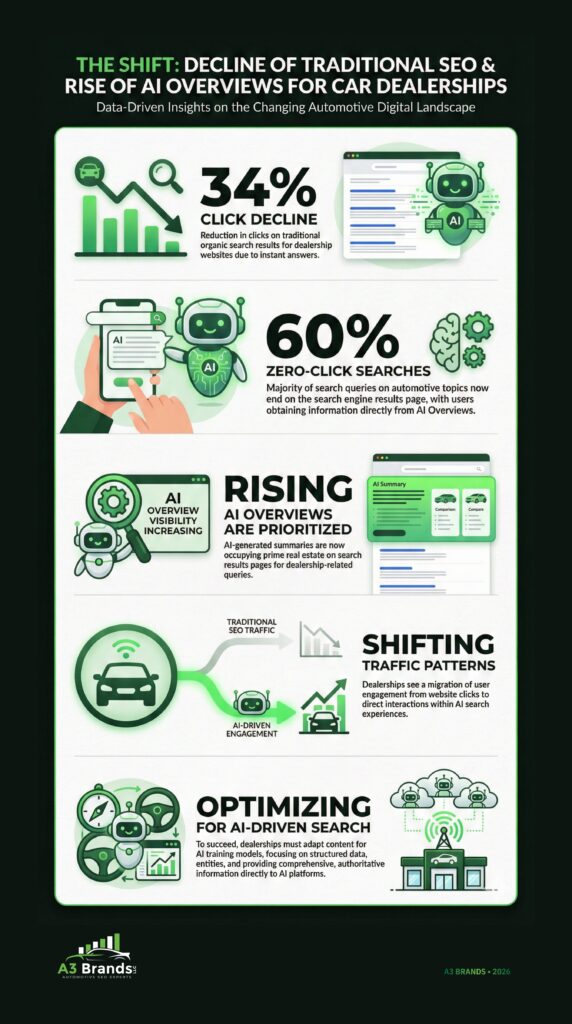
Google AI Overviews now appear in over half of all searches, reducing clicks to organic results by more than 30%. Dealerships must shift from ranking for keywords to being cited in AI-generated answers. Three critical changes for 2026: structure content for AI extraction using 150-250 word atomic sections, target conversational queries with eight or more words that trigger AI responses at significantly higher rates, and prove expertise through verifiable first-hand experience signals that AI systems can cite with confidence.As we’ve seen while helping dealers understand how automotive SEO can help your dealership grow, the shift toward AI-based search is accelerating quickly.
Why Is Traditional Automotive SEO Failing in 2026?
Traditional SEO optimized for blue links. That approach stopped working when Google’s AI Overviews began appearing above organic results, synthesizing answers from multiple sources into a single response.
Ahrefs analyzed 300,000 keywords and found AI Overviews correlate with a 34.5% lower click-through rate for top-ranking pages. Seer Interactive’s 15-month study showed organic CTR dropped from 1.76% to 0.61% for queries with AI Overviews present. That’s a 61% decline in clicks even when you rank well.
Zero-click searches now account for roughly 60% of all Google queries. SparkToro’s research found that for every 1,000 US Google searches, only 360 clicks go to the open web. Car shoppers increasingly get answers without clicking any website. When someone searches “best SUV for families under $50k,” Google’s AI provides a complete answer citing trusted sources. If your content isn’t structured for citation, you’re invisible in these results regardless of your organic rankings.
We’ve tracked this shift across 250+ dealer websites since 2004. The pattern is clear: dealerships optimizing for AI citations are capturing leads that competitors never see. Many dealers are still relying on wrong automotive SEO strategies that ruin dealerships — and AI search punishes those outdated tactics even more.
The Three Shifts At-A-Glance
Shift | Old SEO Approach | 2026 AI-Optimized Approach |
Content Structure | Long-form pages optimized for keywords | 150-250 word atomic sections answering specific questions |
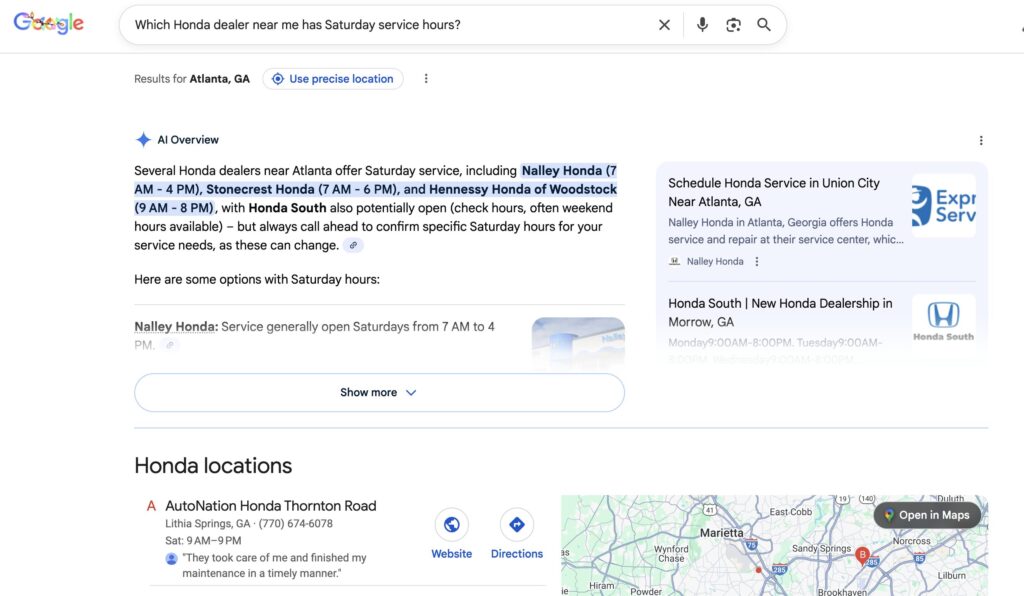
Query Targeting | Short-tail keywords (“Honda dealer Dallas”) | Conversational queries 8+ words (“Which Honda dealer near me has Saturday service hours”) |
Expertise Signals | Manufacturer-derived content | First-hand dealership experience with verifiable local data |
Shift One: How Should Dealerships Structure Content for AI Extraction?
AI engines don’t read pages the way humans do. They retrieve specific paragraphs that directly answer user questions. Your content must be organized into atomic sections, each one a self-contained answer that AI systems can extract and cite independently.
Every major section on your website should follow this structure: a question-based heading, a complete 150-250 word answer, supporting evidence with specific sources, and context explaining why this matters to the buyer. This format allows Google’s AI to pull your content as a citation while still reading naturally for human visitors.
BrightEdge’s research revealed something important: AI Overviews now cite content from positions 21-30 at 400% higher rates than before, and from positions 31-100 at 200% higher rates. Google’s AI is reaching deeper into search results to find helpful, topic-rich content structured for extraction. You don’t need to rank number one anymore. You need content AI systems can easily quote.
We implement this structure across every dealer website we manage. The results are measurable: content formatted for passage retrieval appears in AI Overviews at significantly higher rates than traditionally structured pages, even when both rank similarly in organic results.To support this, dealers also need error-free foundations — as outlined in the technical SEO checklist for dealership website maintenance.
What Makes an Atomic Section Effective for AI Citation?
An atomic section is a self-contained content block between 150 and 250 words that fully answers one specific question. AI systems can lift these sections independently without needing surrounding context. Think of each section as a complete mini-article that stands alone while fitting into a larger page.
Each atomic section needs four elements. First, the question, either explicit in the heading or clearly implied. Second, the complete answer with no critical information requiring readers to look elsewhere. Third, evidence through specific statistics, specifications, or comparisons from verifiable sources. Fourth, context explaining why this information matters to the specific buyer persona reading it.
Headers should match natural language queries. “What credit score do I need to lease a car?” outperforms “Credit Requirements for Vehicle Leasing” because AI systems match headers to user questions when selecting passages for citation.
Google’s AI Overviews are developing sophisticated, context-aware citation models. Dealers can identify which questions matter most using frameworks similar to identifying the search query of your potential customers. Content structured with clear question-and-answer formatting that includes NHTSA data, EPA estimates, IIHS safety ratings, and manufacturer specifications provides the verifiable evidence AI systems need to justify including your content in generated answers.
Shift Two: Why Do Longer Queries Convert Better in AI Search?
Shoppers no longer type “Honda dealer Dallas.” They ask “Which Honda dealer near me has Saturday service hours and good reviews for first-time buyers?” These conversational queries signal specific intent and trigger AI Overviews at dramatically higher rates. Dealers optimizing for these patterns see stronger performance in local SEO for auto dealers as well, since local search interacts directly with AI Overview behavior.
BrightEdge research from January 2025 found that queries containing eight or more words are 7x more likely to trigger AI Overview responses than shorter searches. Google increased AI Overview presence in longer queries by 100% from September to December 2024. Now, 25% of searches using keywords of eight words or more display AI Overviews.
We’ve measured this across 18 months of client data. Dealers ranking for specific, question-based queries generate leads that convert to sales at nearly double the rate of leads from generic short-tail keywords. The traffic volume looks smaller, but revenue per visitor tells the real story.
Your content strategy must target these conversational patterns. Build pages answering specific questions like “How much does Honda Accord maintenance cost in [your city]?” or “What’s included in certified pre-owned inspection at [dealership name]?” These queries face less competition while capturing shoppers Google already identified as actively researching.
How Does Google Business Profile Affect AI Answer Visibility?
Google pulls Business Profile information directly into AI-generated answers for local automotive queries. Incomplete or outdated profiles get skipped entirely, regardless of how well your website ranks organically.
Google’s own research shows businesses with complete Business Profiles are 70% more likely to get visits and 50% more likely to be considered for purchases. Fully populated, verified profiles surface 80% more often in search and generate 4x more website visits than incomplete listings. Dealers can dramatically improve this by applying the strategies outlined in
How Google Business Profile Elevates Your Dealership Website.
We’ve documented dealers jumping from position eight to position three in local pack results through GBP optimization alone, before touching their website. The AI visibility impact is even more pronounced. When shoppers ask “Which [brand] dealer near me has the best service reviews?” Google’s AI synthesizes information from Business Profiles, reviews, and website content. Missing any component reduces your citation likelihood.
Posts expire after seven days. Dealers publishing weekly maintain the activity signals that influence both local pack rankings and AI answer inclusion. Photos, Q&A responses, and review replies all contribute to the completeness score AI systems evaluate when selecting sources.
Shift Three: How Do Dealerships Prove Expertise AI Systems Can Verify?
Google’s E-E-A-T framework, standing for Experience, Expertise, Authoritativeness, and Trustworthiness, determines which sources AI systems cite. The first E, Experience, became critical because AI-generated content now floods the internet and Google actively filters it from quality results.
Experience means first-hand knowledge that content farms cannot replicate. Your service technicians explain common repair issues they see daily. Your finance managers break down lease calculations with real examples from your market. Your sales team addresses questions specific to models in your inventory.
AI Overviews are developing sophisticated, context-aware citation models that prioritize authoritative content. Healthcare queries cite institutional sources at 72% rates. B2B tech queries distribute citations across multiple authoritative sources. Content demonstrating genuine experience receives higher trust scores than generic informational content, even when covering identical topics.
We rebuilt one dealer group’s content strategy around authentic expertise after their traffic declined following AI Overview expansion. Within 90 days, organic visibility recovered and cost per lead dropped substantially. The difference was replacing manufacturer-derived content with information only that dealership could provide: local market insights, real service department observations, and specific inventory expertise. This shift aligns with the evolution explained in AI automotive search 2026 — where AI systems increasingly prioritize firsthand expertise over generic content.
What ROI Can Dealerships Expect From AI-Optimized SEO?
Dealerships that restructure content for AI citation reduce dependence on paid advertising. We consistently see clients cut PPC spend by 50-70% once organic visibility improves in both traditional results and AI Overviews.
The calculation is straightforward. A dealership spending $12,000 monthly on Google Ads that captures half that traffic through organic visibility frees $72,000 annually. Those funds can improve inventory, facilities, or margins. More importantly, organic visibility builds a compounding asset rather than renting attention month to month.
AI Overviews appeared for just 10,000 keywords in August 2024. By May 2025, that number had grown to over 172,000. That percentage will continue growing. Dealerships that adapt their SEO strategy for AI citation now capture leads competitors won’t see for years. Those still optimizing for 2023 search patterns will watch traffic decline while wondering where shoppers went.
Your Competitive Analysis: What Should You Do Next?
We’ll pull your current AI visibility data, test how often your dealership appears in AI-generated answers versus your top local competitors, and identify exactly where you’re losing citations to competing dealers.
No charge for the analysis. We’ll show you specific queries where competitors get cited and you don’t, explain what structural changes would capture that visibility, and outline a 90-day plan if we see a clear opportunity.
If the data shows we can reduce your ad spend while increasing quality leads, we’ll discuss next steps. If we don’t see a path to meaningful ROI improvement, we’ll tell you directly. Twenty years working exclusively with dealerships taught us that honest assessments build better partnerships than overselling.
Call Tim directly at (302)-394-6940 to schedule your AI visibility audit this week.

Tim Boyle
Research Sources
The data referenced in this article comes from the following industry studies:
AI Overviews & Click-Through Rates
Zero-Click Search Behavior
Long-Tail Queries & AI Triggers
Google Business Profile Performance
90-Day SEO Pilot for Dealerships: 2026 ROI Guide

Local SEO for Multi-Store Auto Dealers: The Operational Playbook

Why Your Dealership Conversion Tracking Is Costing You More Than Your Ad Budget

A3 Brands Heads to Digital Dealer 2026: Why AI Search Is the Biggest Shift in Dealership Visibility

How Multi-Store Dealer Groups Finally Make SEO Measurable Across Every Location