
“Most dealerships running paid search are paying for customers they already had.”
That’s not an opinion. It’s what we see consistently after 20 years working exclusively with car dealers. A shopper searches your brand name on Google, clicks your paid ad, and your system records it as a paid conversion. But that person was already coming to your site. You paid Google for something that was free.
The problem isn’t your ad strategy. It’s your dealership conversion tracking. And that’s exactly what Automotive Standards Council (ASC) compliance is designed to fix. We’ve covered the mechanics of a specific ASC and GA4 implementation in detail — if you want the technical walkthrough, read our breakdown of how we cut dealer PPC waste with GA4 tracking. This article focuses on the strategic case: what broken attribution is actually costing you, and what clean measurement makes possible.
Lying to Your Budget?
Reduction with Clean Tracking
Implementation Timeline
Counting the Same Conversion
You're Seeing
Happening
What Is ASC Compliance, and Why Should a Dealer Care?
The Automotive Standards Council developed a standardized measurement framework specifically for dealerships. Think of it as a universal language for how your website tracks and reports customer actions, from a vehicle detail page view all the way through a finance application.
Without standardized tracking, your Google Ads account, your Facebook pixel, your retargeting vendor, and your chat tool are all speaking different dialects. Each one can claim credit for the same sale. We’ve audited dealerships running five or six separate tracking pixels, all counting the same conversion. The result is inflated performance data that makes expensive paid channels look better than they are.
ASC compliance gives your GA4 (Google Analytics 4) setup a consistent foundation: uniform event names, standard data fields specific to automotive retail, and server-side tracking that captures conversions even when a customer’s browser blocks traditional pixels. When dealership conversion tracking gets clean, the picture that emerges is almost always surprising — and almost always reveals that your real cost-per-lead is higher than what your paid dashboards are showing.
What Clean Attribution Reveals About Your Paid Spend
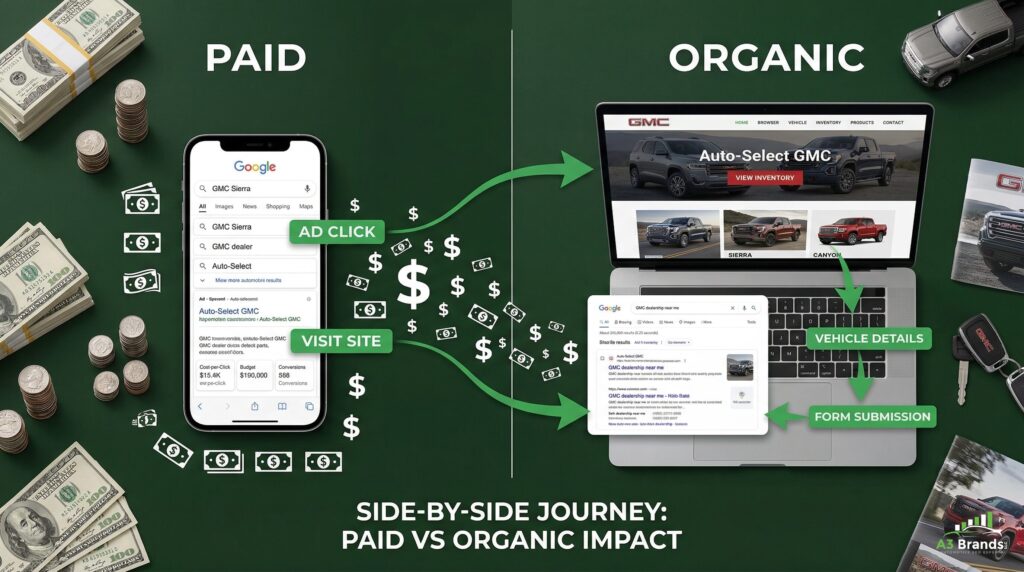
Here’s what we see repeatedly across the dealer groups we support. Once attribution is standardized, a meaningful portion of conversions previously credited to paid campaigns turn out to originate from branded search or direct navigation. These are people who already knew your dealership and were coming regardless. The paid ad just intercepted them on the way.
That’s not a knock on paid search as a channel. Paid media earns its place for conquest traffic and model-specific campaigns. But when a dealership can see clearly which paid keywords are generating genuine incremental conversions versus which are simply capturing organic demand, the waste becomes obvious and the cuts become easy. We’ve written about the real cost comparison between PPC and SEO for dealerships — the gap between what dealers think they’re paying per lead and what they’re actually paying once attribution is accurate is consistently eye-opening.
We’ve worked with dealer groups who ran controlled tests after cleaning up their tracking: they paused branded keyword bidding for a defined period and watched what happened. Organic search stepped in and captured nearly the same volume. The savings were real and immediate. That’s the case for ASC compliance in plain terms. Better measurement leads to smarter cuts, and smarter cuts redirect budget toward channels that actually move the needle. If you’re actively working to reduce customer acquisition costs through organic, that reallocation is where the long-term math starts working in your favor — and we cover exactly how that plays out in our breakdown of dealership CAC reduction through organic SEO.
The Attribution Problem Runs Deeper Than Paid Search
Clean dealership conversion tracking doesn’t just expose paid waste. It changes how you understand the entire path a customer takes before showing up on your lot.
Most dealer analytics platforms record only the last touchpoint before a conversion. A customer who read three of your blog posts, visited your F-150 model page four times over six weeks, and then clicked a retargeting ad gets counted as a paid conversion. The organic content that did most of the selling gets no credit. That misattribution isn’t just an analytics problem. It’s a budget allocation problem. You keep funding the channel that took the final click while starving the channels that built the intent.
ASC-compliant tracking with proper cross-device stitching starts to correct this. We’ve covered how to connect SEO activity to actual showroom visits and units sold, and the consistent finding across implementations is that organic search influences far more of the conversion path than last-click models suggest. When you can see that, the decision about where to invest becomes considerably clearer.
The SEO Benefit Nobody Talks About
ASC compliance improves organic visibility in ways most dealers don’t anticipate when they start the process.
Proper structured data implementation, required under ASC standards, includes vehicle listing schema markup that tells Google exactly what’s on your page: make, model, year, price, availability. Think of schema markup like the window sticker on a vehicle. Without it, Google has to guess what you’re selling. With it, your listings are eligible for rich search results that show price and availability directly on the results page — clicks that cost you nothing per visit. Google’s structured data documentation outlines exactly what’s required for vehicle listings to qualify.
Server-side tagging, the technical backbone of ASC compliance, also reduces reliance on client-side JavaScript. That typically speeds up page load, which Google measures directly through Core Web Vitals — your site’s speed score, one of Google’s confirmed ranking factors. A faster site ranks better. The measurement upgrade and the SEO upgrade arrive together.
For dealer groups investing in model landing pages alongside this work, the combination of clean schema and faster load times compounds quickly. The SEO ROI case gets stronger when your dealership conversion tracking is accurate enough to actually show it — and we’ve laid out how to measure that ROI through test drives and units sold.
What Implementation Actually Looks Like
We won’t pretend this is a one-afternoon project. A clean ASC implementation for a typical dealership or small dealer group takes roughly 12 weeks when done right. The work involves auditing your current tracking setup, configuring GA4 to ASC standards per the Automotive Standards Council’s published specifications, deploying server-side tagging, connecting your CRM and inventory feeds, and running parallel validation before going live.
The most important phase isn’t the technical build. It’s the validation. We spend real time comparing ASC-tracked data against your CRM records to make sure what the system says happened actually happened. That’s where trustworthy measurement gets built.
After go-live, ongoing quality assurance matters. Attribution data drifts when sites update, inventory feeds change, or new vendors add their own pixels. Dealers who treat ASC compliance as a one-time project gradually drift back toward the measurement chaos they started with. We build monitoring into every engagement so that doesn’t happen.

What You Should Measure Before and After
Set your baseline before any changes. Track your current paid cost-per-lead by channel, your paid-to-organic conversion split, and your total monthly paid search spend. Those three numbers will tell you exactly what the measurement cleanup was worth once you have accurate data to compare against.
Understanding how to read those numbers correctly requires knowing the difference between a channel decision and a budget decision. Our local SEO versus PPC decision framework walks through how we help dealers evaluate that split using actual performance data rather than assumptions.
Multi-store operators can take this further by standardizing measurement across all locations simultaneously. Consistent event definitions and parameter schemas mean you can benchmark performance across rooftops with comparable data. For the first time, you’ll be able to see which locations are genuinely outperforming and which are just outspending. That visibility is the foundation for any serious group-level budget strategy.
Cox Automotive’s research on the modern car buying journey consistently shows that customers average multiple digital touchpoints before contacting a dealership. Clean dealership conversion tracking is what lets you see which of those touchpoints you own organically and which you’re renting through paid media. And Google’s own analytics and measurement documentation reinforces the same principle: measurement quality directly determines optimization quality. You can’t improve what you can’t measure accurately.
Ready to See What Your Conversion Tracking Is Actually Telling You?
We’ll pull your current GA4 and paid search setup, identify exactly where attribution is leaking, and show you which conversions you’re paying for that organic search would have captured anyway. No charge for the audit. You’ll walk away with a clear picture of your true cost-per-lead by channel and a specific list of what’s inflating your paid numbers.
If the audit surfaces real savings, we’ll map out a 90-day ASC implementation plan and show you what accurate measurement would change about your budget allocation. If it doesn’t, you’ll at least know your tracking is clean. Either way, you’re better off knowing.
Call A3Brands directly at 302-394-6940 or email info@a3brands.com.

Tim Boyle

90-Day SEO Pilot for Dealerships: 2026 ROI Guide

Local SEO for Multi-Store Auto Dealers: The Operational Playbook

Why Your Dealership Conversion Tracking Is Costing You More Than Your Ad Budget

A3 Brands Heads to Digital Dealer 2026: Why AI Search Is the Biggest Shift in Dealership Visibility

How Multi-Store Dealer Groups Finally Make SEO Measurable Across Every Location