
Dealership SEO attribution is the single biggest gap we see in how stores measure marketing performance. Dealers are spending $8,000 to $15,000 a month on SEO with no idea whether it’s actually driving sales. Meanwhile, their GM can tell you exactly which TV spot pulled which customer into the showroom last Saturday. That’s why SEO budgets get cut first when the market tightens, even when organic is the cheapest lead source on the lot.
We’ve spent 20 years working exclusively with dealerships, and we’ve watched this same story play out hundreds of times. A customer searches “best SUV near me,” clicks your organic listing, browses inventory for twelve minutes, leaves without converting, walks into your showroom three days later. Your CRM logs it as a walk-in. Your sales manager credits the radio ad. Your digital dashboard shows a bounce. Nobody connects those dots, and your SEO investment looks weaker than it is.
Here’s how we fix it.
Translate Digital Into Showroom Language
The single biggest mistake we see is digital teams reporting to executives in metrics nobody at the dealership actually cares about. Sessions, bounce rate, keyword rankings. None of that matches how a GM thinks about the business.
When we build attribution for our dealer clients, we translate every digital metric into a showroom equivalent. Organic sessions become digital lot traffic. Engaged visitors (three or more pages) become window shoppers. Vehicle Detail Page views become brochure requests. Form submissions plus tracked phone calls plus appointment bookings become test drive requests. Suddenly your GM isn’t looking at a spreadsheet of analytics jargon. They’re looking at the same funnel they’ve managed their entire career, just with digital inputs feeding it.
From there, the math becomes familiar. Ten thousand organic sessions a month, at a 30% engagement rate, gives you 3,000 qualified digital shoppers. A 5% lead conversion rate yields 150 leads. At a 40% show rate, that’s 60 showroom visits. Close 25% at $3,000 average gross profit, and you’re looking at $45,000 in monthly SEO-attributed revenue. Over a year, that’s $540,000 from a channel most dealers underfund. This is the same math that powers dealership SEO ROI tied to test drives and units sold.
Close the Loop with CRM and DMS Integration
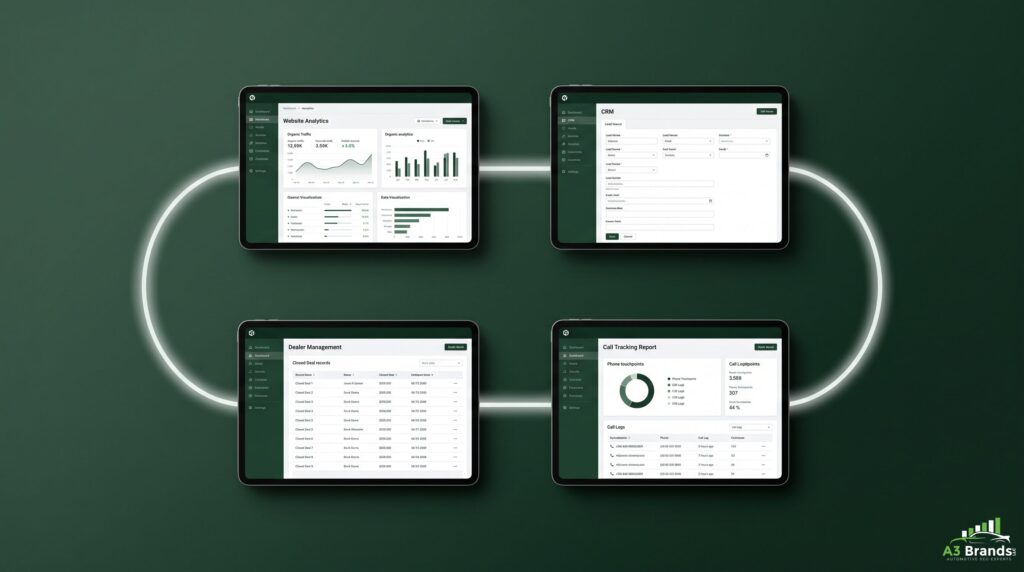
Reporting traffic without connecting it to deals is where most agencies stop. We don’t, because the whole point of dealership SEO attribution is proving SEO sold cars, not just that people visited the website.
This requires four connections: website analytics feeding the CRM, the CRM carrying source data into the DMS, the DMS sending closed deals back to analytics for validation, and call tracking tying phone touchpoints into all of it. Most dealerships have one or two of these wired up. Almost none have all four. When we get all four talking to each other, dealers are often surprised to learn that organic search touched 40-60% more sales than their last-click reports were crediting. This is the core of proper dealership conversion tracking and attribution.
The technical piece matters but it’s not the hard part. Pushing Google Client IDs into the CRM, preserving UTMs (the parameters that tag where traffic came from) through the deal lifecycle, matching closed deals back to original source by email or phone: all of this is solvable per Google’s offline conversion tracking documentation. We walked through the full technical build in our guide to ASC implementation and GA4 tracking. The hard part is getting your sales team, your BDC (Business Development Center), and your IT vendor pulling in the same direction. That’s where our 20 years in the industry does most of the work.
Score the Micro-Conversions That Actually Predict Sales
Not every site visit is equal. Someone who reads a blog post about “best family SUV” is miles away from buying. Someone who views the same VIN three times, checks finance terms, and uses the trade-in tool is probably going to walk in this week. According to Cox Automotive’s market insights research, car shoppers now spend the majority of their buying time online, which means digital behavior is your best early signal.
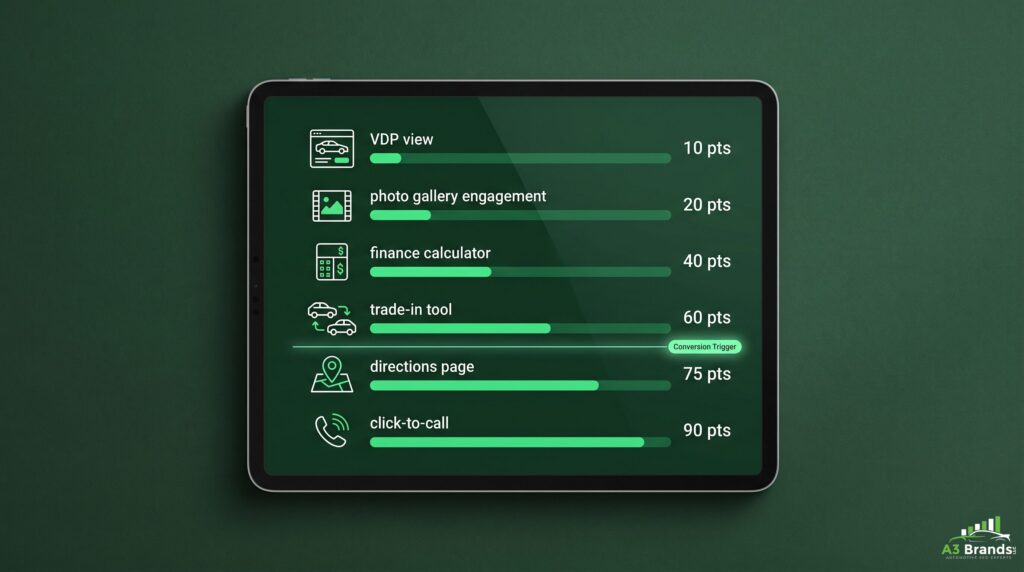
We score these behaviors. A unique VDP view gets 10 points. Photo gallery engagement beyond five images, 15. Finance calculator use, 25. Trade-in completion, 30. Directions page, 35. Click-to-call on mobile, 40. When a visitor crosses 75 points in a single week, our dealer clients send that lead to their highest-converting salesperson, not the next rep in the rotation. That one change consistently moves close rates. We’ve seen it work across domestic, import, and luxury stores. Optimizing your model landing pages is what feeds this scoring engine with the right kind of traffic in the first place. For the technical backbone, we rely on GA4 event configuration feeding into the CRM.
Build Dashboards Executives Actually Read
Here’s the truth most agencies won’t tell you: your executive team isn’t going to learn digital marketing. They don’t need to. What they need is a one-page monthly report that answers four questions. How many customers did SEO bring to my showroom? What did it cost? What did it make? How am I doing against my local competitors?
We call our version the Digital Showroom Report. It shows organic visitors, qualified shoppers, generated leads, showroom visits, attributed sales, gross profit, SEO investment, and ROI. One page. Showroom language. Numbers your GM and your dealer principal can act on without a translator. For multi-store operators, we layer this with local SEO benchmarking across all rooftops so each store’s performance is visible in context. This aligns with NADA’s dealership performance reporting standards, which emphasize business-outcome metrics over channel-specific vanity stats.
Start with a 90-Day Pilot
We know most dealers reading this have been burned before. Agency made big promises, showed pretty charts, couldn’t connect any of it to actual sales. So here’s what we do differently.
We’ll start with a 90-day pilot on your highest-volume model line. First 30 days, we fix the technical foundation, optimize your Google Business Profile through local SEO, and get call tracking wired into your CRM. Days 31 to 60, we build out inventory SEO and local landing pages, and we start reporting leads with source data. Days 61 to 90, we validate the attribution model against actual closed deals from your DMS and show you exactly which organic searches drove revenue. This is the same pilot framework we use to help dealers reduce customer acquisition cost through organic SEO.
If the numbers work, we scale. If they don’t, you walk away with a cleaner technical foundation, better GBP (Google Business Profile), and real attribution data you can use with any partner. No long-term contract. No penalty.
Ready to See What Dealership SEO Attribution Can Actually Prove for Your Store?
We’ll audit your current SEO setup, pull your Google Business Profile performance, compare your organic visibility against your two biggest local competitors, and show you exactly where attribution is leaking. Free. No sales pitch. If what we find makes sense to act on, we’ll map out a 90-day pilot. If it doesn’t, at least you’ll know what you’re working with.
Call A3Brands directly at 302-394-6940, or email info@a3brands.com.

zulkaifrana52webdev

Dealership SEO Attribution: Proving Sales Impact

ASC SEO Pilot: 90-Day Risk Framework for Dealers

90-Day SEO Pilot for Dealerships: 2026 ROI Guide

Local SEO for Multi-Store Auto Dealers: The Operational Playbook

Why Your Dealership Conversion Tracking Is Costing You More Than Your Ad Budget