
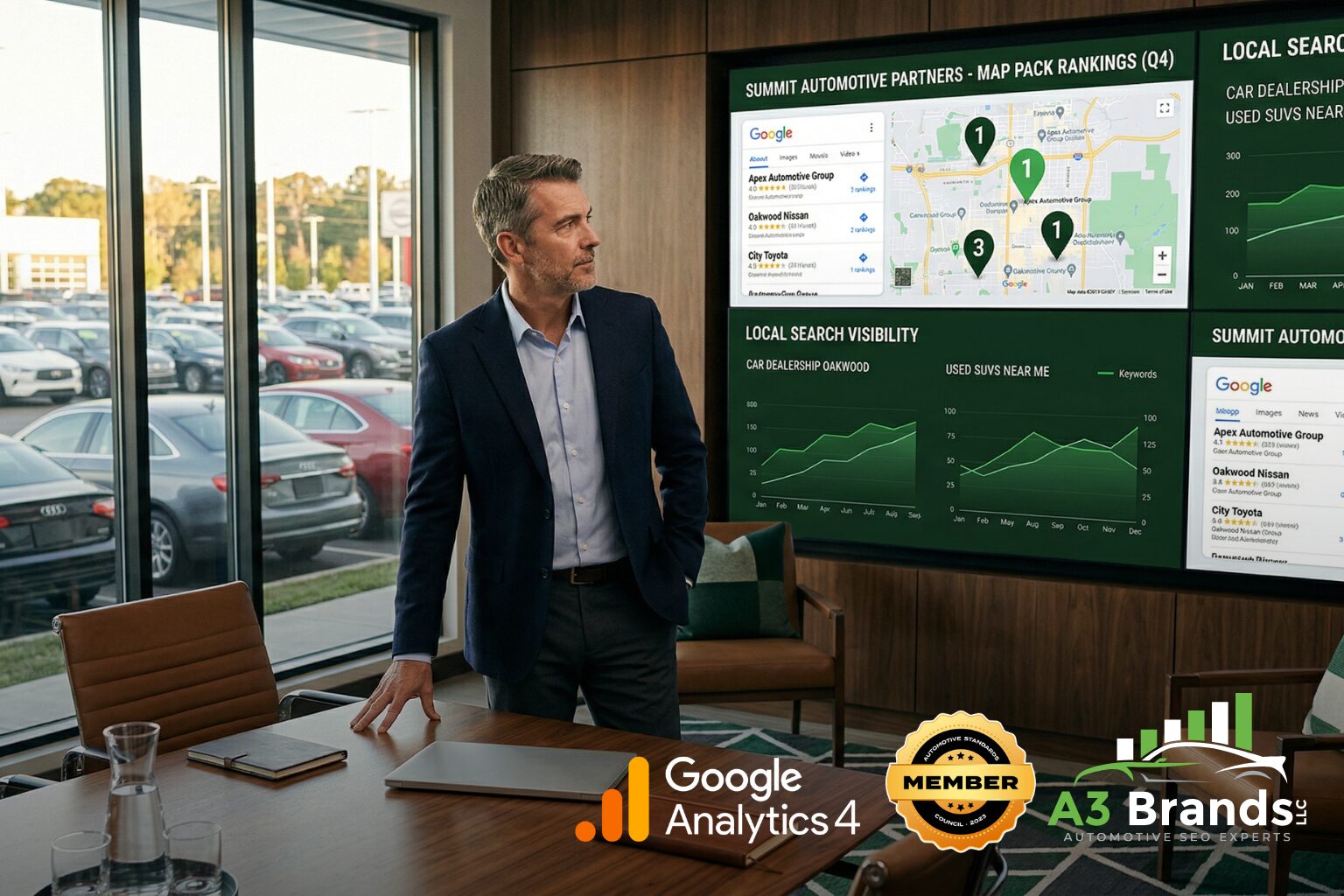
Dealer groups make the same mistake. They take what works at one store and multiply it. They assign someone at each location to “handle the SEO” and hope for consistency. What they get instead is fragmented data, mismatched business profiles, and a review response strategy that depends entirely on which store manager checked their phone last.
We’ve seen this across every type of dealer group we work with. The problem isn’t effort. It’s the absence of an operational system. And without that system, even the strongest automotive marketing strategies for car dealerships fall apart at scale.
Reduction
Before Full Rollout
Experience
- NAP consistency check
- Local pack positions
- GBP call volume baseline
- Review velocity per location
- NAP standardization live
- GBP optimization deployed
- Schema markup implemented
- Governance model activated
- Real data from your markets
- Call volume delta confirmed
- Rollout case built on your numbers
- GM endorsement in hand
Why Multi-Location SEO Breaks Down
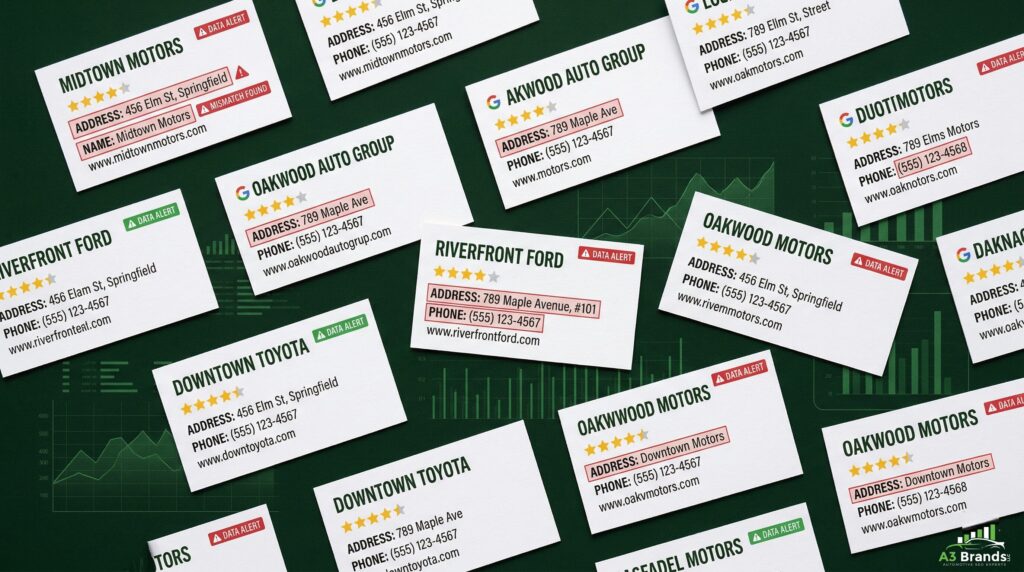
The first thing we audit when a dealer group comes to us is data consistency. Specifically, we check whether the name, address, and phone number listed on Google Business Profile matches what’s on the website, the manufacturer portal, Cars.com, Edmunds, and every directory that influences local rankings. In multi-store groups, this data almost always diverges. One location has an old phone number from a remodel three years ago. Another has an address formatted differently across platforms because two different vendors managed it at different times.
Google cross-references this information constantly. When it doesn’t match, trust drops. Rankings follow. We cover what that visibility loss actually costs in our breakdown of why your competitor ranks higher.
The second breakdown is governance. Who owns the Google Business Profile at each location? Who responds to reviews? Who updates hours when a holiday closes service? In most groups we audit, the honest answer is: everyone and no one. Corporate marketing thinks the store GM handles it. The GM thinks it’s the vendor. The vendor is waiting on approval. Meanwhile, a three-star review sits unanswered for two weeks.
We fix this with a clear ownership model before we touch a single title tag.
The Foundation: One Source of Truth
Before any optimization work makes sense, we establish what we call a master data record. A single source of verified name, address, and phone (NAP) information for each location that every platform pulls from. For most groups, this lives in the DMS (dealer management system). When an address changes, the DMS updates, and everything downstream follows automatically. No more inconsistencies because someone updated the website but forgot the Google profile.
This sounds simple. Executing it across 10 or 20 locations with existing vendor relationships, legacy systems, and varying levels of technical capability at each store is where it gets hard. We’ve done it enough times to know exactly where it breaks and how to prevent it. The same data discipline is what drives our local SEO vs. PPC decision framework for groups evaluating where to shift budget.
Google Business Profile as Your Control Center
For multi-store groups, Google Business Profile isn’t just a directory listing. It’s the front door for local organic traffic. We treat it like inventory. It needs to be current, complete, and actively managed.
At minimum, each location profile needs the correct primary category (New Car Dealer, Used Car Dealer, or both), department-specific phone numbers for sales and service, accurate hours including holiday exceptions, and a consistent post cadence of at least two updates per week. Beyond completeness, the profile needs active review management.
Review velocity matters. A location generating 12 to 15 new reviews monthly and responding to all of them within 24 hours signals to Google that the business is active and customer-engaged. That signal influences local pack rankings directly. We’ve seen stores jump from position 6 to position 2 in the local pack from review management alone, before any technical SEO work touched the site. This is one of the core reasons we built our approach to boosting your website’s local presence around GBP activity first.
For groups managing 10 or more locations, we recommend a hybrid governance model: corporate controls core data such as hours, address, phone, and categories, while local teams handle posts and review responses within approved templates. This keeps brand consistency intact without bottlenecking every response through a corporate approval chain.
Structured Data: The Window Sticker for Search Engines
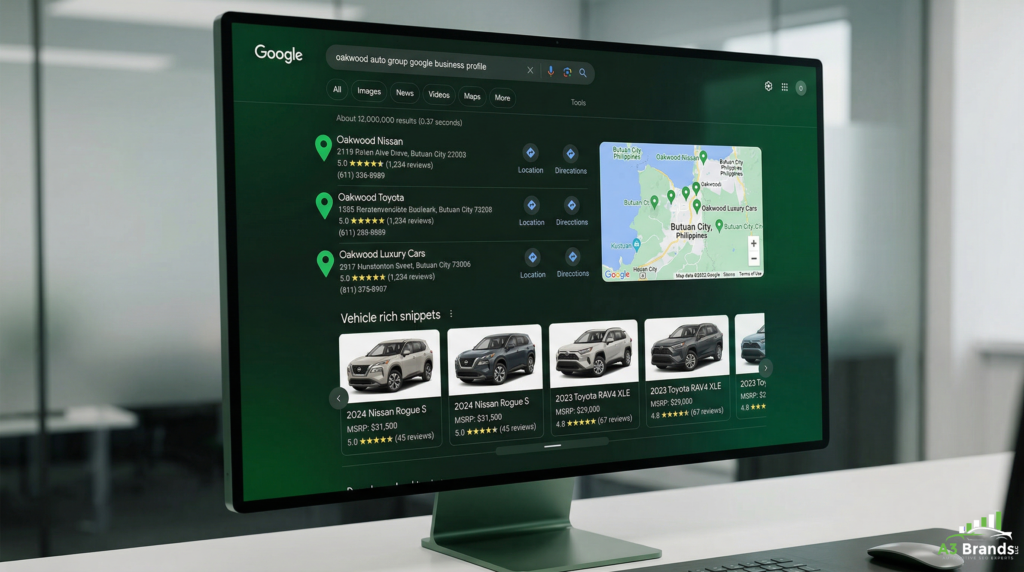
Most dealer group websites we audit are missing Vehicle and AutoDealer schema markup. Schema markup is the machine-readable code that tells Google what you sell, where you sell it, and what it costs. Think of it like the window sticker on a vehicle. Without it, a search engine sees a car on a lot but has no idea what it is.
Properly implemented schema pulls vehicle data directly into search results, enabling rich listings that show make, model, year, price, and condition before a shopper even clicks. For multi-store groups, this has to be implemented consistently across all location pages and inventory feeds, with correct canonical tags to prevent duplicate content issues between locations offering the same models. Poor schema is one of the most common reasons we see dealership website traffic drop without any obvious explanation.
This is technical work. We’ve scoped and executed schema implementations for groups ranging from 3 to 22 locations. The complexity grows with scale, which is why we address it systematically, one cluster of locations at a time, rather than trying to fix everything simultaneously.
The 90-Day Pilot: How We Build Confidence Before You Commit
The multi-store operators we work with don’t want to roll out an untested system across 15 locations and discover it doesn’t translate. We don’t either.
Our standard approach is a 90-day pilot with 3 to 5 representative stores: one high performer, two mid-range, and one that’s been struggling. We establish baseline metrics in week one. Local pack visibility for key model searches, call volume from Google Business Profile, and direction requests. Then we execute the full framework: NAP standardization, GBP optimization, schema implementation, and a review velocity program.
By week 12, we have real data from your specific locations in your specific markets. Local pack impressions typically respond first, followed by call volume, then qualified leads. We build the rollout case on those numbers, not aggregate industry statistics from a white paper.
When the pilot works, scaling to the full group is faster because the playbook is proven and your team has already seen it work. The hesitation that naturally comes with change is reduced when your own GMs have lived through it and can vouch for it. This mirrors the same pilot-then-scale approach behind our ASC implementation and GA4 tracking work for groups cutting PPC waste with better attribution.
Translating Rankings Into Revenue Language
The conversation with a dealer group’s ownership team doesn’t happen in impressions and click-through rates. It happens in cost-per-lead, showroom visits, and units sold. That translation is our job.
We report in two layers. The operational layer tells the marketing team what’s working: GBP call volume, organic traffic to inventory pages, and local pack position for target keywords. The business layer tells ownership why the investment makes sense: leads attributed to organic search, cost-per-lead versus current PPC spend, and projected paid search reduction as organic rankings improve. Our full guide to SEO-to-showroom attribution for car sales walks through exactly how we build that connection.
Dealer groups that shift from PPC-dependent to organic-dominant traffic reduce their cost-per-lead substantially over 12 to 18 months. We’re transparent about the timeline. Organic SEO doesn’t produce results in week three. But the results it produces compound over time in a way that paid clicks never will.
Ready to See Where Your Multi-Location SEO Stands?
If you’re managing three or more locations and your Google Business Profile data isn’t synchronized, your review response rate is inconsistent, or you’re still spending heavily on Google Ads with diminishing returns, here’s what we’ll do.
We’ll pull your GBP profiles for every location, check NAP consistency across your top directories, benchmark your local pack visibility against your primary competitor in each market, and hand you a prioritized list of what to fix first. No charge for the audit. If the numbers make a case for working together, we’ll build out a 90-day pilot proposal tailored to your group. If they don’t, you walk away with a clear picture of exactly where your multi-location SEO stands and what’s holding it back.
Call A3 Brands directly at 302-394-6940 or email info@a3brands.com.

Tim Boyle

Local SEO for Multi-Store Auto Dealers: The Operational Playbook

Why Your Dealership Conversion Tracking Is Costing You More Than Your Ad Budget

A3 Brands Heads to Digital Dealer 2026: Why AI Search Is the Biggest Shift in Dealership Visibility

How Multi-Store Dealer Groups Finally Make SEO Measurable Across Every Location

Local SEO for Car Dealers: What Actually Works in 2026
