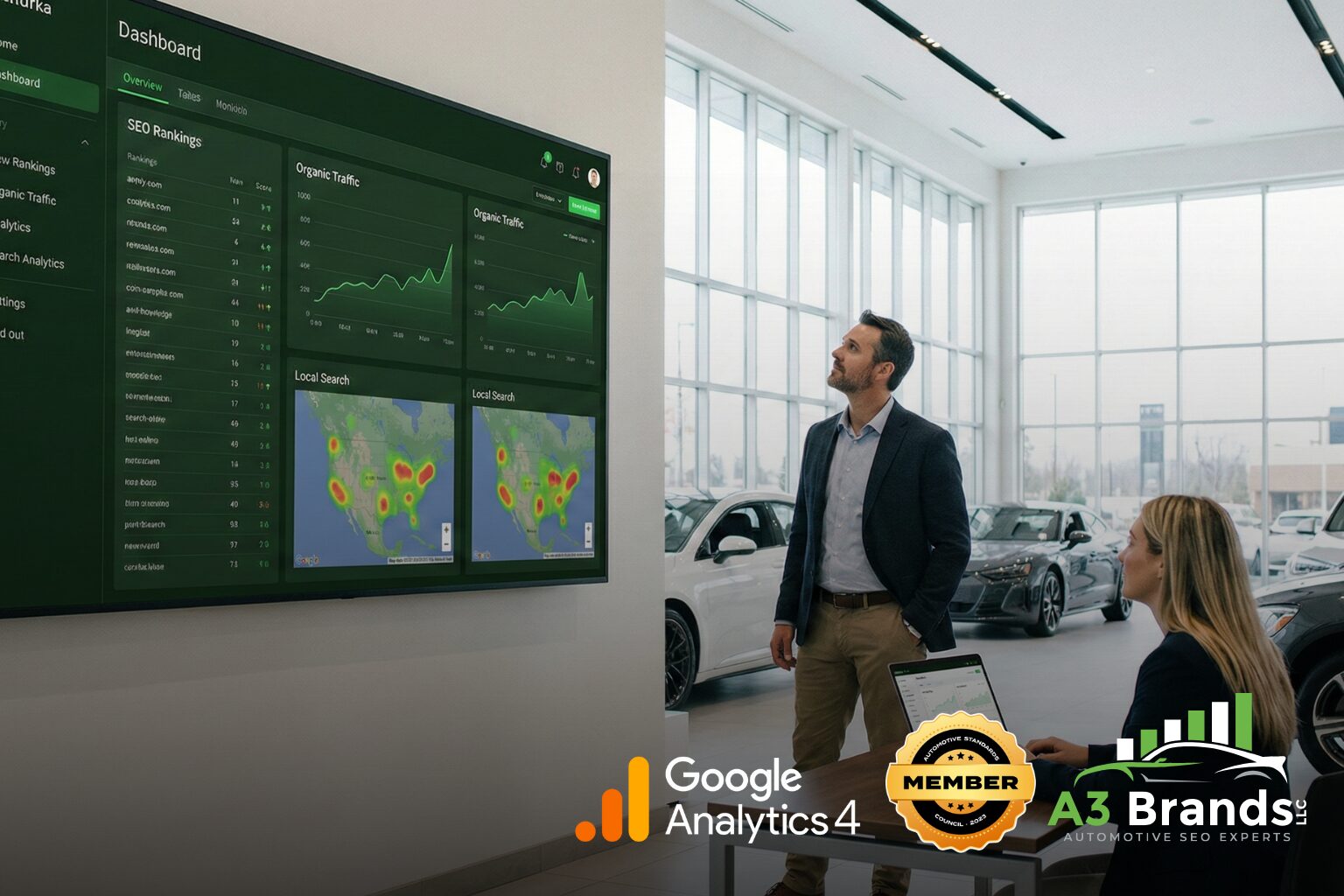
You’re spending $11,000 a month on Google Ads. Your competitor three miles away spends $4,500 and gets more showroom traffic. The difference isn’t budget. It’s strategy. They figured out when organic search wins and when PPC makes sense. Most dealers never run that analysis. We do it every week for dealerships across the country, and the patterns are clear. We’ve broken down the real cost difference between PPC and SEO for dealerships before, and the numbers consistently favor organic in competitive local markets.
After 20 years working exclusively with car dealerships, we’ve watched PPC costs climb while organic search quietly became the better investment for most local markets. Not all markets and not all situations, but more often than most dealers realize. Here’s how to figure out which camp your store falls into.
How to Know When PPC Is Bleeding Your Budget
The first thing we do with any new dealership partner is pull their market data. Not rankings, not traffic. We look at what they’re paying per click versus what those clicks actually produce.
In competitive metros, we consistently see dealership CPCs north of $40 for terms like “Ford dealer near me” or “best price RAV4.” At those rates, you need roughly one in every 25 clicks to walk into your showroom just to break even on ad spend. That math gets ugly fast.
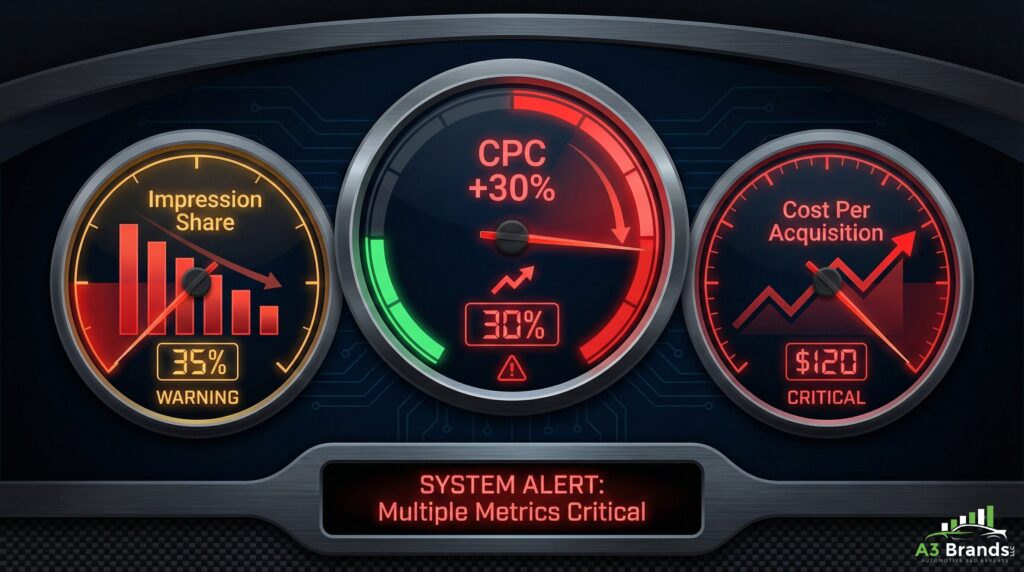
Three signals tell us a market is ripe for an organic shift. First, your cost per click has jumped more than 30% year over year on your core keywords. Second, you’re losing impression share even though your budget hasn’t changed, which means competitors are outbidding you. Third, your cost per acquisition keeps climbing quarter after quarter despite your team optimizing campaigns. When all three show up together, and we see this pattern regularly, it’s time to move money into organic.
That doesn’t mean killing PPC overnight. It means running a smarter split. We typically recommend dealers in saturated markets start shifting 40-60% of their converted PPC budget toward SEO while keeping paid campaigns running for immediate-need inventory and promotions. We’ve outlined how we use ASC implementation and GA4 tracking to identify exactly where PPC waste is happening so you’re making that shift based on real data, not guesswork.
Why Organic Compounds and PPC Doesn’t
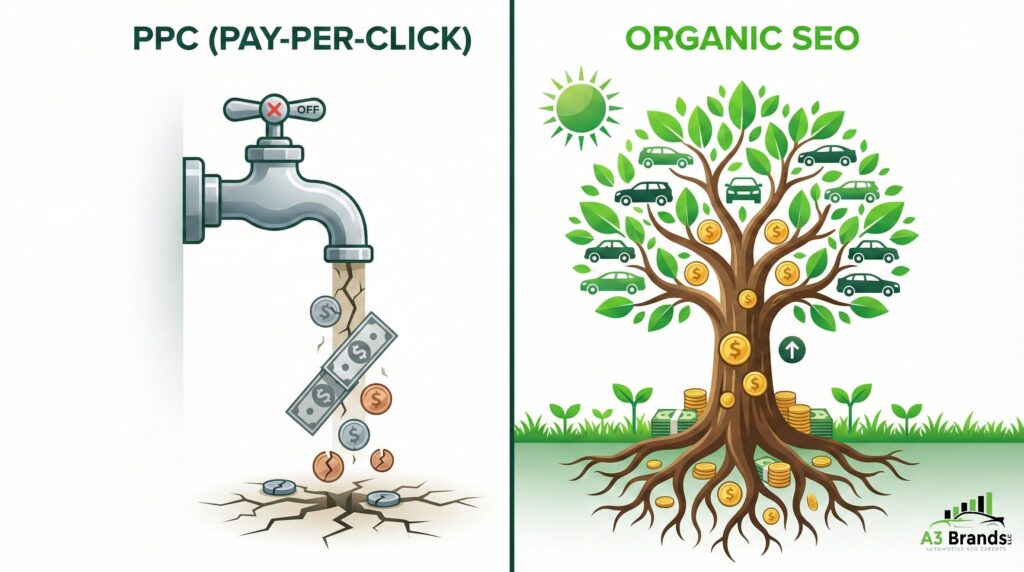
Here’s the fundamental difference we explain to every dealer GM we sit down with. PPC is a faucet. Turn it on, leads flow. Turn it off, they stop. You’re renting visibility.
Organic search is equity. Every page we build, every Google Business Profile optimization we make, every local citation we clean up adds to an asset your dealership owns. Six months of focused SEO work doesn’t disappear when you adjust your budget. The rankings stay. The traffic continues. The cost per lead drops every month because your investment keeps working without additional spend.
We’ve watched this play out hundreds of times. Dealerships that commit to 12-24 months of organic investment typically see their cost per lead drop to a fraction of what they were paying through ads. We walk through exactly how that math works in our piece on dealership customer acquisition cost reduction through organic SEO. And the leads are often better. Organic visitors have already done their research. They’ve read your content, checked your reviews, compared you to the competition. By the time they call or walk in, they’re further along in the buying process than someone who clicked an ad.
According to Google’s own research, customers are 70% more likely to visit and 50% more likely to purchase from businesses with complete Google Business Profiles. That’s free visibility producing real showroom traffic.
Your Google Business Profile Is Your Most Valuable Free Asset
If we could only do one thing for a dealership, it would be Google Business Profile optimization. It’s that important for local search, and most dealers barely scratch the surface.
A complete profile means every field filled out: accurate name, address, and phone number across all listings. Current hours. Every service you offer listed as a category. Professional photos updated monthly. Inventory posted regularly. Customer questions answered within 24 hours. Reviews responded to, every single one, good and bad.
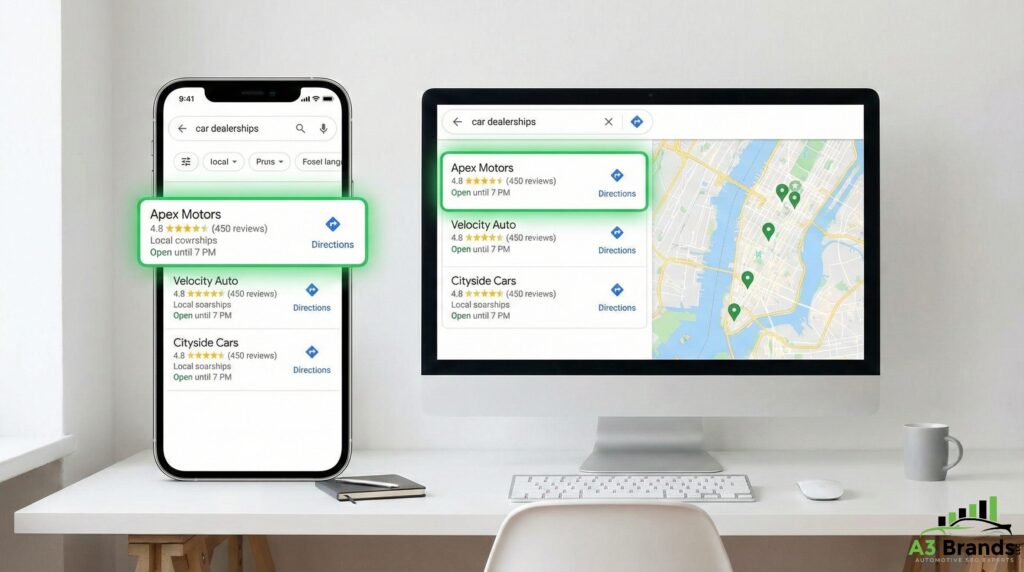
Think of your Google Business Profile as your digital showroom window. Just like a clean, well-lit lot with organized inventory draws walk-ins, a complete and active profile draws clicks, calls, and direction requests. When we optimize profiles for our dealer partners, we consistently see local pack visibility improve within 60-90 days.
The dealers who dominate the local three-pack, those top three map results that 68% of local searchers click, almost always have the most complete and actively managed profiles. Not the biggest ad budgets.
Build Content Around What Shoppers Actually Search
Most dealership websites have thin inventory pages with manufacturer descriptions copied straight from the OEM. That’s a missed opportunity we fix immediately with every partner.
Your inventory is a content goldmine. Every model you sell, every trim comparison shoppers research, every “best price” or “vs.” query in your market represents a page that could rank organically and bring qualified buyers to your site. We’ve written extensively about how to optimize model landing pages for dealership SEO because this single tactic moves the needle faster than almost anything else we do.
We build what we call inventory-driven content: model comparison pages tailored to your local market, buying guides for first-time purchasers in your area, and service pages optimized for every repair and maintenance query your fixed ops department can handle. Each page targets the specific way real people search. Not keyword-stuffed robot content, but genuine answers to the questions your sales team hears every day.
Schema markup, which works like a digital window sticker for search engines, helps Google display your pricing, availability, and reviews right in search results. Google’s structured data documentation explains how this works, and the Vehicle schema on Schema.org defines exactly what fields to include for automotive listings. Dealers using vehicle schema properly tend to see significantly higher click-through rates because shoppers see the information they need before they even visit the site.
When Competitors Start a Bidding War, Go Organic
We see this pattern every year. A new competitor enters a market or an existing rival decides to throw money at Google Ads. CPCs spike. Your impression share drops. The temptation is to increase your own budget to compete.
Don’t take that bait. Bidding wars only have one winner, and it’s Google.
Instead, this is exactly when organic investment pays off most. While competitors burn cash fighting over the same expensive keywords, we help our dealers capture the long-tail searches they’re all ignoring. Terms like “used trucks for sale [neighborhood name]” or “best lease deals [your city] [specific model]” get overlooked in PPC campaigns but drive highly qualified organic traffic. If you’ve noticed your traffic slipping while competitors seem to climb, we’ve diagnosed the most common reasons dealership website traffic drops and what to do about it.
We’ve also found that dealers with established organic presence, strong review profiles, and consistent local citations hold their ground even when new competitors enter with aggressive ad budgets. Your history and domain authority are assets a newcomer can’t buy. They have to earn them over years, and that’s time you’ve already invested.
Local Links and Citations Still Matter
Building local backlinks isn’t glamorous, but it’s one of the most durable ranking signals for dealership SEO. When reputable local organizations, your chamber of commerce, community sponsors, local news outlets, and automotive directories link to your site, Google reads that as trust. And trust ranks.
We focus on quality over quantity. Fifty clean, consistent citations across core directories like Cars.com, Edmunds, BBB, and Yelp matter more than hundreds of low-quality listings. A handful of genuine local partnerships, sponsoring a high school team, hosting a community event, contributing to local business publications, build the kind of authority that PPC can never replicate.
How to Decide: A Practical Framework
You don’t need a complicated formula. Ask three questions about your market.
How expensive are clicks on your top 10 keywords, and are they rising? Pull this from Google Ads Keyword Planner. If CPCs have climbed more than 30% in the past year, organic is likely the better long-term investment.
How many competitors are actively bidding in your market radius? If you’re one of 15-plus dealers fighting for the same paid keywords within 15 miles, the economics favor organic differentiation.
Where are the gaps your competitors aren’t covering? Look at what terms they rank for organically and what they don’t. Inventory-specific, neighborhood-specific, and service-specific queries are often wide open for dealers willing to create genuine content. We wrote a full breakdown of why your competitor ranks higher and what to do about it that walks through this audit step by step.
If two of those three point toward organic, it’s time to talk strategy. And that’s exactly what we do.
What This Looks Like in Practice
We’ll pull your Google Business Profile, audit your current organic visibility, and compare your paid spend against what organic could deliver over 12-24 months. No charge for the analysis. We’ll show you exactly where you’re overpaying for clicks that organic could capture, which competitors are vulnerable in your local market, and what a realistic timeline looks like for your specific situation.
If the numbers make sense, we’ll map out a plan. If they don’t, we’ll tell you that too. We’ve been doing this for 20 years because we’d rather turn down work that won’t produce results than make promises we can’t keep. Call us directly at 302-394-6940 or reach us at info@a3brands.com.

Tim Boyle
90-Day SEO Pilot for Dealerships: 2026 ROI Guide

Local SEO for Multi-Store Auto Dealers: The Operational Playbook

Why Your Dealership Conversion Tracking Is Costing You More Than Your Ad Budget
A3 Brands Heads to Digital Dealer 2026: Why AI Search Is the Biggest Shift in Dealership Visibility

How Multi-Store Dealer Groups Finally Make SEO Measurable Across Every Location