
Most dealers track organic traffic like it’s a vanity metric. Sessions go up, rankings improve, and then someone asks: “But how many cars did we sell from SEO?” Silence.
We’ve spent 20 years answering that question. And the answer isn’t complicated once you build the right measurement system.
Here’s the framework we use to connect organic search performance directly to showroom handshakes and signed deals.
SEO to Showroom
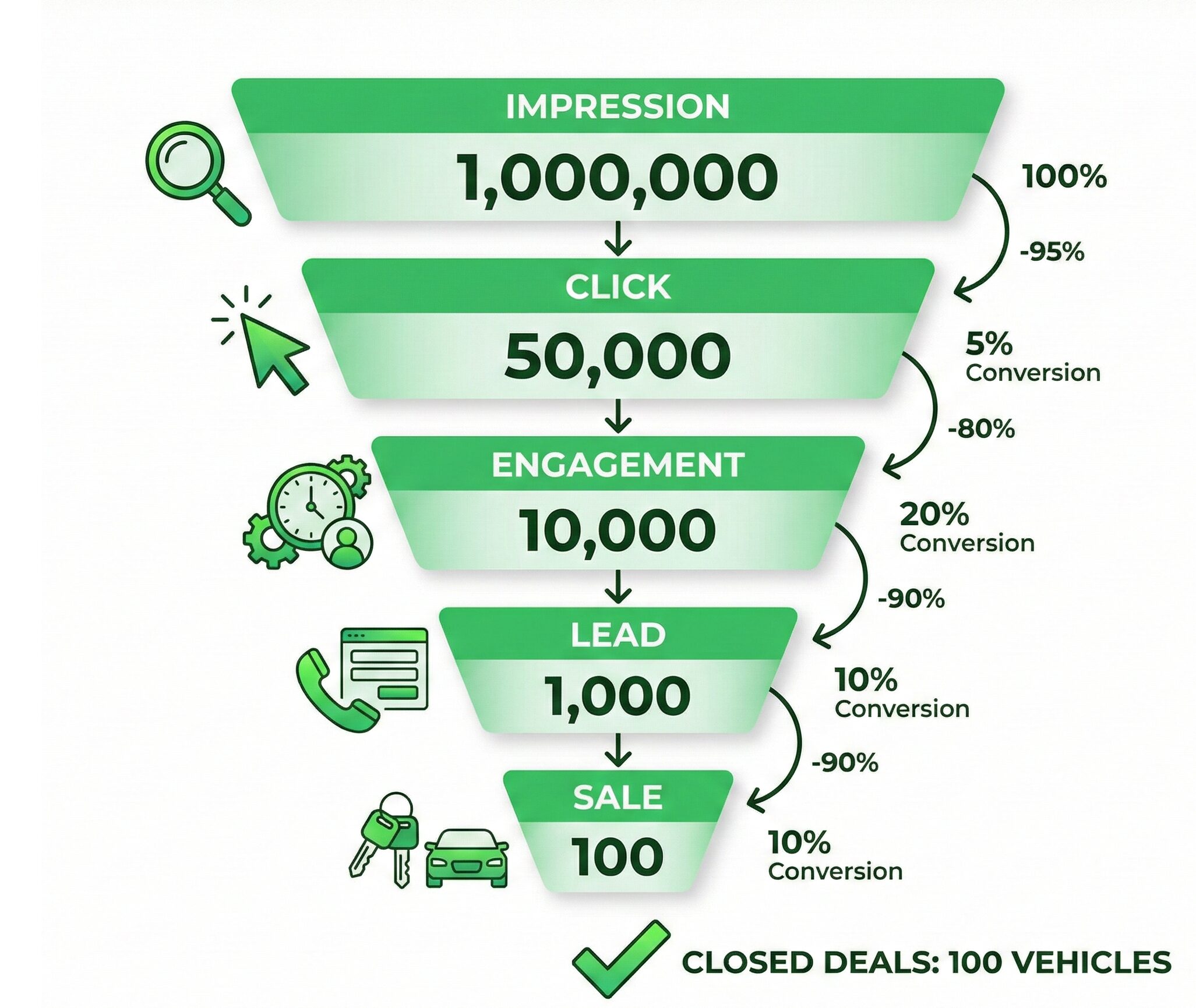
The 5-Stage Attribution Funnel
Top-3 rankings deliver 3-4x more clicks than lower positions.
Quality traffic: 3+ pageviews and 2+ minutes on site.
Forms, calls, and chats. Phone calls = 65% of leads.
Digital leads become physical visits. 45% show rate.
Organic closes at 18-22% vs 12-15% for paid traffic.
Monthly Attribution Results
Attribution Framework by A3 Brands • 20+ Years Automotive SEO
The Problem: Traffic Without Attribution
Dealerships spend thousands monthly on SEO. Traffic increases. Rankings improve. But when the GM asks for proof that organic search sold cars, most agencies shrug and point to “increased visibility.”
That’s not good enough. And it’s why many dealers stay dependent on paid search despite rising costs. We’ve broken down the real cost comparison between PPC and SEO for dealerships before, and the numbers consistently favor organic when you’re measuring actual customer acquisition costs.
The solution is deterministic attribution. That means tracking an individual from their first organic click all the way through to a purchased vehicle. No guessing. No “estimated influence.” Actual proof.
The SEO-to-Showroom Funnel: Five Measurable Stages
We break the journey into five trackable stages. Each one has clear metrics and optimization levers.
Stage 1: Impression to Click. Search Console shows massive CTR differences by rank position. Industry research on click-through rates confirms that top-3 rankings typically deliver three to four times the clicks of positions 4-10. For dealerships targeting 500 local search terms, that difference alone can mean 6,000+ additional monthly visitors. If you’ve noticed your dealership website traffic dropped recently, this is often where the problem starts.
Stage 2: Click to Engagement. Not all traffic is equal. Sessions with three or more pageviews and two-plus minutes on site convert at 4.2 times the rate of bounce traffic. We instrument engagement events on vehicle detail pages, payment calculators, and 360-degree image viewers to identify serious buyers.
Stage 3: Engagement to Lead. This is where anonymous browsers become real prospects. Typical conversion rates we see: form submissions around 2.8 percent, phone calls around 4.1 percent, chat initiations around 3.3 percent. Phone calls are often the biggest organic lead source, accounting for roughly 65 percent of total organic leads at many dealerships.
Stage 4: Lead to Showroom Visit. Bridging digital to physical requires call tracking with dynamic number insertion, appointment scheduling integration, and walk-in tracking through promo codes or staff identification. Without this instrumentation, the connection between organic search and showroom traffic stays invisible.
Stage 5: Showroom Visit to Sale. Organic-sourced showroom visits typically close at 18-22 percent, compared to 12-15 percent for paid traffic. Higher intent means better close rates. That’s the payoff for ranking well on searches that indicate real purchase readiness.
The Math That Makes SEO Boardroom-Ready
Here’s a calculation we walk through with dealership leadership teams. Plug in your own numbers.
Start with 10,000 monthly organic sessions. Apply a 35 percent engagement rate: 3,500 engaged sessions. Apply a 2.8 percent lead conversion rate: 98 leads. Apply a 45 percent show rate: 44 showroom visits. Apply a 20 percent close rate: 9 sales. Multiply by average profit per vehicle (say $3,200): $28,800 monthly organic-attributed profit.
That’s the calculation that turns SEO from “marketing activity” into “revenue channel.” We’ve detailed how organic SEO reduces dealership customer acquisition costs using this exact framework, and the results consistently outperform paid channels.
Model Landing Pages: Where Conversions Happen
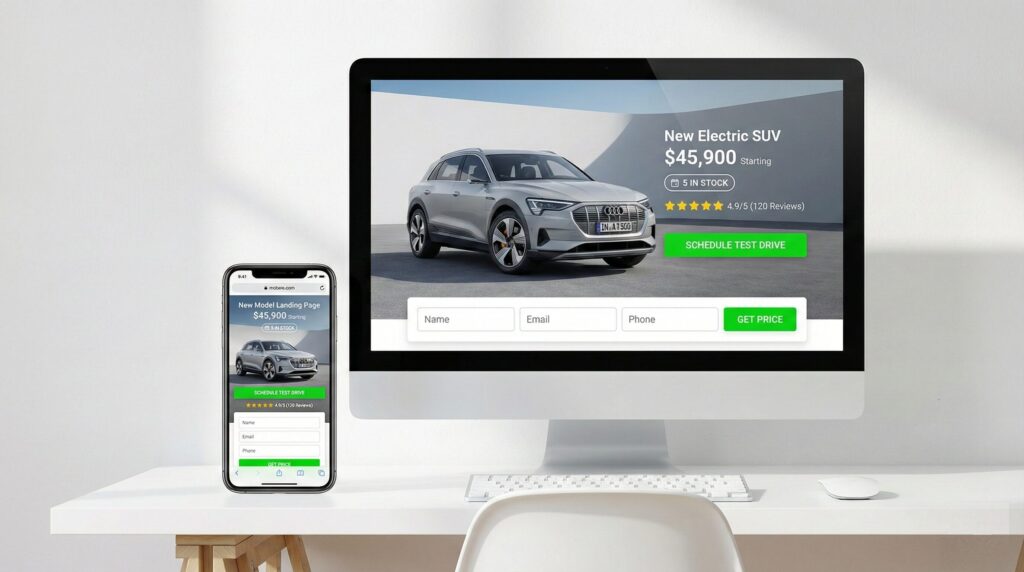
Traffic means nothing without pages designed to convert. We call these Model Landing Pages, and they’re the conversion interface between organic visibility and qualified leads. We’ve written extensively about how to optimize Model Landing Pages for dealership SEO, but here’s the core framework.
Technical requirements matter. Load time under 2.5 seconds. Mobile-first design. Schema markup for Vehicle, Offer, and LocalBusiness so search engines display rich results with pricing and availability. Google’s own documentation on structured data for vehicles explains how proper implementation increases visibility in search results.
But conversion design matters more. Lead capture visible above the fold. Real-time inventory counts. Clear calls to action. Trust signals like reviews and certifications positioned prominently.
We typically see 35-45 percent conversion lift when testing MLP improvements. Form placement, CTA copy, and incentive prominence are the highest-impact variables. The connection between Model Landing Pages and actual showroom visits is direct and measurable when you instrument properly.
CRM Integration: Making Attribution Stick
The CRM is where attribution either works or falls apart. If lead source data doesn’t flow cleanly into your system, you’re back to guessing.
What needs to happen: first-touch attribution fields captured on every form submission. Call tracking data pushed to lead records. Hidden form fields that persist the original organic source even if someone returns later through a different channel.
We map specific fields: initial source, initial keyword, initial landing page, and conversion path. Then we push back outcome data (test drives, VINs sold) to analytics so we can close the loop. Our ASC implementation guide for cutting dealer PPC waste with GA4 tracking covers the technical setup in detail.
The goal is simple. Someone Googles “2024 Honda Accord [your city],” clicks your organic listing, calls your dealership, schedules a test drive, and buys a car. Every step of that journey should be traceable in your CRM.
Phone Tracking: The Missing Link
Phone calls are often the largest organic lead source, but they’re also the hardest to attribute. Without call tracking, organic phone leads look like direct traffic or get credited to whatever the last touchpoint was.
We implement dynamic number insertion, which displays unique phone numbers based on traffic source. Organic visitors see one number. Paid visitors see another. Direct traffic sees a third. The call connects to the same sales line, but tracking happens automatically.
Staff receive a brief audio tag (“This call is from organic search”) so they know the lead source before saying hello. Calls get recorded, transcribed, and pushed to the CRM with full attribution data.
Reporting That Speaks Dealer Language
Technical dashboards impress digital teams. But GMs and owners need different information.
We build bilingual dashboards. One view shows organic sessions, keyword rankings, and technical metrics. The parallel view translates everything into showroom language: organic phone calls converted to appointments, appointments converted to test drives, test drives converted to sales.
Trends matter more than snapshots. We show 13-month views with year-over-year comparisons so leadership can see trajectory, not just current state.
For multi-location groups, we normalize data by market size, competition density, and inventory levels. That way rooftop comparisons are fair and actionable.
The 90-Day Pilot: Proving Impact Before Scaling
We don’t ask dealers to commit to enterprise-wide transformation on faith. That’s not how trust gets built.
Instead, we start with a focused pilot. Pick one high-intent model or local market. Implement full attribution instrumentation. Build or optimize the Model Landing Page. Set up call tracking with CRM integration. Run for 90 days.
At the end, we measure lift in appointments, test drives, and sold VINs. If the numbers prove out, we scale. If they don’t, we’ve learned something valuable without enterprise-level investment.
This phased approach works especially well for dealerships that have been burned by previous agency relationships. Small wins build trust. Trust enables scale.
What This Looks Like in Practice
A typical 90-day pilot produces 15-30 percent improvement in click-through rates from search results, measurable lift in organic-attributed leads, and clear documentation connecting specific organic visitors to specific vehicle purchases.
By month six, dealerships running this framework typically see organic-attributed revenue covering SEO investment at 2:1 or better. By month twelve, 4:1 returns are common. Cox Automotive’s research on car buyer behavior consistently shows that digital touchpoints influence the vast majority of purchase decisions, making proper attribution essential.
The key is commitment to measurement. Organic search only looks like a vanity metric when you’re not tracking what matters.
Why Mobile Performance Matters for Showroom Conversions
Google’s automotive research shows that over 70 percent of auto shoppers use mobile devices during their research. That means your Model Landing Pages need to load fast and convert on smaller screens.
We target Core Web Vitals thresholds: Largest Contentful Paint under 2.5 seconds, First Input Delay under 100 milliseconds, and Cumulative Layout Shift under 0.1. Pages that miss these benchmarks lose rankings and conversions simultaneously.
Ready to Connect SEO to Showroom Sales?
We’ll pull your current organic performance, map your attribution gaps, and show you exactly where leads are falling through the cracks. No charge for the initial analysis.
If we can demonstrate a clear path to measurable showroom impact, we’ll build a 90-day pilot plan. If we can’t, we’ll tell you that too.
Call us directly at 302-394-6940 or email info@a3brands.com.

Tim Boyle
90-Day SEO Pilot for Dealerships: 2026 ROI Guide

Local SEO for Multi-Store Auto Dealers: The Operational Playbook

Why Your Dealership Conversion Tracking Is Costing You More Than Your Ad Budget

A3 Brands Heads to Digital Dealer 2026: Why AI Search Is the Biggest Shift in Dealership Visibility
How Multi-Store Dealer Groups Finally Make SEO Measurable Across Every Location