(302)-394-6940

Why Your Competitor Ranks Higher (And How to Close the Gap)

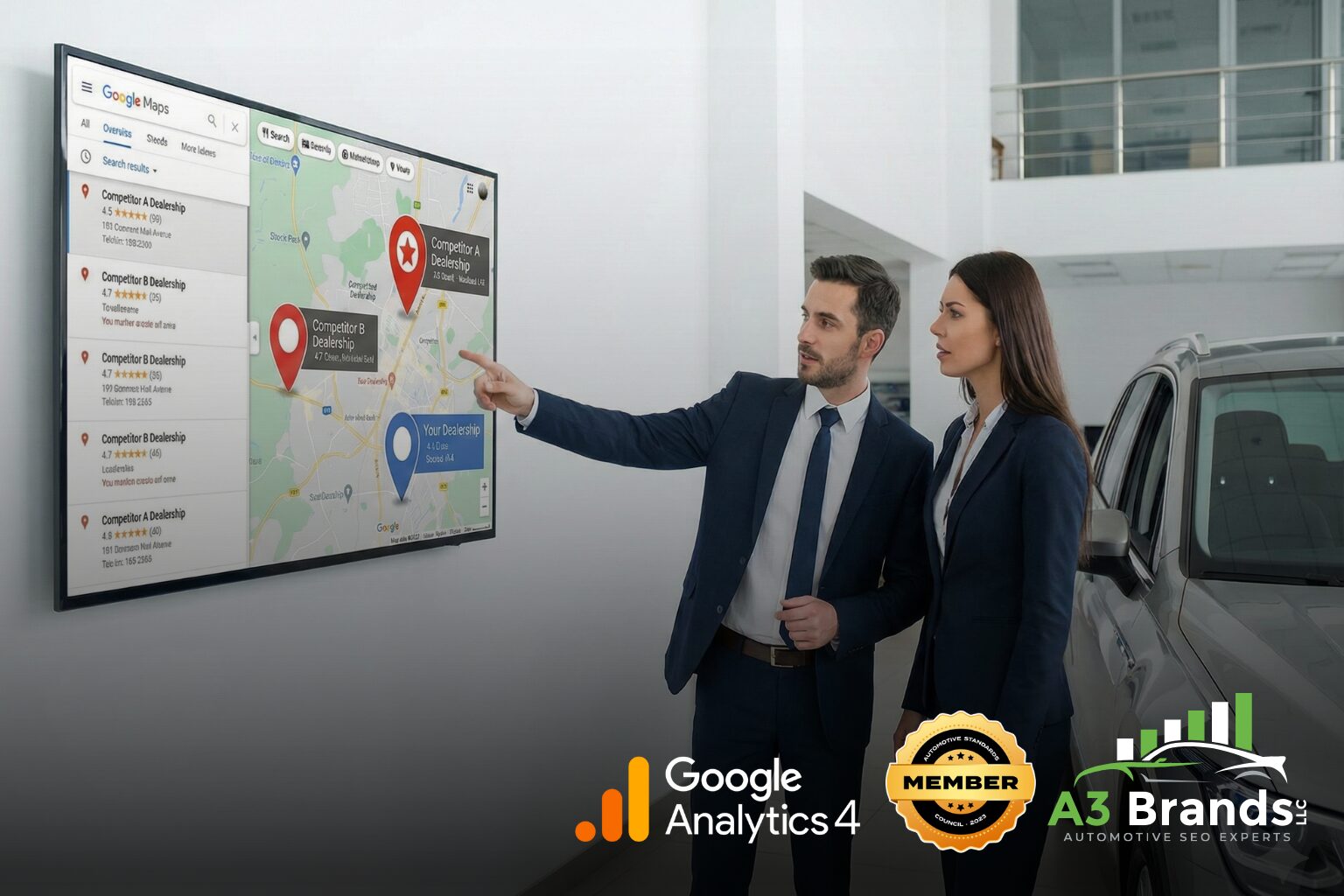
Two agent discussing Local search results showing competing car dealerships ranking higher

A local SEO competitive audit shows where your dealership loses ground to competitors in search results. Focus on five areas: Google Business Profile completeness, review velocity, local rankings, technical site health, and content gaps. Most dealers can identify 3-5 quick wins in under two hours. The goal isn’t a perfect score. It’s knowing exactly where you’re losing customers and fixing the highest-impact gaps first.

Your competitor ranks #1 for “Honda dealer [your city].” You’re on page 3. That’s 15 qualified shoppers daily walking into their showroom instead of yours.

Here’s what makes it worse: they’re probably not doing anything sophisticated. They just fixed problems you don’t know you have.

In 20 years working exclusively with dealerships, we’ve run hundreds of competitive SEO audits. The pattern is always the same. Dealers assume competitors have bigger budgets or better agencies. The truth? Most gaps come down to five fixable areas nobody’s bothered to check. (For a deeper look at where dealership SEO is heading in 2026, we break down the biggest shifts coming.)

Here’s the audit process we use with clients. You can run this yourself or we can do it together. Either way, you’ll know exactly where you stand.

Why Your Competitor Ranks Higher

It's not bigger budgets or better agencies.
It's 5 fixable gaps nobody bothered to check.

1
Incomplete Google Business Profile
They filled every field, added Q&A, and post weekly updates
2
Low Review Velocity
They get 0.5+ new reviews daily and respond within hours
3
No Multi-ZIP Rank Tracking
They track rankings from customer locations, not their office
4
Technical Issues Ignored
They fixed site speed and got 70%+ of inventory indexed
5
Thin Content Pages
They publish 1,500+ word model pages while you have 200

Quick Reference: The 5 Local SEO Audit Areas

Audit Area

What to Check

Target Benchmark

Time to Fix

Google Business Profile

Completeness, categories, Q&A, posts

90%+ complete, weekly posts

4-6 hours

Review Velocity

Daily new reviews, response rate

0.5+ reviews/day, 100% response

60-90 days

Local Rankings

3-pack presence, ZIP code coverage

Top 3 for brand + city terms

90-180 days

Technical Health

Speed, indexation, mobile experience

Green Core Web Vitals, 70%+ indexed

1-2 weeks

Content Depth

Model pages, VDP uniqueness, service pages

1,500+ words per model page

Ongoing

Start With Your Google Business Profile

Your Google Business Profile (that free listing in Maps and local search) is the highest-impact element for local visibility. Most dealers fill out the basics and forget it exists.

Pull up your profile and your top three competitors’ profiles side by side. Does every field have information? Services listed? Hours for each department? Photos from the last 90 days?

Then check features most dealers skip: the Q&A section, Google Posts, and product catalogs. We’ve seen dealers jump from position 8 to position 3 in the local pack just by answering common questions and posting weekly updates. No website changes required.

Also check category selection. Most dealers pick “Car Dealer” and stop. But adding secondary categories like “Used Car Dealer” or “Auto Repair Shop” expands which searches you appear for.

Check Your Review Velocity

Reviews directly impact rankings and click-through rates. We track two numbers: total count and monthly velocity.

Quick calculation: look at your last 30 days of reviews and divide by 30. That’s your daily velocity. Competitive markets need at least 0.5 new reviews daily. Market leaders hit 1.0 or higher.

Volume isn’t everything. Are you responding within 24 hours? Are responses personalized or copy-paste templates? Google notices, and so do shoppers.

One pattern we’ve seen: dealers with 4.2 to 4.5 star averages and high response rates outperform perfect 5.0 ratings. A few honest critical reviews with thoughtful responses actually build more trust.

Look at Where You Actually Rank

This is where dealers get surprised. They check rankings from their office computer, but Google personalizes results based on location and search history. What you see isn’t what customers see.

Use a rank tracking tool and check rankings from multiple ZIP codes in your market. Track three keyword groups:

High-intent buying searches: “[brand] dealer near me,” “buy [model] [city].” These are your money keywords.

Service searches: “[brand] service center,” “oil change near me.” Fixed ops keywords drive long-term profit.

Research searches: “best [brand] dealer [city],” “[model] vs [competitor model].” These capture early-stage shoppers.

Pay special attention to the local 3-pack (those top three map listings). If you’re not there for your primary brand and city, that’s a critical gap. And with AI changing how automotive search works, ranking visibility is becoming even more competitive.

Run a Basic Technical Health Check

Technical SEO sounds intimidating, but the basics are straightforward. You’re looking for problems that prevent Google from properly seeing your pages.

Check site speed. Go to Google’s PageSpeed Insights and look at Core Web Vitals. Green is good. Red is hurting your rankings right now. Common dealer issues: oversized images, chat widgets blocking interaction, slow inventory pages.

Check indexation. Type “site:yourdomain.com” into Google. Compare results to your actual inventory count. If you have 300 vehicles but only 150 indexed pages, half your inventory is invisible.

Check mobile experience. Over 70% of dealer traffic comes from phones. If your site is clunky on mobile, you’re losing customers.

Evaluate Your Content Depth

Content is where we see the biggest gaps between market leaders and everyone else.

Model landing pages matter most. Leading dealers publish 1,500 to 2,000 words per model covering trim comparisons, local incentives, and competitive alternatives. Average dealers have 200 words of manufacturer copy. Google rewards depth.

Individual vehicle pages need to be unique. Dealers who add original descriptions and local context get significantly more pages indexed than those just showing inventory feed specs.

Service content creates opportunity. Most dealers have one generic service page. Top performers have separate pages for oil changes, brake service, and every other offering. Each page ranks for different searches. (We cover how content marketing can reduce your PPC costs in more detail.)

What This Looks Like in Practice

We recently audited a dealer who couldn’t figure out why a smaller competitor consistently outranked them. The answer wasn’t budget. The competitor had optimized their Google Business Profile, responded to every review within hours, and had three times the indexed pages.

Within 90 days of addressing those gaps, our client moved from page 3 to the local 3-pack. Organic leads increased 34%. Google Ads spend dropped $4,200 monthly.

That’s the real value of a competitive audit. Not a report that sits in a drawer. Clear priorities that move numbers.

Want Us to Run This Audit for You?

We’ll pull your Google Business Profile, compare it to your top 3 local competitors, and show you exactly where you’re losing ground. It takes about 30 minutes. No charge, no obligation.

If the gaps are fixable, we’ll map out a 90-day plan. If not, you’ll still walk away knowing what’s costing you customers.

Request Your Free Competitive Audit or reach out to our team at  (302)-394-6940 or email info@a3brands.com and we’ll schedule a time that works.

More Posts