
The numbers
The search data behind the 2027 SEO trends
To prepare for the automotive SEO trends of 2027, a dealership should get five things ready: answer the research questions buyers ask before they shop, be a source Google's AI Overviews cite, be one of the dealer websites AI tools quote, make stock, used cars and service easy for AI tools to read, and keep its Google rating in the top half of franchised dealers. The numbers behind each one are below.
Each step comes from what US buyers searched on Google and asked AI tools about the 25 car brands we track in November 2026. These figures come from A3 Brands' own monthly dataset, and this page is updated every month.
This page covers how buyers search Google and what AI tools tell them, the trends that shape dealership SEO in 2027. It does not cover vehicle technology or new models.
How to read it: every figure is national. A single store's market can look different, which is why the checklist ends with your own number.
| Figure | November 2026 | What it counts |
|---|---|---|
| Car brands tracked | 25 | Car brands in the data, all US |
| Search terms read | 1,130,158 | Distinct US Google search terms about the brands and their models |
| Monthly searches behind them | 424,491,140 | US Google searches a month across those terms |
| AI questions read | 177,405 | Questions about the brands in the AI prompt data |
| Dealer websites AI cited | 34,491 | Franchised dealer websites cited at least once, counted again for each brand export they appear in |
| Brands where dealer sites beat the top single site | 21 of 25 | Dealer sites together vs. the most-cited other site |
| AI questions aimed at a dealership | 6.2% | 11,018 questions about stores, stock, service or offers |
Car brands tracked
- November 202625
- What it countsCar brands in the data, all US
Search terms read
- November 20261,130,158
- What it countsDistinct US Google search terms about the brands and their models
Monthly searches behind them
- November 2026424,491,140
- What it countsUS Google searches a month across those terms
AI questions read
- November 2026177,405
- What it countsQuestions about the brands in the AI prompt data
Dealer websites AI cited
- November 202634,491
- What it countsFranchised dealer websites cited at least once, counted again for each brand export they appear in
Brands where dealer sites beat the top single site
- November 202621 of 25
- What it countsDealer sites together vs. the most-cited other site
AI questions aimed at a dealership
- November 20266.2%
- What it counts11,018 questions about stores, stock, service or offers
The market
The market buyers walk into in 2027
Buyers reach 2027 paying more for each car than ever. The average new vehicle sold for a record $51,109 in October 2026, with incentives at 6.8% of the price (Kelley Blue Book, November 10, 2026). Cox Automotive's full-year forecast for 2026 is 16.1 million new vehicles (Cox Automotive, updated November 5, 2026). Dealership Guy's report from Used Car Week sums up the takeaway from Cox Automotive's Jonathan Smoke: 2027 "looks a lot like 2026 with a little more on top" (Dealership Guy, November 17, 2026). New sales are projected up 1% and used retail up 2%. The headwinds cited are inflation, higher interest rates and energy prices.
A flat market at record prices puts the weight on winning the buyers already shopping. The five trends below are where that contest now happens: in research searches, in Google's AI answers and in the questions buyers put to AI tools about a store.
Research first
1. Buyers research long before they shop
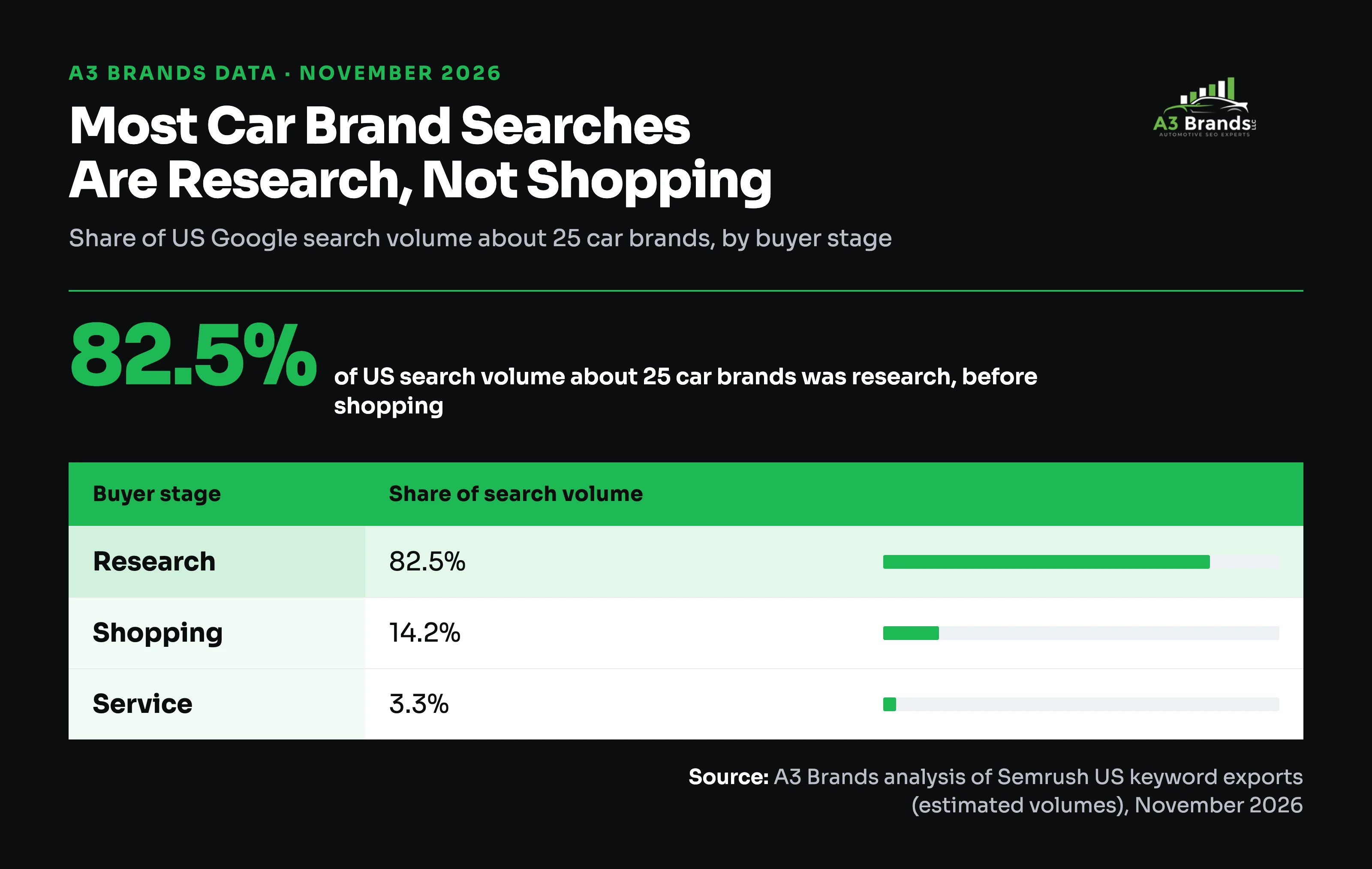
82.5% of brand search volume is research (Figure 2): buyers search a model name, a trim, a comparison or a question about towing or range long before they visit the lot. Shopping searches (price, lease, deals, for sale, near me, dealer, used) and service searches make up the rest.
That split matters for where a store puts its effort. Inventory, specials and a finance form are needed, but they answer the smaller share of what buyers type. The bigger share needs answer pages on the store's own site: which trim tows what, what happens at lease end, how two of your models compare, each published under the store's name. We write those pages for client stores from the questions buyers type about the models they sell.
Research pages are also the pages AI tools pick as sources. In our AI Search Study, dealer editorial pages (the guides and answers a store writes) were cited by AI engines, meaning named as a source in an AI answer, far more often than vehicle listing pages. The margin figure has both rates.
Source data
| Buyer stage | Share of search volume | Typical searches |
|---|---|---|
| Research | 82.5% | A model name, a trim, a comparison, a spec question |
| Shopping | 14.2% | Price, lease, deals, for sale, near me, dealer, used, certified |
| Service | 3.3% | Oil change, recall, warranty, parts, tires, brakes |
Research
- Share of search volume82.5%
- Typical searchesA model name, a trim, a comparison, a spec question
Shopping
- Share of search volume14.2%
- Typical searchesPrice, lease, deals, for sale, near me, dealer, used, certified
Service
- Share of search volume3.3%
- Typical searchesOil change, recall, warranty, parts, tires, brakes
Google AI
2. Google answers car questions before the links
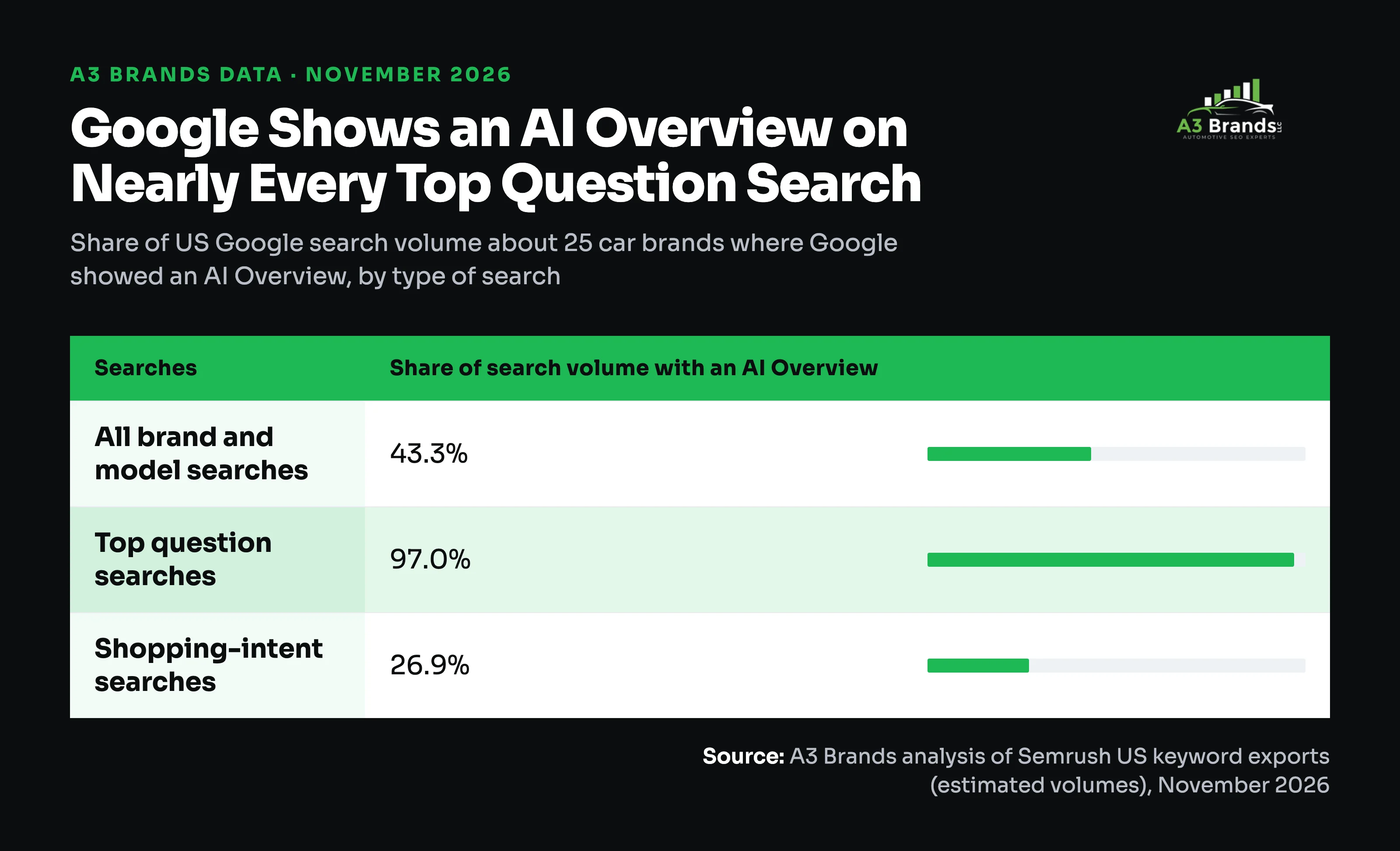
Google showed an AI Overview on 43.3% of US search volume about the 25 brands, and on nearly all the volume of each brand's top question searches (Figure 3). Shopping searches get one less often. When an AI Overview appears, a written answer sits above the links, and the buyer may never scroll to them.
When the answer sits on top, fewer people click through. In Pew Research Center's study of 900 US adults' browsing, people who saw an AI summary clicked a regular search result on 8% of visits, against 15% when no summary appeared (Pew Research Center, July 22, 2025).
An AI Overview usually lists its sources. The pages it cites show what kind of answer Google wants. Every A3 plan includes a monthly AI visibility report on where a client store is mentioned and cited, and we build the store's pages to give that kind of answer.
So the question for any dealer is a simple one: when Google writes the answer about a model you sell, is your page one of the sources it lists?
Source data
| Searches | Share of search volume with an AI Overview | What it covers |
|---|---|---|
| All brand and model searches | 43.3% | US Google search volume about 25 car brands and their models |
| Top question searches | 97.0% | Each brand's top 25 question searches (625 searches) |
| Shopping-intent searches | 26.9% | Searches Semrush labels transactional, from each brand's top 60 (535 searches) |
All brand and model searches
- Share of search volume with an AI Overview43.3%
- What it coversUS Google search volume about 25 car brands and their models
Top question searches
- Share of search volume with an AI Overview97.0%
- What it coversEach brand's top 25 question searches (625 searches)
Shopping-intent searches
- Share of search volume with an AI Overview26.9%
- What it coversSearches Semrush labels transactional, from each brand's top 60 (535 searches)
AI answers
3. AI tools quote dealer websites when buyers ask about cars
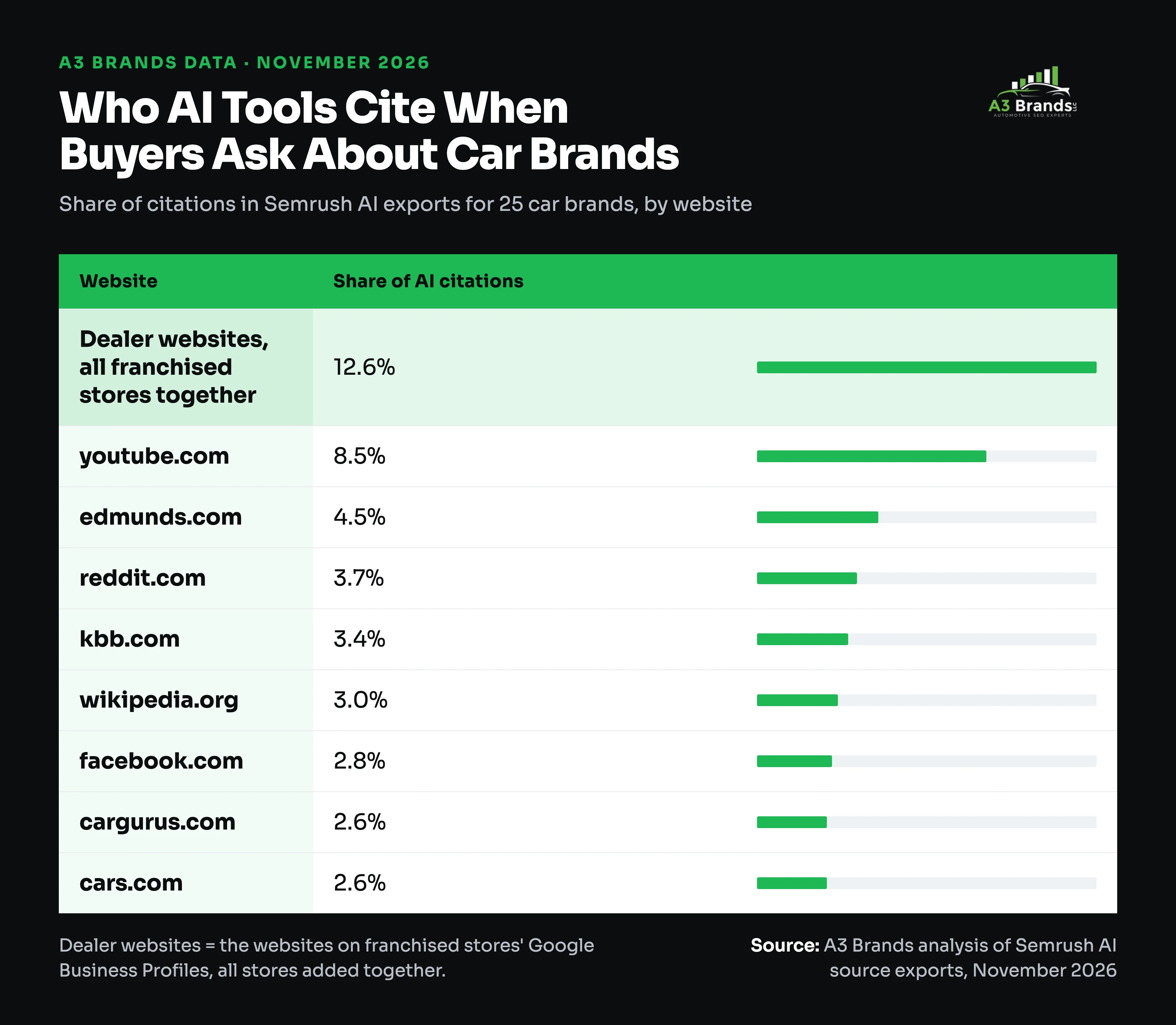
Franchised dealers' own websites, all stores added together, earn 12.6% of the citations in Semrush's AI exports for the 25 brands, more than any single website (Figure 4). The most-cited single website is youtube.com, followed by edmunds.com, reddit.com, kbb.com, wikipedia.org, facebook.com, cargurus.com and cars.com.
Brand by brand, dealer websites together were cited more than the single most-cited other website in most of the 25 brands (Figure 1). AI tools do quote dealerships, then. What matters for your store is whether it's one of the dealer sites they pick.
The single sites on that list are a video site, review and listing sites, a forum, a social network and an encyclopedia. A store can show up on several of them without owning them, through its listings, its reviews and its videos. Video is the clearest case: youtube.com tops the list, so walkaround and feature videos of the models a store sells, on its own channel and embedded on its model pages, give AI tools one more place to find the store.
For client stores we work on all three: we audit the listings, manage reviews and replies, and produce video reels every month. Of everything on that list, the store's own website is the one place it fully controls, which is why we start there.
Source data
| Website | Share of AI citations |
|---|---|
| Dealer websites, all franchised stores together | 12.6% |
| youtube.com | 8.5% |
| edmunds.com | 4.5% |
| reddit.com | 3.7% |
| kbb.com | 3.4% |
| wikipedia.org | 3.0% |
| facebook.com | 2.8% |
| cargurus.com | 2.6% |
| cars.com | 2.6% |
Dealer websites, all franchised stores together
- Share of AI citations12.6%
youtube.com
- Share of AI citations8.5%
edmunds.com
- Share of AI citations4.5%
reddit.com
- Share of AI citations3.7%
kbb.com
- Share of AI citations3.4%
wikipedia.org
- Share of AI citations3.0%
facebook.com
- Share of AI citations2.8%
cargurus.com
- Share of AI citations2.6%
cars.com
- Share of AI citations2.6%
AI questions
4. Buyers ask AI about your stock, trade-ins and reviews
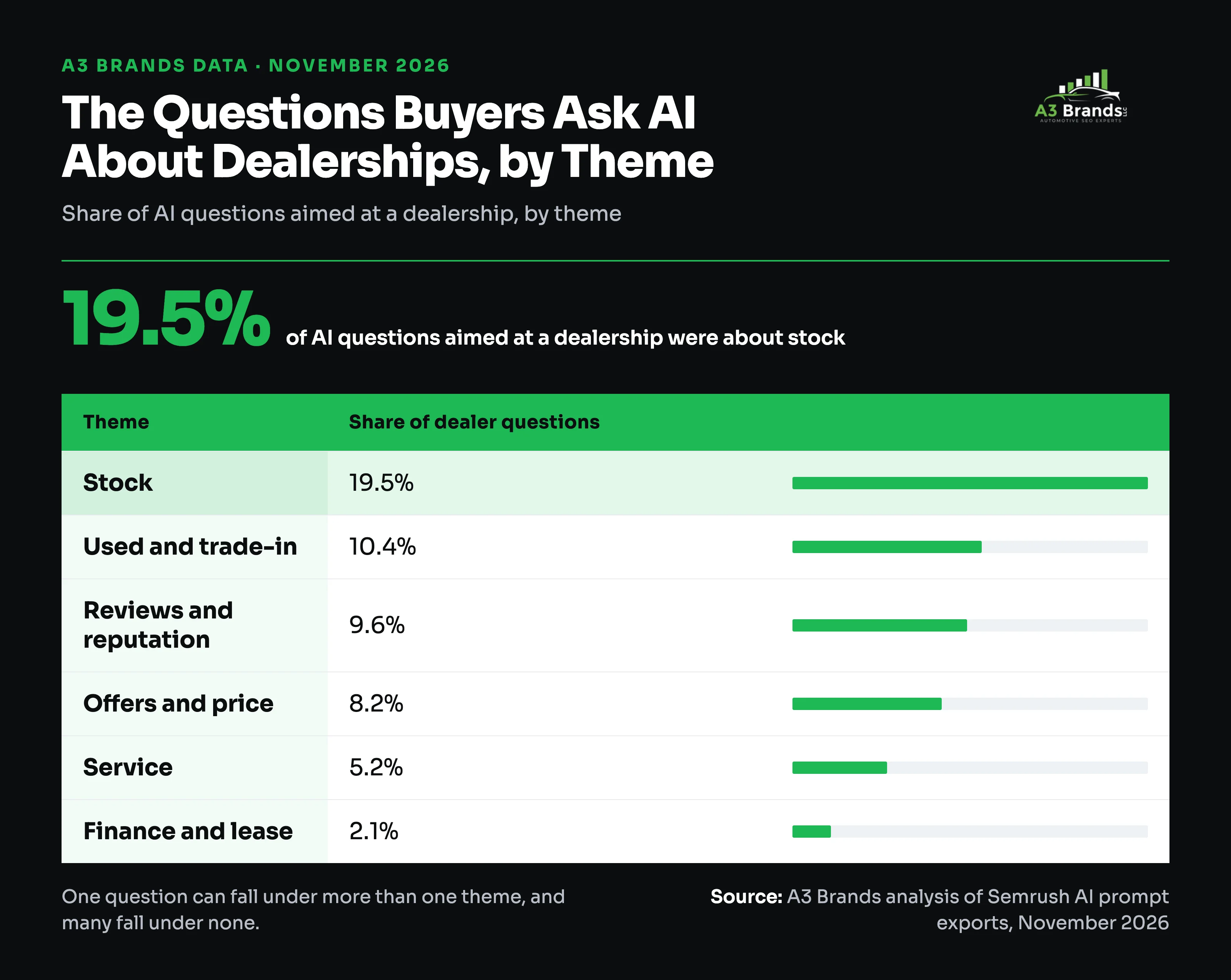
Stock is the top theme when buyers ask AI tools about a dealership: 19.5% of dealer questions ask about inventory or what is for sale (Figure 5). Used and trade-in, reviews and offers follow.
Dealer questions are a small share of all AI questions about the brands (Figure 1), but they are the ones whose answer names a store, yours or a competitor's.
Reviews show up as a theme of their own. When a buyer asks an AI tool which store to trust, the answer is built partly from what is written about the store on the web.
AI tools can only repeat what they can find. A store's site needs plain statements of the stock it carries by model, the used and certified cars on its lot and what its service department does. Model landing pages and inventory page optimization come with every A3 plan.
The site also has to let those tools in. That means the robots.txt file allows AI crawlers (the bots AI tools send to read websites, such as OAI-SearchBot and PerplexityBot), vehicle pages carry their price, trim and stock details in the page itself rather than only after scripts load in the browser, and schema markup (code that labels facts for machines) describes the dealership, its vehicles and its FAQs.
Source data
| Theme | Share of dealer questions | Words that mark it |
|---|---|---|
| Stock | 19.5% | inventory, in stock, available, for sale |
| Used and trade-in | 10.4% | used, pre-owned, certified, trade-in |
| Reviews and reputation | 9.6% | reviews, ratings, recommended, trusted |
| Offers and price | 8.2% | deals, discounts, incentives, specials, price |
| Service | 5.2% | service, repair, maintenance, oil change, parts |
| Finance and lease | 2.1% | financing, lease, loan, credit, payment |
Stock
- Share of dealer questions19.5%
- Words that mark itinventory, in stock, available, for sale
Used and trade-in
- Share of dealer questions10.4%
- Words that mark itused, pre-owned, certified, trade-in
Reviews and reputation
- Share of dealer questions9.6%
- Words that mark itreviews, ratings, recommended, trusted
Offers and price
- Share of dealer questions8.2%
- Words that mark itdeals, discounts, incentives, specials, price
Service
- Share of dealer questions5.2%
- Words that mark itservice, repair, maintenance, oil change, parts
Finance and lease
- Share of dealer questions2.1%
- Words that mark itfinancing, lease, loan, credit, payment
Reputation
5. Google ratings set a high bar for dealerships
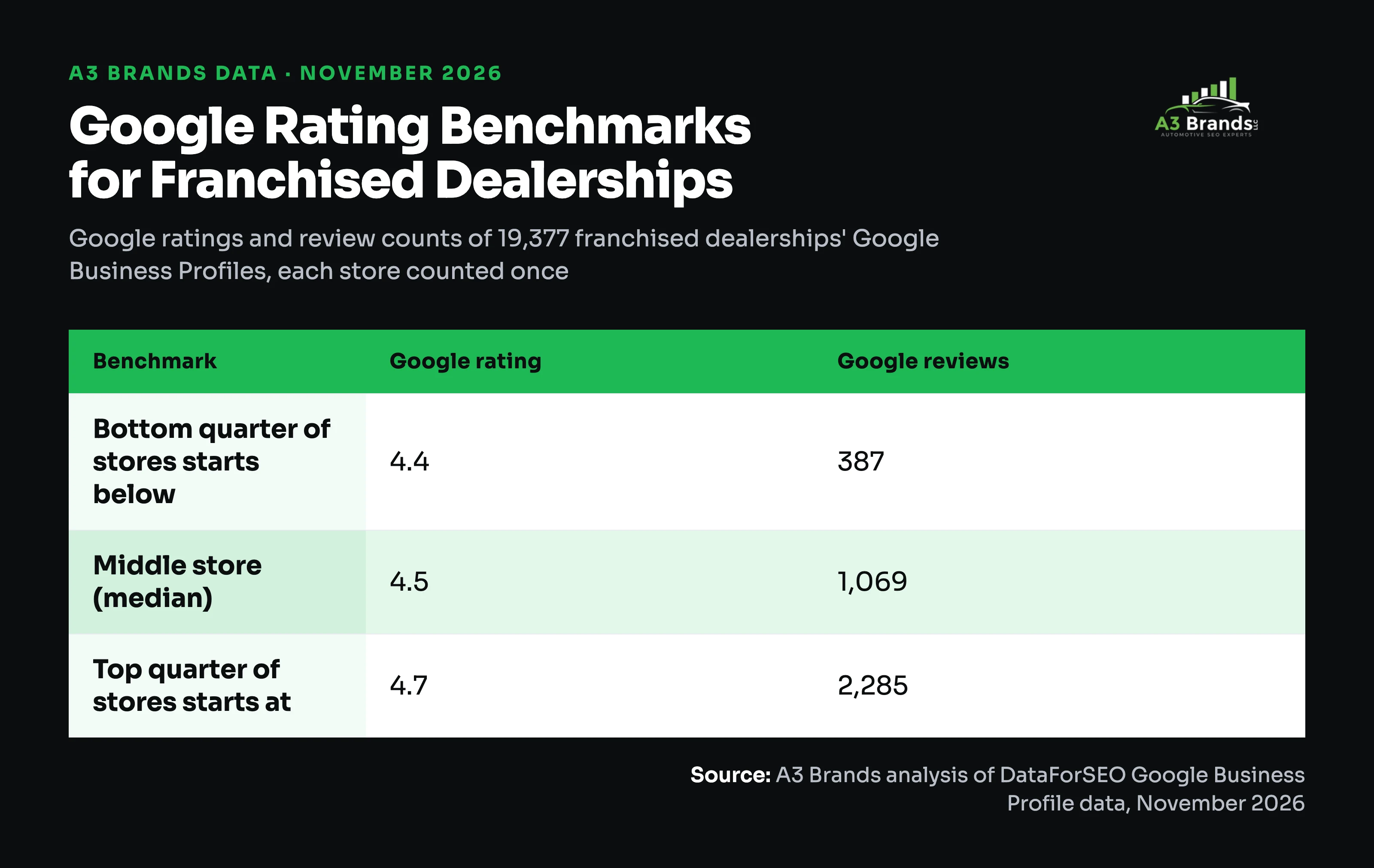
The middle franchised dealership has a 4.5-star Google rating (Figure 6), across 19,377 franchised dealerships' Google Business Profiles. Review counts run high too.
In other words, a good rating is what most stores already have. Three in four franchised dealers rate at or above the bottom-quarter mark in Figure 6, so a store just under it trails most of its peers even when its rating looks fine on its own. Review counts sort stores into quarters the same way.
Every A3 plan includes review generation and response management, so new reviews keep coming in and each one gets an answer. Moving from the bottom quarter to the middle takes several hundred more reviews, so the flow has to be steady.
More reviews go with more AI citations. Across 18,191 franchised dealer websites, stores with 2,000 to 4,999 Google reviews were more likely to have their website cited in AI answers than stores with fewer than 250 (the margin has both rates). That is an association, not a cause: bigger stores tend to have both more reviews and more pages. Our AI Search Study drew mostly on stores that already lead on reviews, and inside that narrower group review volume showed no link. What predicted citation there was the number of editorial pages a store published. Reviews also matter on their own terms: they are one of the themes buyers raise when they ask AI about a store (Figure 5).
Source data
| Benchmark | Google rating | Google reviews |
|---|---|---|
| Bottom quarter of stores starts below | 4.4 | 387 |
| Middle store (median) | 4.5 | 1,069 |
| Top quarter of stores starts at | 4.7 | 2,285 |
Bottom quarter of stores starts below
- Google rating4.4
- Google reviews387
Middle store (median)
- Google rating4.5
- Google reviews1,069
Top quarter of stores starts at
- Google rating4.7
- Google reviews2,285
Outlook
What to expect from search in 2027
More answers will arrive before the links. AI Overviews already cover a large share of car searches (trend 2), and Google's AI Mode is one of the four engines in our AI question data. Each month we will show whether that share is growing.
Paid search moves the same way. Google begins upgrading Dynamic Search Ads campaigns to AI Max in February 2027 (Google, updated June 11, 2026). AI Max matches search terms, writes ad text and picks landing pages from a store's website, so the pages a store publishes for search also become the pages its ads send buyers to.
What stays the same: buyers research first, AI tools quote dealer websites, and reviews come up when buyers ask AI which store to trust. A store that answers its buyers' questions on its own site is set up for all of it. Our automotive SEO guide covers each part, and our AI Search Study shows which dealer pages AI tools cite.
Checklist
Your 2027 preparation checklist
Here's what to have in place for 2027, one item per trend, and how we help with each one.
- Your site answers the questions buyers ask before they shop (trend 1). Keyword mapping and a content strategy for the models you sell are part of every client's first month.
- Your pages show up as sources in Google's AI Overviews (trend 2). Our monthly AI visibility report shows where your store is mentioned and cited.
- AI tools name your store (trend 3). SAGGY, our free AI scan, shows whether ChatGPT, Google AI and Perplexity mention you today.
- AI tools can read your stock, used cars and service (trend 4). Stock is what buyers ask AI about most, so we set up and verify AI crawler access on your site and optimize your inventory and vehicle pages.
- Your Google rating sits in the top half (trend 5). Review generation and response management come with every A3 plan.
The national figures show where search is heading. Where your store stands in its own market takes a store-level check, and that's where we start.
Measurement
How to measure dealership SEO in 2027
Rankings alone no longer tell you whether search is working, because more answers now show up before the links. Each month we report four things to client stores.
- Google rankings and organic traffic, verified in GA4. Searches for a model, a service or "near me", beyond the store's own name, are the growth SEO earns.
- What buyers do straight from the map: calls, direction requests and website clicks on the Google Business Profile.
- The form, call and chat leads that come from Google's free results, tracked in GA4.
- Whether AI tools name and cite the store, from the monthly AI visibility report.
Method
Method and limits
Each month A3 Brands loads three data sets for 25 car brands into one database. Semrush US keyword exports give search terms, estimated monthly volume (Semrush's estimates, not Google's own counts) and whether Google shows an AI Overview. Semrush AI prompt exports give questions tracked on ChatGPT, Gemini, Google AI Mode and Google AI Overview, with the sites each answer cites. DataForSEO Google Business Profile data gives each franchised store's rating, review count and website.
The keyword exports are the top 50,000 rows per brand, not all searches (Dodge had 87,956). The AI prompt exports are the top 10,000 rows per brand. So the figures describe the most-searched and most-asked part of the market.
Buyer stage is read from the words in each search. Service words come first (oil change, recall, warranty, parts, tires and similar). Then shopping words (price, lease, deals, for sale, near me, dealer, used, certified and similar). Everything else is research.
A dealer website is the website on a franchised store's Google Business Profile. Carmaker websites and shared platforms such as Facebook, YouTube, Cars.com and Edmunds are left out. A franchised store is a profile whose Google category marks it as that brand's dealer.
For AI questions, we collected 143,315 answers from Google AI Overview, 29,476 from Google AI Mode, 29,308 from Gemini and 27,881 from ChatGPT. That is the size of each collection, not each engine's share of the market. Citation shares are not split by engine.
The AI Overview share for questions covers each brand's top 25 question searches, 625 in all, weighted by search volume.
For reviews and AI citations, 18,191 franchised dealer websites were each counted once, matched from their Google Business Profile and grouped by the store's Google review count. A website counts as cited if it appears in any of the 25 Semrush cited-website exports, which hold up to 10,000 websites per brand.
For Google ratings, each store is counted once, even if it is the dealer for several brands. The same business name in the same city and state is one store.
We report national figures only. We never rank car brands against each other, and a brand's own website being cited in its own answers is not counted as a finding.
Questions
Frequently asked questions
Short answers, using the November 2026 figures above.
How should a car dealership prepare for 2027?+
Answer the research questions buyers ask before they shop, be a source Google's AI Overviews cite, be one of the dealer websites AI tools quote, make stock, used cars and service easy for AI tools to read and keep your Google rating in the top half. Each step is backed by A3 Brands' November 2026 data on 25 car brands.
What are the biggest automotive SEO trends for 2027?+
Buyers research far more than they shop, Google answers a large share of car searches with an AI Overview before the links, and AI tools cite franchised dealers' own websites, added together, more than any single other site in most brands. Each trend is measured on this page every month.
What is automotive SEO?+
Automotive SEO is the work of getting a car dealership found when buyers search Google and ask AI tools about the cars and services it sells: its website pages, its Google Business Profile, its reviews and its listings. In 2027 it also means being a source AI answers quote, which is what AEO and GEO cover.
Does SEO still work for car dealerships in 2027?+
Yes. Car buyers still run hundreds of millions of Google searches a month about the brands we track (Figure 1), and most of that search is research (Figure 2). What changes in 2027 is where the answer appears: Google shows an AI Overview on nearly every top question search (Figure 3), and AI tools cite dealer websites, all stores together, more than any single site (Figure 4). Dealership SEO in 2027 means being the page those answers use. Our automotive SEO guide explains how it works.
How should a dealership measure SEO in 2027?+
By leads and AI answers, not rankings alone: Google rankings and organic traffic, Google Business Profile calls and directions, leads from Google's free results, and whether AI answers name the store. The measurement section above explains each one A3 reports to client stores every month.
How long does dealership SEO take to work?+
It depends on the store, its market and where its site starts. Our SEO timeline walks through what happens month by month.
Will AI replace Google search for car buyers?+
Not in our data. Car buyers still run hundreds of millions of Google searches a month about the brands we track (Figure 1), and Google answers a large share of them with an AI Overview (Figure 3). For a store the job is the same either way: be the page those answers quote.
What does the automotive customer journey look like in search?+
Most of it is research: model, trim and comparison searches far outweigh shopping and service searches. Figure 2 has the November 2026 split.
How often does Google show an AI Overview for car searches?+
On a large share of US search volume about the 25 car brands we track, and on almost every top question search. Figure 3 has the November 2026 figures.
Which websites do AI tools cite most when buyers ask about cars?+
The most-cited single sites were youtube.com, edmunds.com, reddit.com, kbb.com and wikipedia.org.
Do AI tools like ChatGPT cite car dealership websites?+
Yes. Added together, franchised dealers' own websites were cited more than the single most-cited site in most of the 25 brands; Figure 4 has the figures. Whether your store is one of them takes a store-level check.
What do car buyers ask AI about dealerships?+
Stock is the top theme, then used and trade-in, then reviews. Figure 5 has the share for each theme.
What is a good Google rating for a car dealership?+
Top half means at or above the middle franchised store in Figure 6, on both rating and review count. The top quarter starts higher on both.
Where does this data come from?+
From A3 Brands' monthly dataset: Semrush US keyword exports (estimated search volume) and AI prompt exports for each brand, the top rows rather than all, and DataForSEO Google Business Profile data for franchised stores. The method section above has the details.
How often is this page updated?+
Every month, after the new data is loaded.
Prepare your store for 2027
About the author

Tim Boyle
Founder & President, A3 Brands
Tim Boyle is the founder and president of A3 Brands, the automotive SEO agency working only with car dealerships on SEO, AEO (answer engine optimization) and GEO (generative engine optimization). He has worked in automotive since 2001: he supplied more than 3,000 dealerships through Speedway Distributors, ran internet sales and the BDC at Baker Automotive Group and managed Acura's digital programs across North America, then founded A3 Brands in November 2021.
Read Tim’s full bio →